
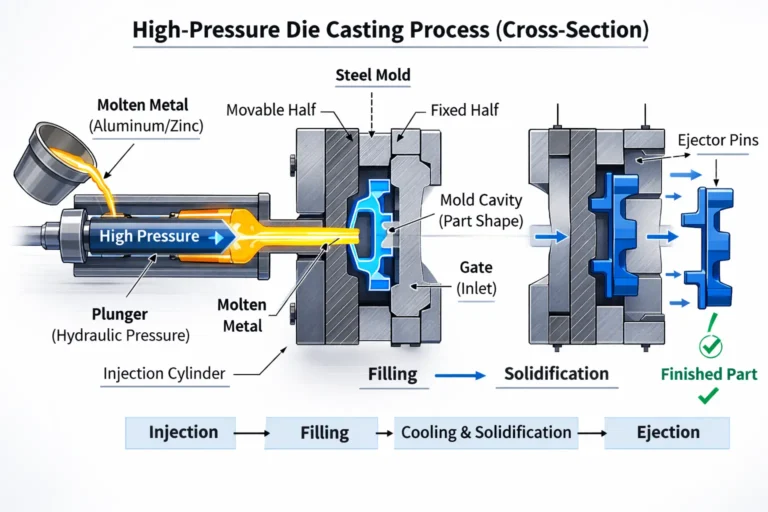
Die casting is a high-pressure manufacturing process that produces metal components with exceptional efficiency and reliability. When molten metal is injected into a precision steel mold at high speeds, the result is parts with excellent dimensional accuracy, smooth surface finishes, and consistent repeatability.
But here’s the truth: success starts with design.
A well-planned die casting design considers three critical phases: how molten metal flows into the mold, how the part solidifies, and how it’s ejected. These design decisions directly influence part quality, manufacturing efficiency, and overall production cost.
What Is Die Casting Design?
Die casting design is the process of planning and shaping metal parts to ensure they can be manufactured efficiently and reliably using high-pressure die casting. In this process, molten metal is injected into a precision steel mold at high speed and pressure, producing parts with excellent dimensional accuracy, smooth surface finish, and consistent repeatability. The goal of die casting design is to optimize the part’s geometry so that metal flows evenly, solidifies uniformly, and avoids defects such as porosity, warpage, or short shots.
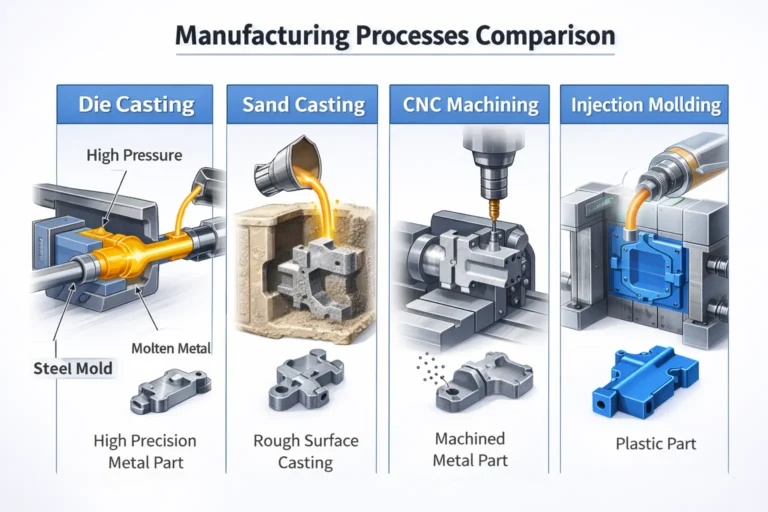
How It Differs from Other Methods
| Process | Key Characteristics |
|---|---|
| Die Casting | High precision metal parts, excellent surface finish, high-volume capability |
| Sand Casting | Rough surface, lower precision, flexible for large parts |
| CNC Machining | Highest precision but higher cost, material waste |
| Injection Molding | Plastic materials only, similar design principles |
Designers must account for wall thickness, draft angles, fillets, ribs, and bosses—all working together to create parts that are both strong and manufacturable. Die casting strikes the perfect balance between complex geometry, structural integrity, and cost-efficiency.
Why Good Die Casting Design Matters
Good design isn’t optional—it’s the foundation of profitable manufacturing. Here’s why:
3.1 Reduce Manufacturing Cost
Optimized design significantly lowers production costs. Uniform wall thickness, proper draft angles, and efficient rib/boss integration reduce:
- Secondary machining requirements
- Material waste
- Assembly steps
- Labor expenses
3.2 Improve Structural Strength
A well-designed die casting part is stronger and more durable. Features such as ribs, fillets, and uniform wall thickness help distribute stress evenly and prevent weak points. This improves the part’s resistance to deformation, bending, or cracking under load, making it suitable for high-performance applications in automotive, electronics, and industrial equipment.
3.3 Prevent Casting Defects
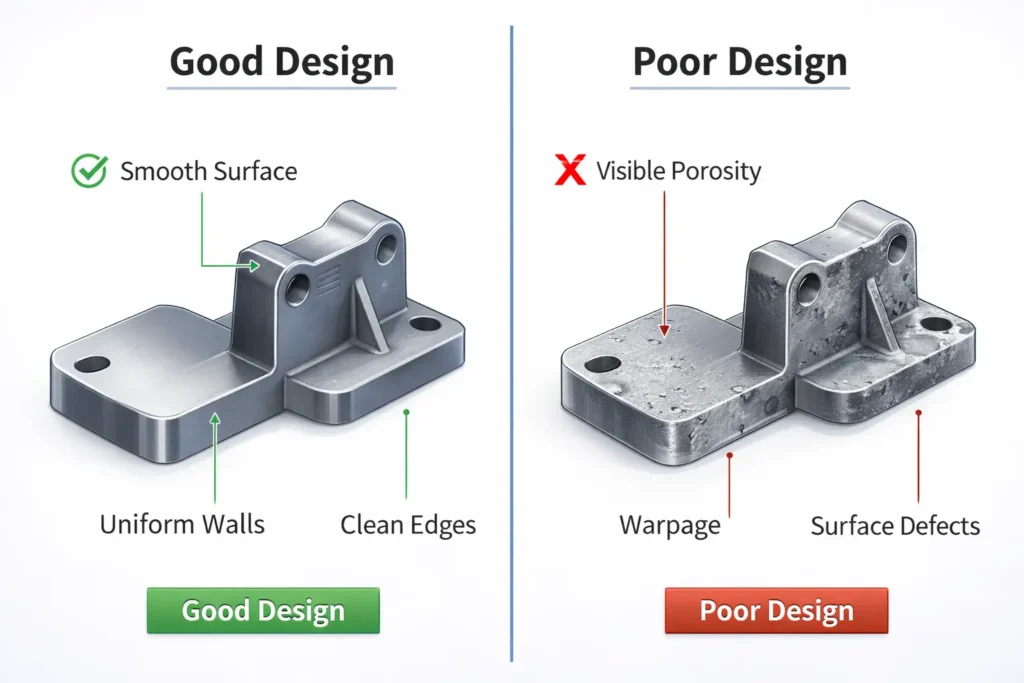
Poor design causes the most common defects. Uneven walls create porosity. Sharp corners cause cold shuts. Insufficient draft produces flash. Following proven principles eliminates these issues at the source.
3.4 Improve Production Efficiency
Optimized parts enable:
- Shorter cycle times
- Smoother metal flow
- Higher yield per mold
- Faster, predictable manufacturing
For high-volume production, efficiency directly impacts profitability and delivery schedules.
By focusing on these key areas, companies can produce cost-effective, high-quality, and reliable die cast parts, reducing downstream problems while meeting the demands of modern manufacturing.
Key Die Casting Design Principles
Master these fundamental principles to ensure manufacturability, structural integrity, and cost efficiency. Together, they form the core of any robust die casting design.
4.1 Uniform Wall Thickness
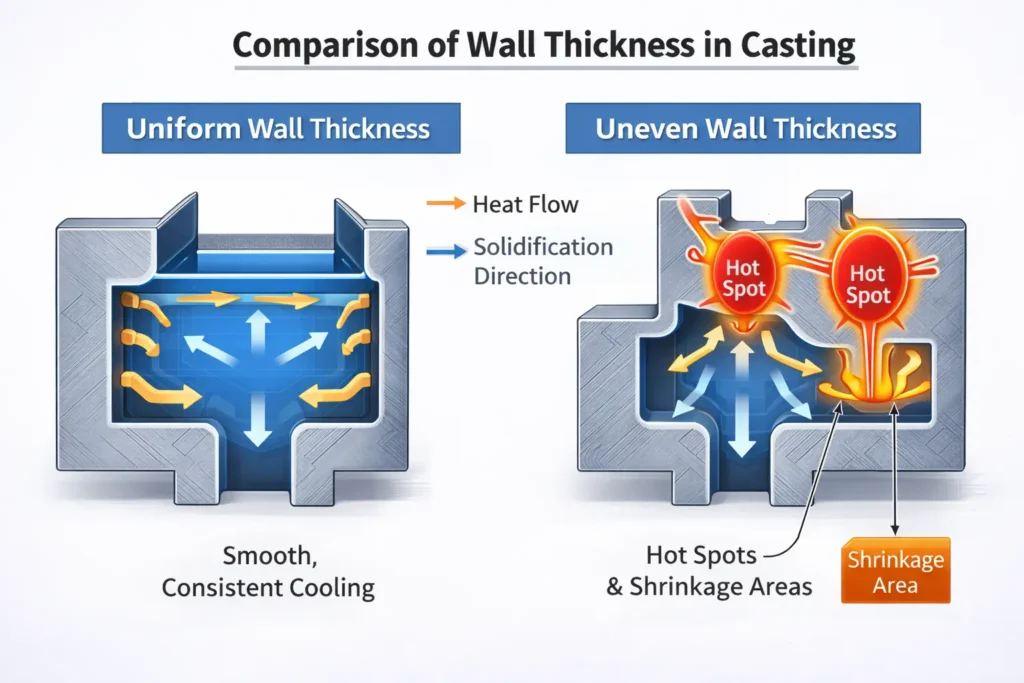
Why it matters: Uneven walls cause porosity, shrinkage, and warpage as metal cools at different rates.
Best practice: Maintain gradual transitions between thick and thin sections. Avoid sudden geometry changes.
Recommended wall thickness by material:
| Material | Wall Thickness Range |
|---|---|
| Aluminum | 1.5 – 4 mm |
| Zinc | 1 – 3 mm |
| Magnesium | 1 – 3 mm |
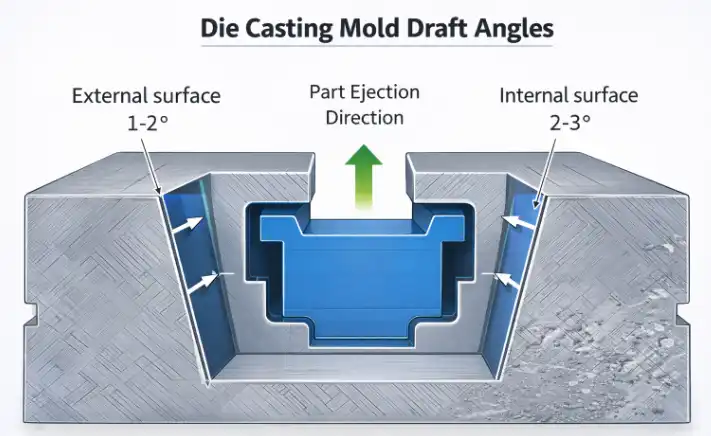
4.2 Draft Angles
Why it matters: Draft allows smooth part ejection without damage, sticking, or excessive flash.
Recommended angles:
- External surfaces: 1°–2°
- Internal surfaces: 2°–3°
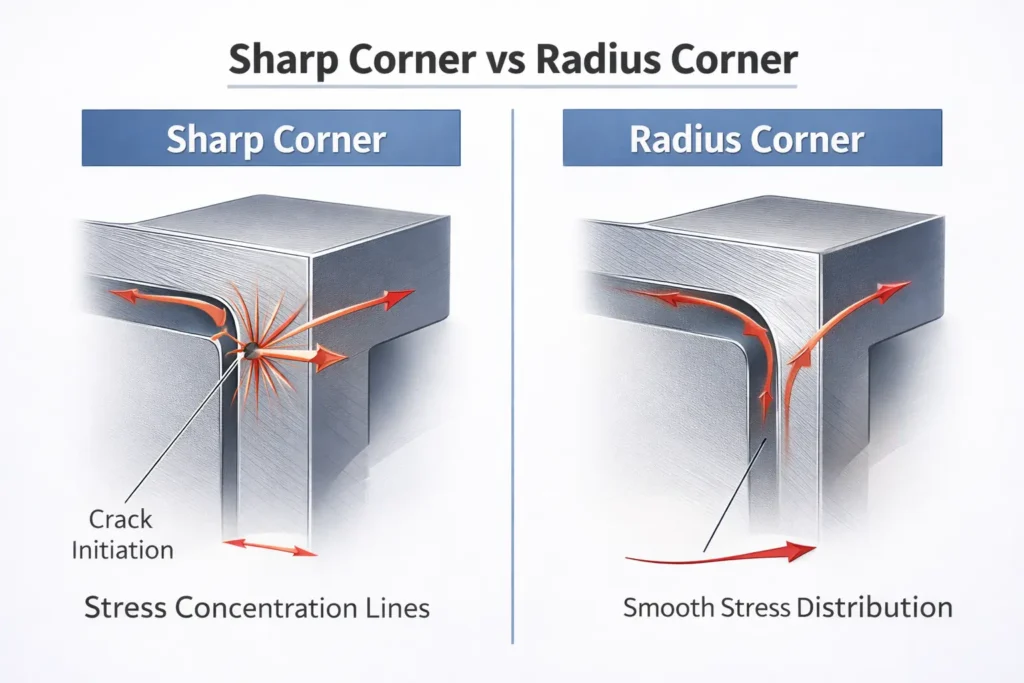
4.3 Fillets and Radii
Why it matters: Sharp corners concentrate stress and impede metal flow.
Best practice: Add fillets and radii (≥0.5 mm minimum) to all corners to improve strength and flow.
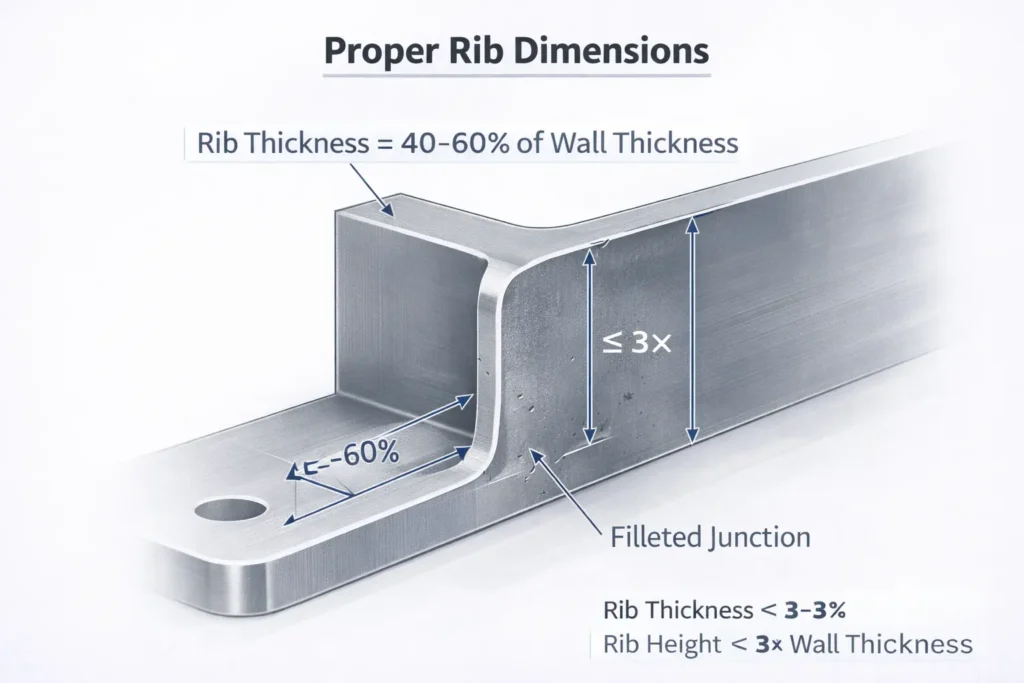
4.4 Rib Design
Why it matters: Ribs strengthen thin walls without increasing overall thickness.
Key recommendations:
- Rib thickness: 40–60% of wall thickness
- Rib height: ≤3× wall thickness
- Use filleted junctions to prevent stress concentration.
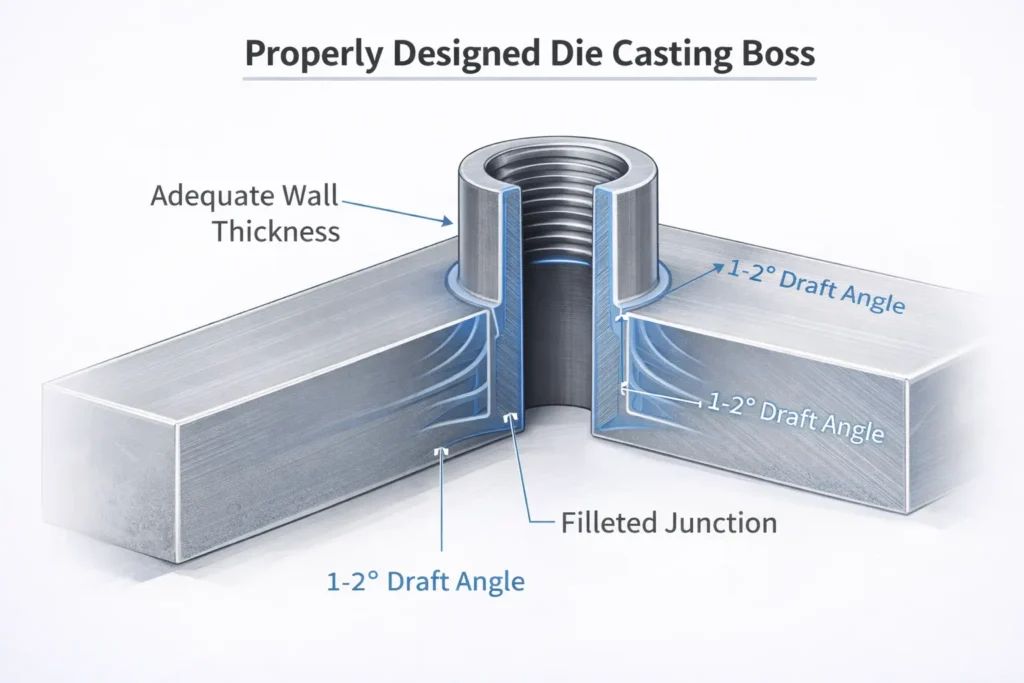
4.5 Boss Design
Why it matters: Bosses accommodate screws and inserts.
Best practices:
- Maintain adequate wall thickness around the boss
- Include draft angles for ejection
- Fillet all junctions
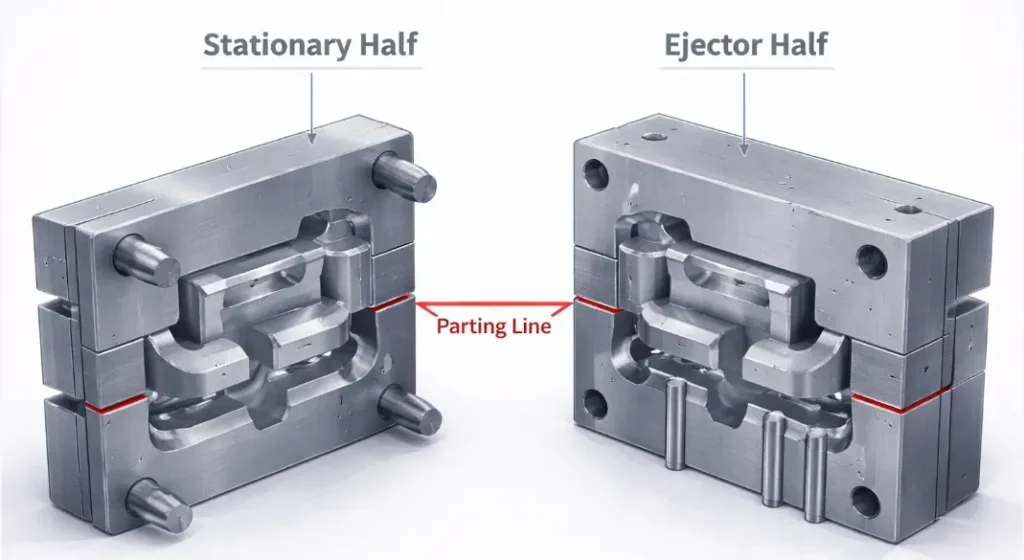
4.6 Parting Line Considerations
The parting line determines how the mold separates and affects flash formation and mold complexity. Designing with a simple parting line reduces tooling costs and improves dimensional accuracy. Features such as undercuts should be minimized or supported by side actions or slides.
4.7 Text and Logos
Raised or recessed text and logos are common in die-cast parts. Ensure:
- Text depth ≥0.3 mm
- Draft angles included for easier ejection
- Avoid fine details that cannot be reliably cast
By following these core principles, engineers can create die-cast parts that are strong, manufacturable, and cost-effective, laying a solid foundation for defect-free production.
Die Casting Material Design Guidelines
Die casting design involves careful material selection, as it impacts strength, weight, corrosion resistance, thermal conductivity, and manufacturability. Each metal requires specific design adaptations:
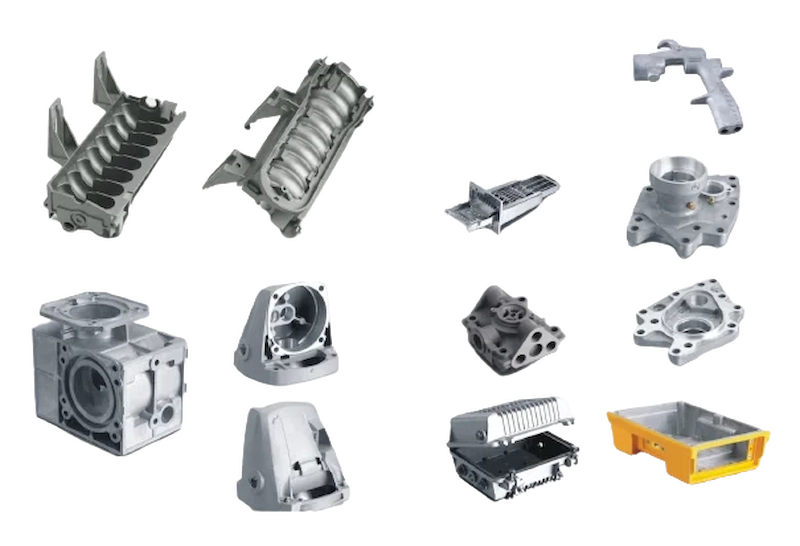
5.1 Aluminum Die Casting Design
Applications: Hardware components, connectors, decorative parts
Design considerations:
- Wall thickness: 1–3 mm
- Supports very thin, intricate features
- Excellent for small, detailed components
- Low melting point reduces cycle time
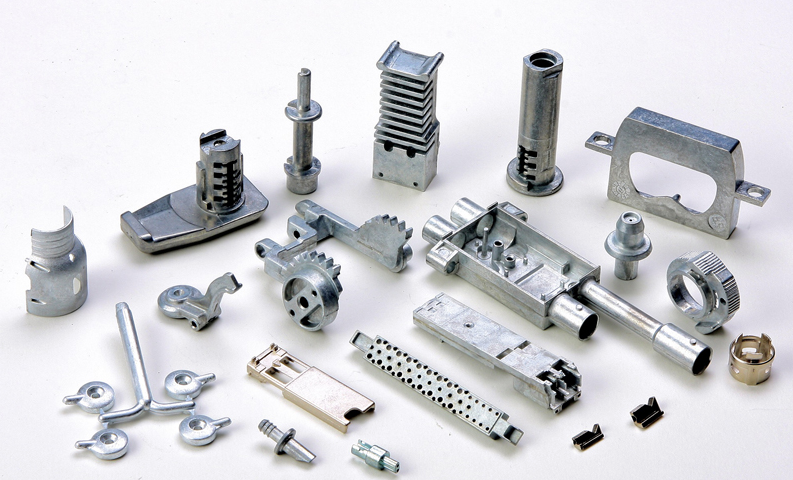
5.2 Zinc Die Casting Design
Applications: Hardware components, connectors, decorative parts
Design considerations:
- Wall thickness: 1–3 mm
- Supports very thin, intricate features
- Excellent for small, detailed components
- Low melting point reduces cycle time
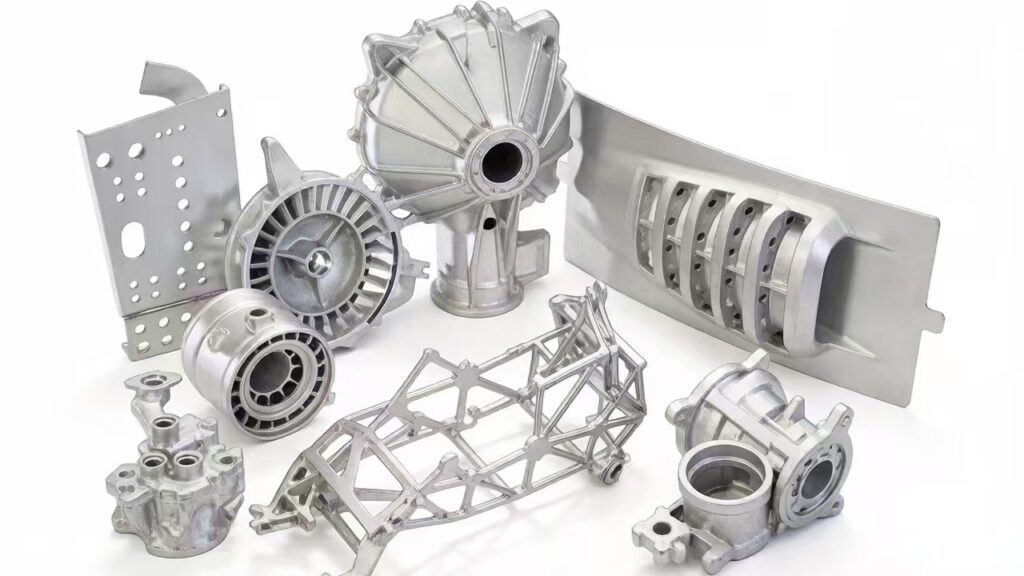
5.3 Magnesium Die Casting Design
Applications: Aerospace, electronics, automotive (weight-critical)
Design considerations:
- Wall thickness: 1–3 mm
- Careful rib/boss design required
- Excellent dimensional stability
- Very sensitive to sharp corners—fillets essential
Die Casting Mold Design Considerations
A well-designed die casting part must work hand-in-hand with a properly engineered mold, making mold design an essential component of die casting design. Mold design directly affects part quality, cycle time, defect rates, and production efficiency. Even the best part design can fail if the mold is poorly planned. The following are key mold considerations every die casting engineer should keep in mind:
6.1 Gate Design
The gate controls how molten metal enters the mold cavity. Proper gate design ensures smooth, balanced metal flow, reducing turbulence and minimizing the risk of cold shuts and porosity. Guidelines include:
- Position gates to allow uniform filling
- Avoid sharp angles that disrupt flow
- Use multiple gates for large or complex parts
6.2 Runner System
Runners transport molten metal from the sprue to the gates. An optimized runner system balances flow to all cavities, ensures proper pressure, and minimizes metal waste. Design tips:
Keep runners as short and direct as possible
Maintain a consistent cross-section to prevent pressure loss
Use adequate venting near runners for trapped air
6.3 Venting System
Vents allow trapped gases to escape during mold filling. Without proper venting, defects such as porosity and burn marks can occur. Key points:
- Place vents at high points and complex geometries
- Keep vents narrow enough to prevent metal leakage
- Ensure adequate venting for multi-cavity molds
6.4 Ejector Pin Placement
Ejector pins push the part out of the mold after solidification. Poor placement can cause surface blemishes or part deformation. Recommendations:
- Distribute pins evenly to avoid stress concentration
- Avoid pins on critical surfaces that require tight tolerances
- Combine with proper draft angles to ease ejection
6.5 Cooling System
The cooling system controls solidification rate, shrinkage, and cycle time. Efficient cooling improves part quality and productivity:
- Place cooling channels near thick sections to prevent hot spots
- Optimize flow rate for uniform temperature distribution
- Consider conformal cooling for complex geometries
Common Die Casting Design Mistakes
Even experienced designers can make errors in die casting design that lead to costly defects. Here’s how to avoid them:
| Mistake | Consequence | Solution |
|---|---|---|
| Uneven wall thickness | Shrinkage, warpage, porosity | Maintain uniform thickness; gradual transitions |
| Sharp corners | Stress concentration, cracks | Add fillets and radii |
| Excessive undercuts | High tooling cost, complexity | Minimize or design for side actions |
| Insufficient draft | Sticking, surface damage | Apply 1°–3° draft angles |
| Too-thin sections | Short shots, weak parts | Respect material minimums |
| Overly complex features | High defect rates | Simplify while maintaining function |
Pro tip: Conduct design reviews and use simulation tools before mold manufacturing begins.
Die Casting Defects Caused by Poor Design
Many common casting defects can be directly traced back to flaws in the die casting design. Understanding this link is the first step to improving your die casting design and preventing these issues.
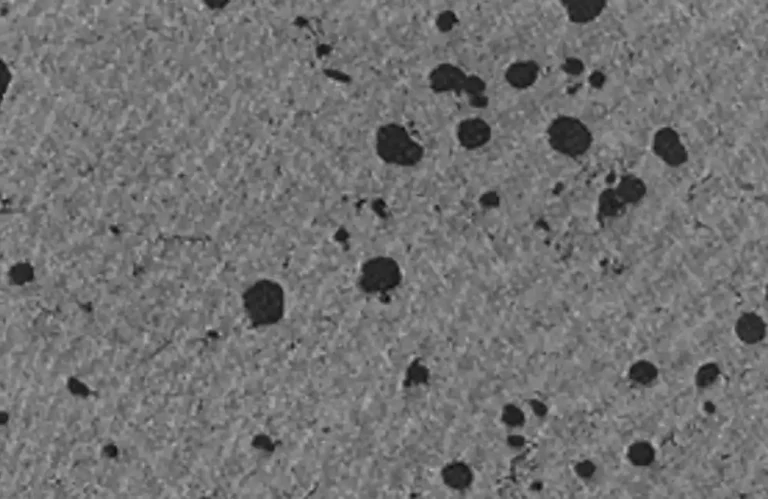
8.1 Porosity
Cause: Thick sections, uneven walls, trapped gases
Effect: Weak spots, potential leaks
Prevention: Maintain uniform wall thickness, use proper venting, and avoid abrupt thickness changes.
8.2 Shrinkage
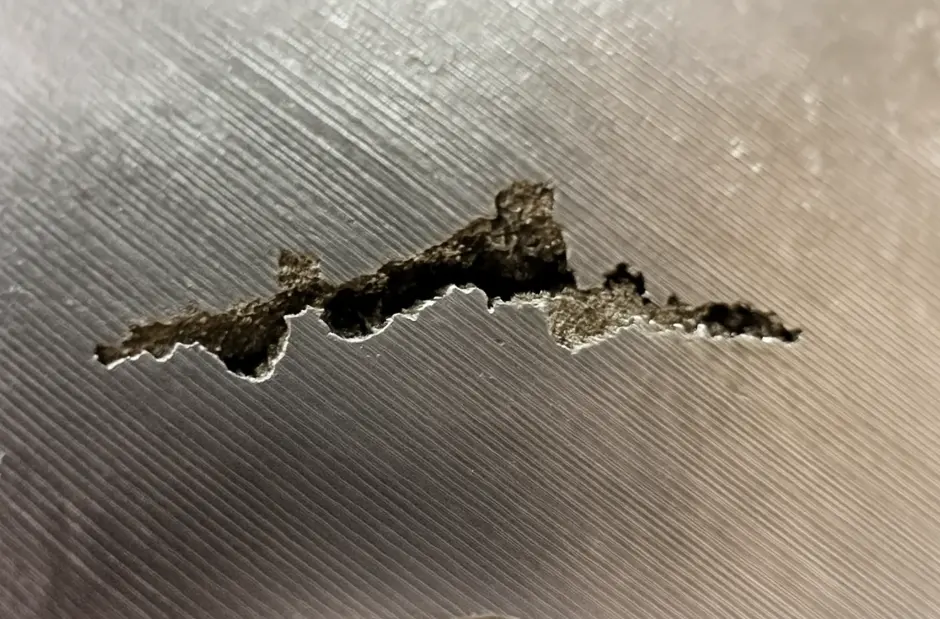
Cause: Large or thick areas of metal that cool unevenly.
Effect: Surface depressions, internal voids, or dimensional inaccuracies.
Prevention: Use gradual thickness transitions, add ribs, and optimize cooling channel placement in the mold.
8.3 Cold Shut
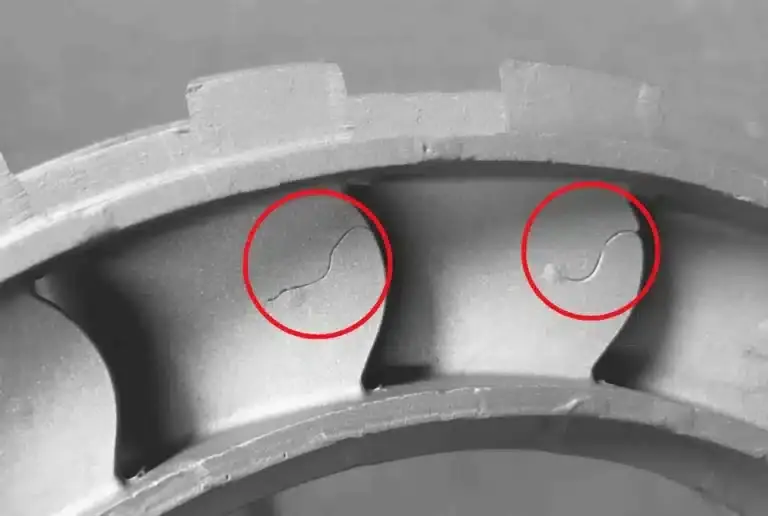
Cause: Metal streams meet but do not fuse properly, often due to poor gating or thin sections.
Effect: Weak seams or cracks on the surface.
Prevention: Optimize gate design, maintain minimum wall thickness, and ensure smooth metal flow paths.
8.4 Flash
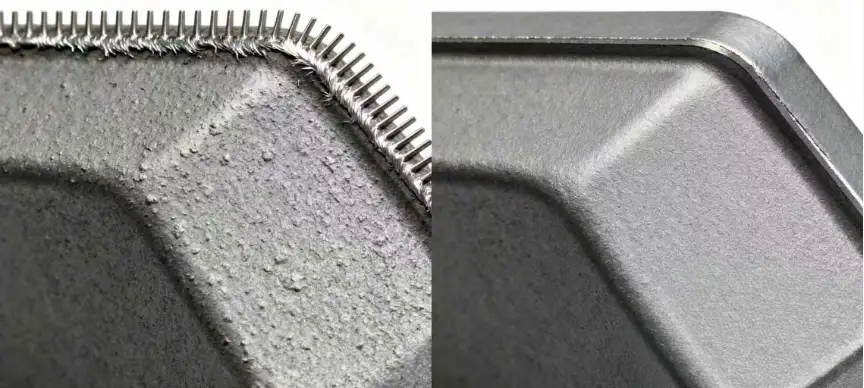
Cause: Metal escaping at parting lines due to insufficient draft or excessive mold complexity.
Effect: Extra machining, surface defects, and increased scrap.
Prevention: Apply proper draft angles, simplify parting lines, and ensure mold alignment.
8.5 Warpage
Cause: Uneven cooling, improper wall thickness, or lack of structural reinforcement.
Effect: Distorted parts that may not meet dimensional tolerances.
Prevention: Add ribs, fillets, and uniform wall thickness; optimize mold cooling.
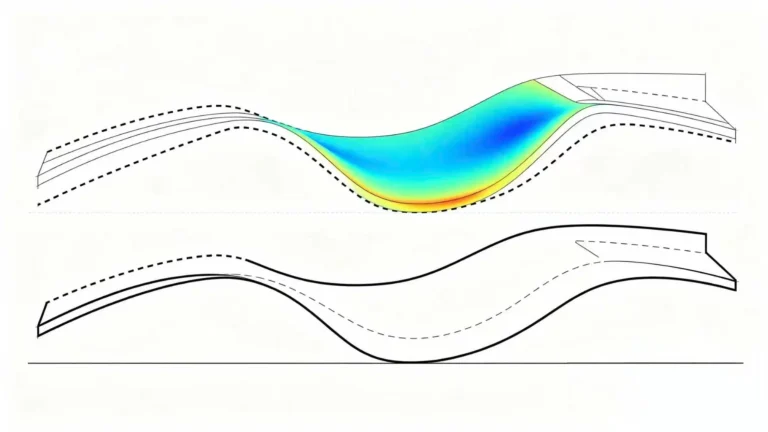
Design for Manufacturability (DFM)
DFM, an integral part of die casting design, is the proactive process of evaluating and refining a part’s design to ensure it can be manufactured as efficiently and cost-effectively as possible.
A formal DFM review with your manufacturing partner (like IEC MOULD) can:
- Optimize Wall Thickness: Identify and correct thick sections or variations.
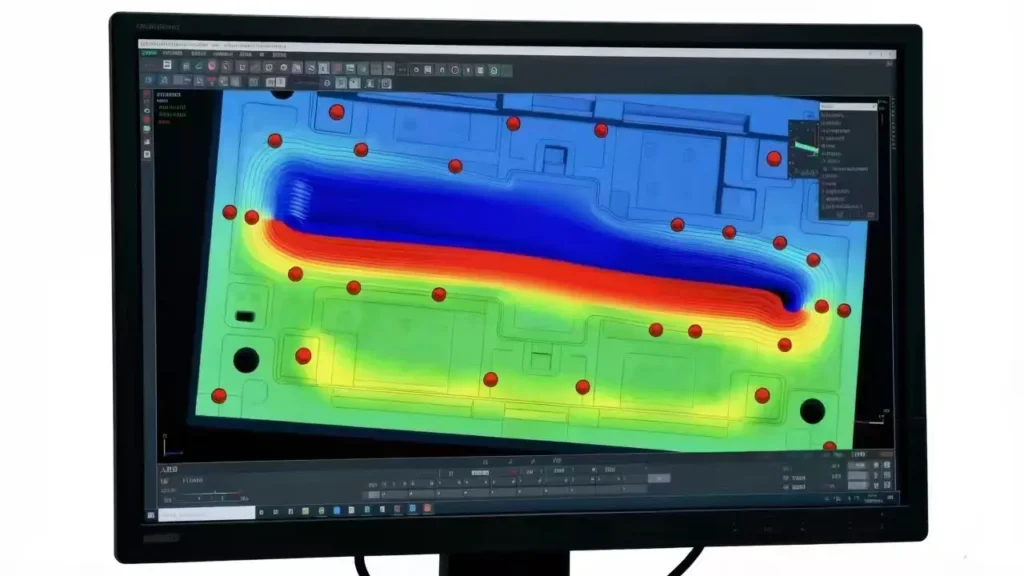
- Reduce Defects: Simulate metal flow to predict and eliminate potential issues such as air entrapment and cold shuts.
- Simplify Tooling: Suggest minor geometry changes that eliminate the need for complex slides or cores.
DFM tools include:
Moldflow Simulation: Computer software that virtually simulates the filling, cooling, and solidification of the metal to validate the design and gating system.
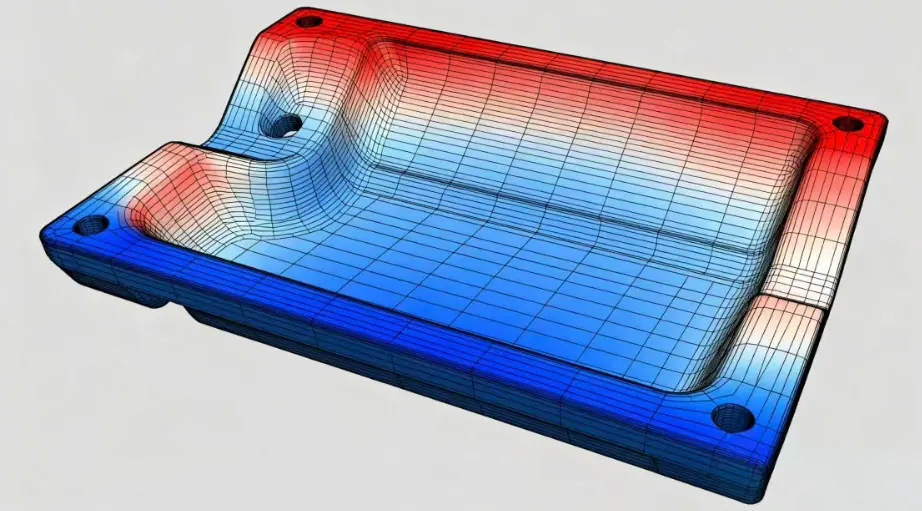
Structural Optimization: Finite Element Analysis (FEA) to ensure the part can withstand loads with minimal material.
Cost Reduction Analysis: A systematic review to identify areas where material, cycle time, or secondary operations can be reduced.
Die Casting Design for Different Industries
The principles remain the same, but the focus shifts based on the application. This adaptability is what makes die casting design suitable for a vast range of industries.
- Automotive Components: Focus on high strength, lightweighting, and thermal management. Examples include transmission housings, engine brackets, and structural components.
- Pump and Valve Parts: Require pressure tightness (no porosity), corrosion resistance, and good wear characteristics. Examples include pump housings, impellers, and valve bodies.
- Medical Devices: Require high precision, clean surfaces without porosity, and dimensional stability for sterile environments. Examples include medical device housings, diagnostic equipment frames, and surgical instrument parts.
Die Casting Design Optimization Techniques
Optimizing die cast part design is essential for improving performance, reducing material usage, and increasing production efficiency. Advanced design techniques allow engineers to produce lighter, stronger, and more cost-effective parts while minimizing defects.
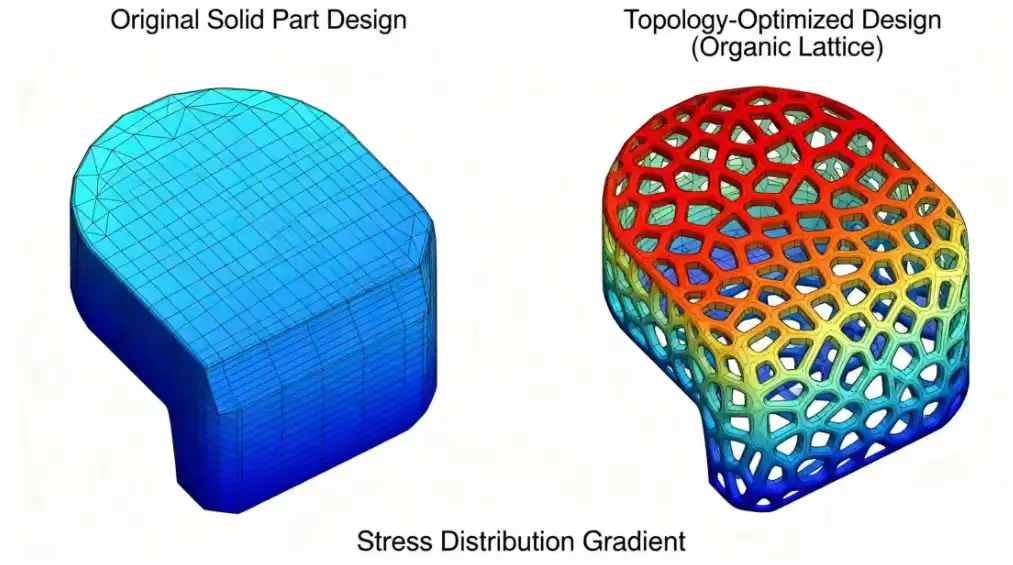
11.1 Topology Optimization
Topology optimization uses computer algorithms to remove unnecessary material while maintaining structural integrity.
Reduces part weight without sacrificing strength
Minimizes stress concentrations
Ideal for automotive, aerospace, and electronics applications
11.2 Lightweight Design
Lightweighting is critical in industries like automotive and aerospace to improve fuel efficiency and reduce costs.
- Incorporate hollow sections and ribs strategically
- Use high-strength alloys like Aluminum and Magnesium
- Optimize wall thickness for minimal material usage while maintaining durability
11.3 Thermal Management
For parts exposed to heat or requiring heat dissipation, thermal performance is a key design consideration.
- Integrate cooling fins or channels directly into the die cast design
- Ensure uniform wall thickness to prevent hot spots
- Use Moldflow simulations to optimize solidification and minimize defects
11.4 Integrated Structures
Complex assemblies can often be simplified by integrating multiple functions into a single die cast component.
Reduce assembly steps and machining costs
Minimize the number of fasteners and joints
Improve dimensional accuracy and part strength
11.5 Simulation and Validation
Using tools like Moldflow analysis, FEA (Finite Element Analysis), and 3D CAD simulations helps engineers:
Predict defects before production
Validate structural performance under load
Optimize gating, venting, and cooling systems
Die Casting Design Checklist
Are walls as consistent as possible, with gradual transitions?
Have I applied at least 1-2° of draft to all surfaces parallel to the ejection direction?
Are all sharp internal and external corners replaced with a generous radius (≥0.5mm)?
Are ribs used to stiffen the part, and do they follow the 60% thickness rule?
Are bosses cored and connected with fillets and ribs?
Is the parting line simple and placed on a single plane where possible?
Is the selected alloy (Aluminum, Zinc, Magnesium) right for the application's functional and aesthetic needs?
Have I specified tight tolerances only where functionally necessary?
How IEC MOULD Supports Your Die Casting Design
At IEC MOULD, we don’t just build molds; we engineer complete solutions. We understand that the path to a perfect part begins long before the molten metal hits the die. Our team of experienced engineers partners with you to turn your concepts into high-quality, cost-effective realities.
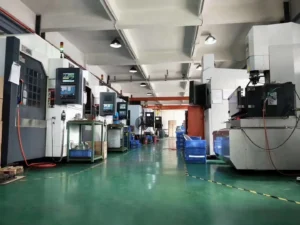
We provide complete die casting solutions:
DFM Analysis: We rigorously review your design and provide actionable feedback to optimize manufacturability, reduce costs, and prevent defects.
Moldflow Simulation: We use advanced simulation software to virtually test and validate your design, ensuring optimal gating, filling, and cooling strategies.
Die Casting Mold Manufacturing: We design and build high-precision, long-lasting dies tailored to your specific part and production volume.
High Pressure Die Casting: Our state-of-the-art facility produces consistent, high-quality castings.
CNC Machining & Surface Finishing: We handle all secondary operations in-house, delivering ready-to-use components.
Assembly: We can manage complex assembly processes and provide a fully integrated supply chain.
From design optimization to mass production, IEC MOULD is your single-source partner for success.
Frequently Asked Questions (FAQ)
Can die casting produce thin-wall parts?
Yes, especially with zinc alloys, which can be cast with walls as thin as 0.75 mm. Aluminum and magnesium can also produce thin walls, typically starting around 1.0-1.5 mm.
What is the difference between casting and die casting?
“Casting” is a broad term for shaping material by pouring it into a mold. Die casting is a specific type of casting where molten metal is injected under high pressure into a reusable steel die, resulting in higher precision and faster production than other methods like sand casting.
How does DFM improve die casting parts?
Design for Manufacturing (DFM) proactively optimizes a part’s design to align with the process, reducing costs by minimizing material and machining, improving quality by preventing defects, and speeding up time-to-market.
Conclusion
Mastering die casting design is the single most effective way to unlock the full potential of this versatile manufacturing process. By adhering to the core principles—uniform walls, proper draft, generous radii, and smart ribbing—you can engineer parts that are not only functional and robust but also a pleasure to manufacture. This proactive approach ensures:
Lower overall cost through reduced material and cycle time.
Higher quality with fewer defects and consistent mechanical properties.
Faster production with higher yields and smoother manufacturing flow.
Don’t leave the success of your project to chance. Leverage the expertise of a dedicated partner to navigate the complexities of design and tooling.
Ready to optimize your next project? Contact IEC MOULD today for a professional design consultation and DFM review.