
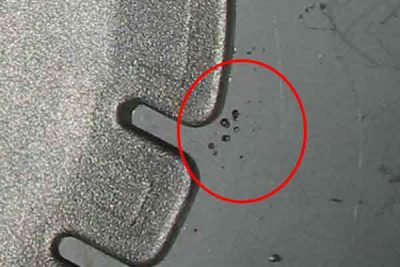
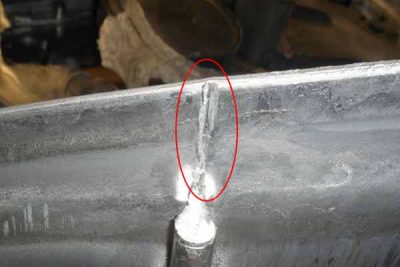
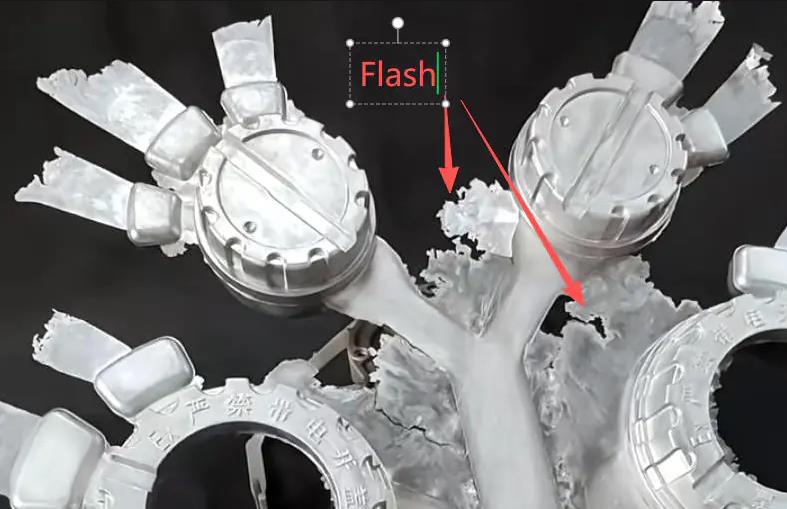
Pressure directly controls how molten metal fills, solidifies, and compensates for shrinkage inside the mold. Improper pressure—too low, too high, or unstable—can lead to common die casting defects such as porosity, cold shuts, and flash.
In high-pressure die casting, optimizing injection pressure, intensification pressure, and timing is essential to achieving consistent, defect-free parts. This guide shows you exactly how injection pressure, intensification pressure, and timing affect each defect—and how to set them right for aluminum, zinc, and magnesium alloys.
What Are Die Casting Defects
Die casting defects are imperfections that occur during the metal casting process, affecting part quality, performance, and consistency. The most common die casting defects include porosity (internal voids), cold shuts (incomplete fusion of metal flow), and flash (excess material leakage at parting lines).
Among the many process variables, die casting pressure is one of the most critical factors influencing defect formation. It governs how molten metal fills the die cavity, how it solidifies, and how effectively shrinkage is compensated during the process.
Improper pressure—whether too low, too high, or unstable—is a leading cause of common die casting defects. Inconsistent pressure control can result in incomplete filling, internal voids, or excess material leakage, all of which directly impact casting quality.
Why Pressure Is a Key Factor in Die Casting Quality
From an engineering standpoint, pressure is not just a machine setting—it is a core variable that determines casting integrity. Its role can be understood through three key functions:
- Metal Flow Behavior
Injection pressure controls how molten metal enters and fills the cavity. Stable pressure helps achieve smooth, consistent filling. - Solidification and Feeding
Intensification pressure supports metal feeding during solidification, improving internal density. - Mold Sealing and Flash Control
Pressure must be balanced with clamping force to prevent material leakage at the parting line.
Pressure Stages in High Pressure Die Casting
In high-pressure die casting, pressure is applied in multiple stages, each serving a specific purpose:
- Injection Pressure → Drives molten metal into the die cavity
- Intensification Pressure → Compresses metal to reduce internal defects
- Holding Pressure → Maintains stability during solidification
A well-controlled pressure profile across these stages is essential for achieving consistent casting quality and minimizing die casting defects.
Quick Overview: Pressure vs. Common Die Casting Defects
| Defect Type | Pressure Condition | Resulting Issue |
|---|---|---|
| Porosity | Too low or unstable pressure | Internal voids, reduced density |
| Cold Shut | Insufficient injection pressure | Incomplete fusion of metal fronts |
| Flash | Excessive or imbalanced pressure | Metal leakage at the parting line |
In summary, die casting pressure acts as a balancing factor—both insufficient and excessive pressure can lead to defects. Achieving high-quality castings depends on selecting and controlling the right pressure profile based on alloy type, part geometry, and mold design.
Key Types of Die Casting Defects
While many die casting defects exist, three defects are most closely related to pressure control and have the greatest impact on part quality:
- Porosity (internal voids)
- Cold Shut (incomplete metal fusion)
- Flash (excess material leakage)
These defects directly affect mechanical strength, sealing performance, and dimensional accuracy, making them critical in both engineering design and supplier evaluation.
Quick Comparison of Common Defects
| Defect | Typical Appearance | Main Risk | Pressure Sensitivity |
|---|---|---|---|
| Porosity | Internal or surface voids | Leakage, weak structure | High |
| Cold Shut | Visible seam lines | Reduced strength | Medium–High |
| Flash | Excess material at edges | Extra machining cost | High |
1. Porosity in Die Casting (Gas & Shrinkage)
Porosity is one of the most critical die casting defects, especially in parts that require air tightness or structural integrity.
Types of Porosity:
- Gas porosity → caused by trapped air during filling
- Shrinkage porosity → caused by insufficient feeding during solidification
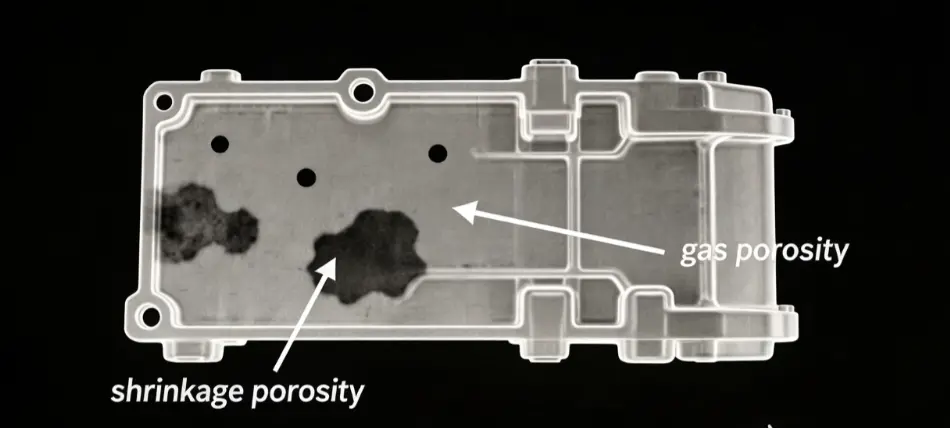
👉 Key takeaway:
Controlling porosity requires stable pressure and correct timing, not simply higher pressure. This principle applies to most die casting defects encountered in production.
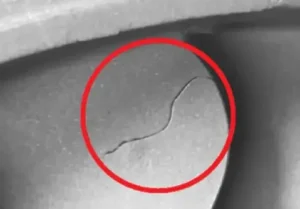
2. Cold Shut in Die Casting
Cold shuts occur when two streams of molten metal meet but fail to fuse properly, forming a visible weak line.
Where It Happens
- Thin-wall sections
- Long flow paths
- Complex geometries
👉 Key takeaway:
Cold shuts are primarily caused by insufficient or inconsistent injection pressure.
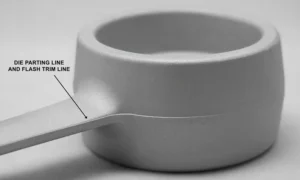
3. Flash in Die Casting
Flash is excess metal that escapes from the mold, typically at the parting line or vent areas.
Why It Matters
- Increases trimming and machining costs
- Affects dimensional accuracy
👉 Key takeaway:
Flash is usually caused by pressure exceeding system limits, not just poor mold condition.
Summary: Pressure–Defect Relationship
| Pressure Condition | Main Risk | Typical Defect |
|---|---|---|
| Too Low | Incomplete filling, poor feeding | Cold shut, shrinkage porosity |
| Too High | Turbulence, mold separation | Gas porosity, flash |
| Unstable | Inconsistent flow & solidification | Mixed defects |
In practice, controlling die casting defects is not about simply increasing or decreasing pressure—it is about balancing injection pressure, intensification pressure, and process stability.
How Pressure Affects Different Die Casting Defects
Die casting pressure is not a single setting—it is a dynamic process parameter that changes throughout the injection cycle. The way pressure is applied (magnitude, timing, and stability) directly determines how molten metal flows, fills, and solidifies inside the die.
In this section, we break down how pressure influences each major defect—and what actually happens inside the mold from a process perspective.
1️⃣ Porosity: The Relationship Between Pressure and Gas Entrapment
Porosity is highly sensitive to pressure control, especially in high-pressure die casting, where metal is injected at high speed.
How pressure causes porosity:
- Low pressure → insufficient feeding
- Molten metal cannot compensate for shrinkage during solidification
- Results in shrinkage porosity, especially in thicker sections
- Excessive or unstable pressure → turbulence
- High-speed, high-pressure flow creates turbulent metal fronts
- Air gets trapped inside the cavity → gas porosity
- Delayed intensification pressure
- If intensification pressure is applied too late, solidification has already started
- Feeding becomes ineffective, increasing internal voids
Key insight:
👉 It’s not just high pressure, but controlled pressure timing that reduces porosity.
2️⃣ Cold Shut: Why Low Pressure Leads to Incomplete Filling
Cold shuts are primarily caused by insufficient flow energy, which is directly related to injection pressure.
How pressure causes cold shuts:
- Low injection pressure → low flow velocity
- Metal fronts move slowly and lose heat quickly
- When two fronts meet, they fail to fuse
- Inconsistent pressure → uneven flow
- Some areas fill faster than others
- Leads to temperature differences and poor bonding
- Pressure drop during filling
- In long flow paths or thin walls, pressure loss reduces filling capability
Typical scenarios:
- Thin-wall aluminum housings
- Parts with multiple gates or complex geometry
Key insight:
👉 Maintaining sufficient and stable injection pressure is critical for complete cavity filling.
3️⃣ Flash: How Excessive Pressure Causes Overflow
Flash is a direct result of pressure exceeding the mechanical limits of the die system.
How pressure causes flash:
- Excessive intensification pressure
- Metal is forced into parting lines or micro gaps
- Creates thin excess material around edges
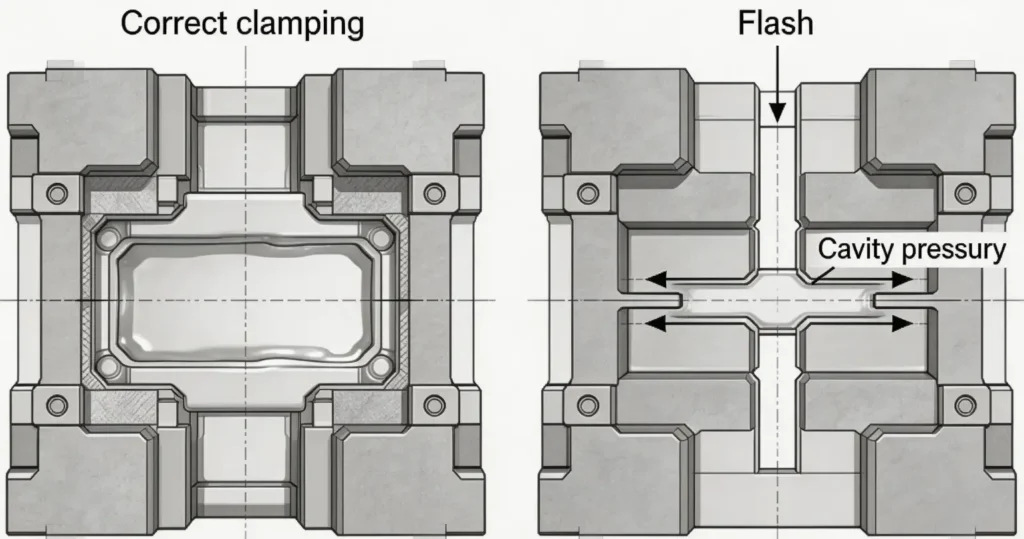
- Pressure exceeding clamping force
- Die halves slightly separate under high force
- Molten metal escapes
- Localized pressure concentration
- Poor gating design can create pressure spikes in certain areas
Additional contributing factors:
- Worn molds
- Poor die alignment
- Insufficient machine tonnage
Key insight:
👉 Flash is often not just a pressure issue, but a mismatch between pressure and clamping capacity.
Optimal Pressure Settings to Reduce Die Casting Defects
Achieving defect-free castings is not about using the highest possible pressure—it’s about applying the right pressure at the right stage of the process. In high pressure die casting, optimizing pressure involves balancing injection pressure, intensification pressure, and holding pressure based on alloy type, part geometry, and mold design.
This section provides practical pressure ranges and optimization guidelines used in real production to reduce common die casting defects such as porosity, cold shuts, and flash.
🔍 Typical Die Casting Pressure Ranges by Material
Different alloys require different pressure levels due to variations in fluidity, solidification behavior, and thermal properties.
| Material | Injection Pressure (MPa) | Intensification Pressure (MPa) | Key Considerations |
|---|---|---|---|
| Aluminum Alloys (A380, ADC12) | 30 – 80 | 80 – 150 | Balance flow and porosity control |
| Zinc Alloys (Zamak) | 20 – 50 | 50 – 100 | Lower pressure due to high fluidity |
| Magnesium Alloys | 40 – 100 | 100 – 180 | Requires stable, controlled filling |
📌 Pressure Profile Across the Die Casting Cycle
In high-pressure die casting, pressure is not applied as a single value—it follows a multi-stage profile, where each stage plays a specific role in controlling metal flow, solidification, and defect formation.
Stage 1: Slow Shot (Low Pressure Phase)
During the initial stage, molten metal is pushed slowly into the shot sleeve and gate area at relatively low pressure. This controlled movement helps evacuate air from the cavity and reduces the risk of turbulence.
A stable slow shot phase is essential for minimizing gas entrapment, which is a primary cause of porosity.
Stage 2: Fast Shot (High Injection Pressure Phase)
Once the metal reaches the gate, injection speed and pressure increase rapidly to fill the cavity before solidification begins.
Adequate injection pressure at this stage ensures complete filling, especially in thin-wall sections and complex geometries.
Insufficient pressure during this phase can lead to cold shuts or misruns, as the metal may lose temperature before filling the mold.
Stage 3: Intensification Pressure Phase
After the cavity is filled, intensification pressure is applied to compress the molten metal and compensate for shrinkage during solidification.
This stage plays a critical role in improving casting density and reducing internal defects.
If intensification pressure is too low or applied too late, shrinkage porosity is more likely to occur.
Stage 4: Holding Pressure Phase
Holding pressure maintains stability as the metal solidifies, ensuring that pressure is evenly distributed until the gate fully freezes.
This helps prevent pressure drop and reduces the risk of localized defects.
🎯 Recommended Pressure Optimization Strategy
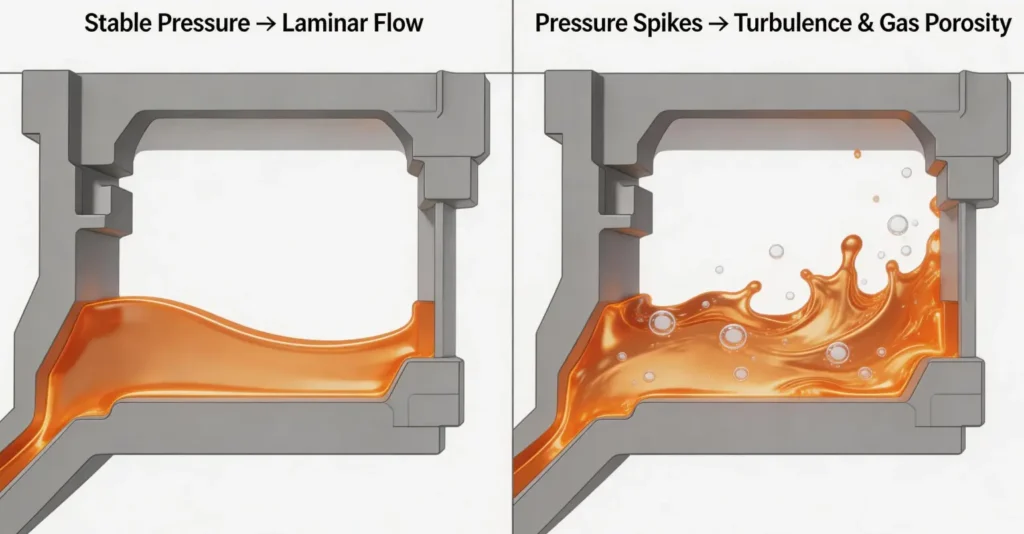
1. Maintain Stable Injection Pressure
- Ensure consistent metal flow velocity
- Avoid sudden pressure spikes that cause turbulence
- Use controlled acceleration profiles
👉 Helps reduce:
- Cold shuts
- Gas porosity
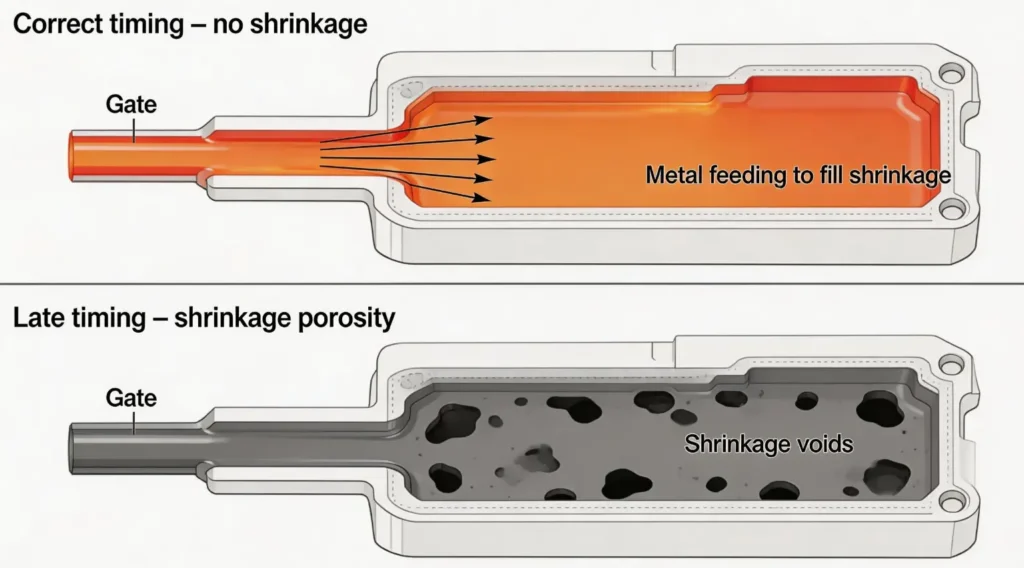
2. Optimize Intensification Pressure Timing
- Apply pressure before gate solidification
- Ensure sufficient feeding during shrinkage
👉 Helps reduce:
- Shrinkage porosity
- Internal voids
3. Match Pressure with Clamping Force
- Verify machine tonnage vs projected area
- Prevent the separation under high pressure
👉 Helps reduce:
- Flash
- Dimensional variation
4. Balance Pressure with Temperature and Speed
Pressure does not work in isolation. It must be coordinated with:
- Melt temperature → affects flowability
- Die temperature → affects solidification rate
- Injection speed → affects turbulence
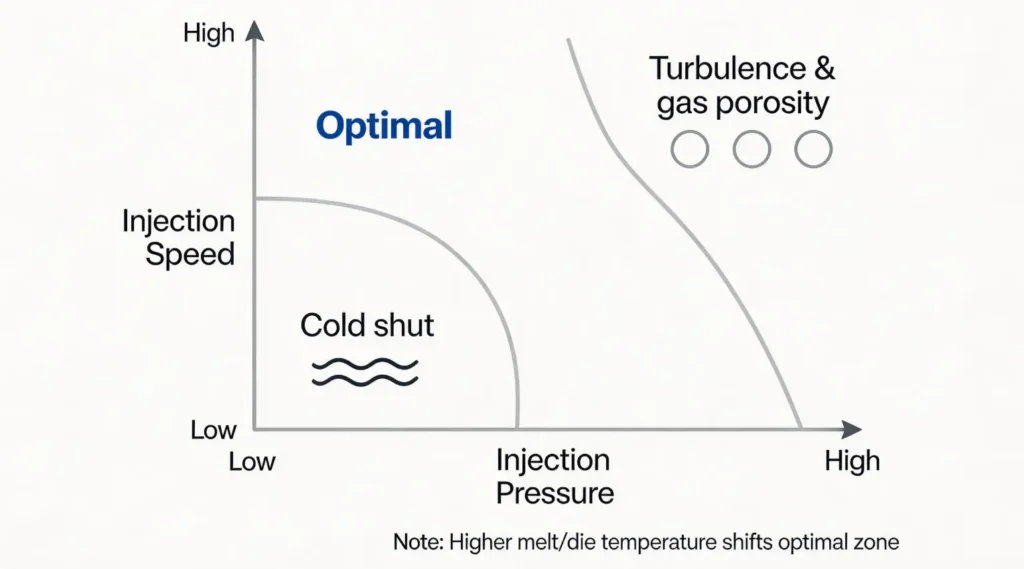
👉 Example:
- High pressure + high speed = turbulence risk
- Moderate pressure + optimized speed = smoother filling
🧩 Engineering Insight: Pressure Optimization Is Application-Specific
There is no “one-size-fits-all” pressure setting in die casting. Optimal parameters depend on the part wall thickness, flow length, gate design, and venting efficiency
👉 This is why advanced manufacturers rely on:
- Mold flow simulation (CAE)
- Real-time pressure monitoring systems
- Process window validation
Practical Tips to Optimize Pressure in Die Casting Production
In real die casting production, pressure control is not achieved by a single adjustment. It depends on how well pressure is integrated with tooling design, machine capability, injection behavior, and process stability. The following practices are widely used on the shop floor to reduce defects such as porosity, cold shuts, flash, and dimensional variation.
1. Improve Gating and Venting Design
A stable pressure system starts with a well-designed mold. Even with correct machine settings, poor flow paths will still create turbulence and pressure imbalance.
Proper gating and venting help ensure molten metal fills the cavity smoothly without trapping air or creating localized pressure spikes.
👉 This reduces gas entrapment during high-speed filling and improves pressure distribution across the cavity, which helps minimize porosity and cold shuts.
2. Control Injection Speed and Pressure Together
Injection pressure and injection speed must be treated as a combined system rather than independent parameters.
A multi-stage injection profile is typically used, where the initial stage focuses on air evacuation and the later stage increases pressure for complete filling.
👉 When pressure is increased without controlling speed, flow becomes turbulent and air is more easily trapped. When both are balanced, the cavity fills more uniformly, reducing internal defects and incomplete fusion.
3. Match Machine Tonnage with Applied Pressure
Clamping force must be sufficient to counteract the intensification pressure during solidification. If the machine capacity is not properly matched, even optimized pressure settings can lead to die separation.
A proper tonnage selection ensures that the mold remains tightly closed throughout the cycle, even under peak pressure conditions.
👉 This prevents flash formation at the parting line and maintains dimensional stability during high-pressure injection.
4. Optimize Intensification Pressure Timing
The effectiveness of intensification pressure depends more on timing than on magnitude alone.
It must be applied before the gate fully solidifies so that molten metal can still be fed into shrinking areas during solidification.
👉 When timing is correct, internal shrinkage is compensated effectively, significantly reducing porosity in thicker sections of the casting.
5. Maintain Stable Pressure Through Real-Time Monitoring
Modern die casting processes rely heavily on pressure curve monitoring rather than fixed parameter settings.
By tracking injection and intensification pressure in real time, operators can detect instability early and adjust process parameters before defects accumulate.
👉 A stable pressure curve ensures repeatability across production cycles and reduces random quality variation in mass production.
6. Maintain Mold Condition and Alignment
Even with optimized pressure settings, worn or misaligned molds can disrupt pressure balance inside the cavity.
Regular inspection of parting surfaces, vents, and alignment systems ensures that pressure is distributed evenly during injection.
👉 This helps prevent localized pressure leakage, which is a common cause of flash and inconsistent filling.
7. Validate Pressure Settings Through Simulation and Testing
Before mass production, pressure parameters should be validated using mold flow simulation and trial runs.
Simulation helps predict how pressure behaves inside the cavity, including flow fronts, air entrapment zones, and pressure loss areas.
👉 This reduces trial-and-error on the shop floor and improves the stability of die casting pressure settings from the beginning of production.
🧠 Key takeway
Effective die casting pressure control is not achieved by increasing or decreasing pressure alone. It requires a system-level approach that combines tooling design, machine matching, and real-time process control.
When these factors are properly integrated, manufacturers can achieve stable production conditions that significantly reduce porosity, cold shuts, and flash while improving overall casting consistency.
How Professional Die Casting Manufacturers Control Pressure for Quality
In high-quality die casting production, pressure control is not handled as a single parameter—it is managed as a fully integrated system that combines tooling design, machine capability, and real-time process control.
For buyers and engineers, understanding how a supplier controls die casting pressure is one of the most reliable ways to evaluate their ability to deliver consistent, defect-free parts at scale.
1. Pressure Control Starts at the Tooling Design Stage
Professional manufacturers begin optimizing pressure long before production—during the DFM (Design for Manufacturing) phase.
Key engineering practices:
- Mold flow simulation (CAE) to predict pressure distribution and air entrapment
- Optimized gate and runner design to balance flow and minimize pressure loss
- Engineered venting systems to release trapped gas under high pressure
👉 Result:
- Stable filling behavior
- Reduced dependence on extreme pressure settings
2. Matching Machine Capability to Part Requirements
Advanced die casting suppliers carefully match machine parameters to each project.
Critical factors:
| Parameter | Why It Matters |
|---|---|
| Machine tonnage | Must withstand intensification pressure to prevent flash |
| Shot capacity | Ensures complete and stable cavity filling |
| Injection system performance | Determines pressure response speed and stability |
👉 Key insight:
A mismatch between machine capability and part design often leads to unstable pressure profiles, even if settings appear correct.
3. Real-Time Pressure Monitoring and Control
Leading manufacturers use sensor-based monitoring systems to track pressure throughout the casting cycle.
What is monitored:
- Injection pressure curve
- Intensification pressure peak
- Pressure consistency across cycles
What this enables:
- Immediate detection of process deviation
- Data-driven parameter adjustment
- Reduced variation between batches
Example: Controlled vs Uncontrolled Pressure Process
| Process Type | Characteristics | Result |
|---|---|---|
| Uncontrolled | Manual adjustments, inconsistent curves | High defect rate, unstable quality |
| Controlled | Data-driven, repeatable pressure curves | Cons |
4. Closed-Loop Process Optimization
Top-tier die casting manufacturers implement closed-loop control systems, where machine parameters automatically adjust based on real-time feedback.
Benefits:
- Maintains optimal pressure despite external variations
- Compensates for temperature changes and material differences
- Ensures repeatability in mass production
👉 This is especially critical for:
- Automotive components
- Pressure-tight housings
- High-precision industrial parts
5. Process Validation and Continuous Improvement
Before mass production, experienced suppliers validate pressure settings through:
- Trial runs and parameter window studies
- CpK analysis for critical dimensions
- Defect rate tracking and root cause analysis
After SOP (Start of Production), they continuously improve by:
- Monitoring defect trends
- Refining pressure curves
- Updating process standards
What This Means for Buyers
If you are sourcing die casting components, pressure control capability directly impacts:
- Product quality consistency
- Scrap rate and cost efficiency
- Lead time stability
Key questions to ask a supplier:
- Do you use mold flow simulation before tooling?
- How do you monitor injection and intensification pressure?
- Can you provide process capability data (CpK)?
👉 These questions quickly reveal whether a supplier relies on experience-based adjustments or systematic process control.
From Pressure Control to Long-Term Reliability
Ultimately, consistent die-casting quality is not achieved by a single optimal pressure setting—it is the result of a repeatable, controlled process system.
Manufacturers that invest in engineering validation, advanced equipment, and data-driven control can deliver not just good samples—but stable, scalable production quality.
FAQ: Die Casting Defects and Pressure
What is die casting pressure?
Die casting pressure is the force used to inject molten metal into a mold cavity during the casting process. It includes injection pressure (to fill the mold) and intensification pressure (to compress the metal during solidification).
👉 Proper die casting pressure ensures:
- Complete mold filling
- Reduced porosity
- Improved part density
Does higher pressure reduce porosity in die casting?
Higher pressure can reduce shrinkage porosity by improving metal feeding during solidification. However, excessive pressure may increase gas porosity due to turbulence.
👉 Best practice:
- Use controlled intensification pressure
- Avoid excessive injection speed
- Combine with proper venting
What pressure is used in high pressure die casting?
Typical pressure ranges in high-pressure die casting are:
- Aluminum: 80–150 MPa (intensification pressure)
- Zinc: 50–100 MPa
- Magnesium: 100–180 MPa
👉 The exact pressure depends on part geometry, wall thickness, and mold design.
How does pressure affect die casting defects?
Pressure directly affects how molten metal flows and solidifies inside the mold.
- Low pressure → incomplete filling → cold shuts or misruns
- High pressure → turbulence → gas porosity or flash
- Unstable pressure → inconsistent quality
👉 Optimizing pressure helps reduce the most common die casting defects.
How to reduce die casting defects?
4-step pressure optimization can reduce die casting defects:
✅ Stable injection pressure → prevents cold shut
✅ Timely intensification → reduces porosity
✅ Match pressure with clamping force → stops flash
✅ Balance pressure with temperature & speed → smooth filling
What is the difference between injection pressure and intensification pressure?
| Parameter | Purpose | When Applied |
|---|---|---|
| Injection pressure | Fill the cavity completely | During filling stage |
| Intensification pressure | Compensate shrinkage, reduce porosity | After cavity is filled, before gate solidifies |
Get Expert Support for Your Die Casting Pressure Optimization
If you are producing aluminum, zinc, or magnesium castings and struggle with porosity, cold shuts, or flash, getting the right pressure settings from the start can save weeks of trial and error.
✨ Ready to Turn This Guide into Defect‑Free Castings?
If you have a drawing, a sample, or even just an initial idea, you can start by sharing your project details.
👉 Typical information to prepare:
- 2D drawings or 3D CAD files (STEP / IGS / STL)
- Alloy type and performance requirements (e.g., pressure tightness, heat treatment)
- Estimated annual volume
With this information, a technical team can quickly evaluate your pressure‑related risks and provide actionable recommendations.