Skip to content
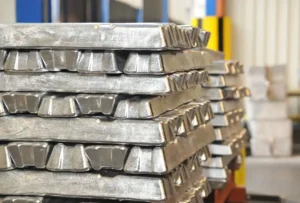

In today’s manufacturing landscape, industries are under constant pressure to produce components that are lighter, stronger, and more cost-efficient. Whether it’s automotive, electronics, or industrial machinery, the challenge is not just about design—but also about selecting the right material and manufacturing process. Across aluminum casting industries, this pressure has driven widespread adoption of lightweight metal solutions.
This is where aluminum casting becomes a critical solution. Across the aluminum casting industries, manufacturers rely on this process to meet diverse production demands. By combining advanced casting techniques with specific aluminum alloys, manufacturers can achieve both performance and scalability.
Different applications require different alloys. For example, A380 and ADC12 aluminum alloys are widely used in aluminum die casting for their excellent fluidity and cost efficiency, while A356 aluminum alloy is preferred in structural applications due to its superior mechanical properties.
From automotive components to heat sinks and industrial housings, aluminum casting enables the production of custom aluminum casting parts that meet precise functional and economic requirements.
In this guide, we’ll explore the top aluminum casting industries, along with the real applications and alloy choices behind them.
What Are Aluminum Casting Industries?
Aluminum casting industries refer to sectors that use aluminum casting processes—such as die casting, sand casting, and gravity casting—to manufacture high-performance metal components.
These industries rely not only on casting techniques but also on specific aluminum alloys to meet different functional requirements.
The most common aluminum casting industries include:
- Automotive
- Aerospace
- Electronics
- Industrial machinery
- Construction
- Medical equipment
- Consumer products
These 7 aluminum casting industries represent the core market segments driving demand for high-quality cast components. Across these sectors, manufacturers select alloys like A380, ADC12, A356, and 6061 based on factors such as strength, corrosion resistance, thermal conductivity, and cost.
Why Aluminum Casting Is Widely Used Across Industries
The widespread adoption of aluminum casting is not just due to the material itself, but also because of the versatility of aluminum alloys and casting processes. Across aluminum casting industries, the reasons for this widespread adoption go beyond the material itself.
1. Lightweight with High Strength
Aluminum alloys such as A356 and 6061 are known for their high strength-to-weight ratio, making them ideal for structural components in automotive and aerospace applications.
These alloys allow manufacturers to reduce overall product weight without compromising mechanical performance.
2. Excellent Corrosion Resistance
Many aluminum alloys naturally form a protective oxide layer. For example, A356 aluminum alloy offers strong corrosion resistance, making it suitable for outdoor and industrial environments.
3. Cost Efficiency for Mass Production
For high-volume production, alloys like A380 and ADC12 are commonly used in aluminum die casting.
These alloys provide:
- Excellent fluidity
- Good dimensional stability
- Lower production cost
This makes them ideal for producing large quantities of aluminum casting parts with consistent quality.
4. Complex Geometry Capability
Certain die casting alloys, especially ADC12, are optimized for filling thin walls and complex molds.
This allows manufacturers to design intricate components such as:
- Heat sinks
- Electronic housings
- Structural brackets
Reducing the need for secondary machining and assembly.
5. Common Aluminum Alloys Used in Casting
To better understand how alloy selection impacts performance, here’s a comparison of commonly used aluminum casting alloys:
| Alloy | Typical Process | Key Properties | Common Applications |
|---|---|---|---|
| A380 | Die casting | Excellent fluidity, good strength, and cost-effective | Automotive parts, electronic housings |
| ADC12 | Die casting | Superior castability, good dimensional stability | Enclosures, consumer electronics |
| A356 | Sand / Gravity casting | High strength, excellent corrosion resistance, heat-treatable | Aerospace, structural components |
| 6061 | Machining / secondary processing | High strength, versatile, good machinability | Precision parts, mechanical components |
Note: Alloy selection depends on factors such as mechanical requirements, production volume, and casting process. This flexibility is what makes aluminum casting industries so diverse in their applications.
Limitations of Aluminum Casting in Certain Applications
While aluminum casting offers significant advantages across many industries, it is not always the optimal solution for every application. Understanding its limitations helps engineers and buyers choose the right material and process.
1. Limited High-Temperature Performance
Compared to materials like cast iron or steel, aluminum alloys have lower heat resistance.
For example, components such as turbocharger housings or exhaust systems are typically made from cast iron or high-temperature alloys rather than aluminum.
High-temperature environments above ~300°C
Cast iron or heat-resistant steel alloys
2. Higher Tooling Cost for Die Casting
Aluminum die casting requires high-precision molds, which can involve significant upfront investment.
Low-volume or prototype production
Sand casting or CNC machining may be more cost-effective for small batches
3. Porosity and Its Impact on Mechanical Properties
Porosity is a known challenge in aluminum casting, especially in die casting processes. It can affect fatigue strength, pressure tightness, and structural reliability in critical components.
High-load or safety-critical parts
- Vacuum die casting
- Improved mold design
- Secondary machining or impregnation
4. Lower Wear Resistance Compared to Steel
Aluminum alloys generally have lower hardness and wear resistance than steel.
Friction-heavy components (e.g., gears, sliding parts)
- Surface treatment (anodizing, coating)
- Use steel inserts or hybrid designs
Aluminum vs. Other Metals: Why Industries Choose It
When selecting a material for casting, manufacturers often compare aluminum with other metals such as steel, zinc, and magnesium. Each material has its strengths, but aluminum stands out in many industrial applications due to its balance of performance, cost, and manufacturability.
1. Material Comparison Overview
| Property | Aluminum (A380 / A356) | Steel | Zinc (Zamak) | Magnesium |
|---|---|---|---|---|
| Weight | Lightweight | Heavy | Medium | Very lightweight |
| Strength-to-weight ratio | High | Very high | Medium | High |
| Corrosion resistance | Excellent | Moderate | Good | Moderate |
| Cost | Moderate | Higher machining cost | Low (material) | Higher |
| Casting complexity | Excellent (die casting) | Limited | Excellent | Good |
| Heat resistance | Moderate | Excellent | Low | Moderate |
2. When Aluminum Is the Best Choice
Aluminum is often the preferred option when:
Weight reduction is critical (automotive, aerospace)
Complex shapes are required (die casting parts)
Good corrosion resistance is needed
Medium-to-high production volume is involved
3. When Other Metals May Be Better
Despite its advantages, aluminum is not always the ideal choice:
- Steel is better for high-temperature and heavy-load applications
- Zinc (Zamak) is preferred for small, high-precision parts with tight tolerances
- Magnesium is used when extreme weight reduction is required
👉 Practical Selection Insight
Material selection depends on multiple factors—mechanical performance, production volume, cost, and surface finish. An experienced aluminum casting supplier helps customers make the right choice early in the design stage. This is why experienced partners across aluminum casting industries are essential for optimizing both material and process selection.
Top 7 Aluminum Casting Industries and Real-World Applications
In aluminum casting industries, applications vary by sector—alloy selection, production volume, and performance all influence the final solution.
For buyers and engineers, understanding these differences is essential when choosing the right supplier or manufacturing approach.
Below, we break down the top industries using aluminum casting, with real applications and measurable results.
🚗 1. Automotive Industry
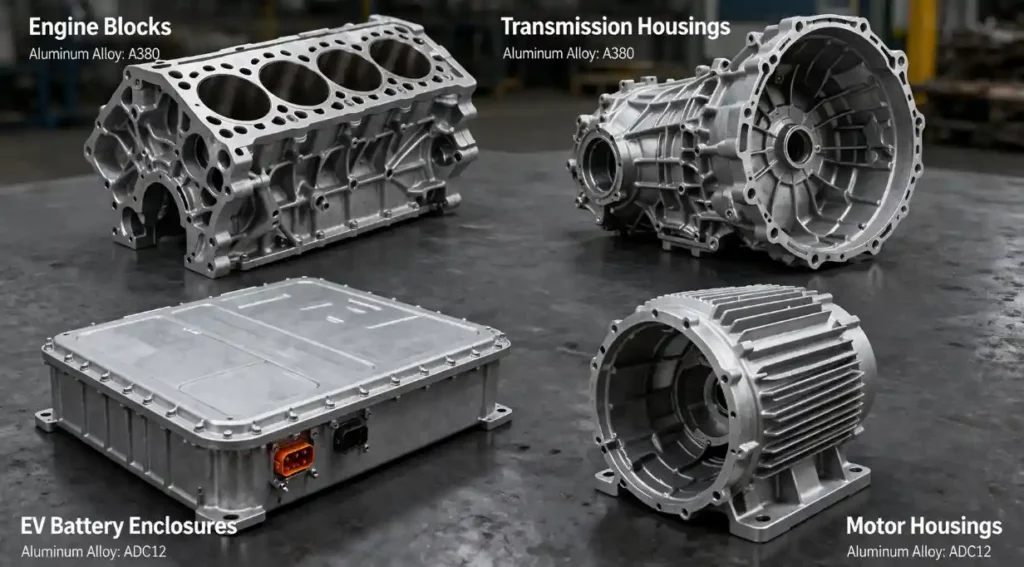
The automotive sector is one of the largest users of aluminum casting, driven by the need for lightweight and high-performance components, especially in electric vehicles.
Typical Applications
- Engine blocks
- Transmission housings
- EV battery enclosures
- Motor housings
Recommended Alloys: A380 and ADC12
Micro Case:
An EV manufacturer needed to reduce battery housing weight while maintaining strength.
Replaced welded steel with an integrated A380 aluminum die casting design.
- Weight reduced by 25–35%
- Part count reduced by 40%+
- Cost reduced by 15–20%
Results may vary depending on design, alloy selection, and production conditions.
✈️ 2. Aerospace Industry
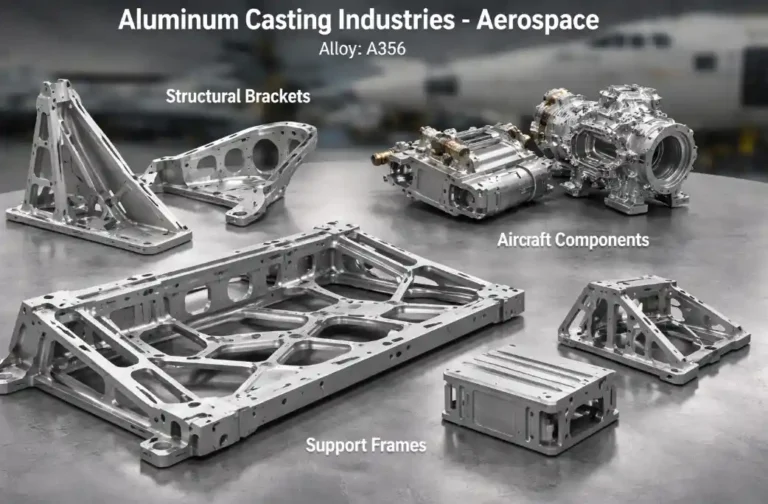
Aerospace applications require strict weight control and high mechanical performance.
Typical Applications
- Structural brackets
- Aircraft components
- Support frames
Recommended Alloys
A356 is widely used due to its high strength and heat-treatable properties.
Micro Case:
They needed lightweight structural parts with high strength.
We used A356 gravity casting with T6 heat treatment.
- Weight reduced by 20–30%
- Strength improved by ~15%
- Scrap rate reduced by 10–15%
Results may vary depending on design, alloy selection, and production conditions.
💻 3. Electronics Industry
Aerospace applications require strict weight control and high mechanical performance.
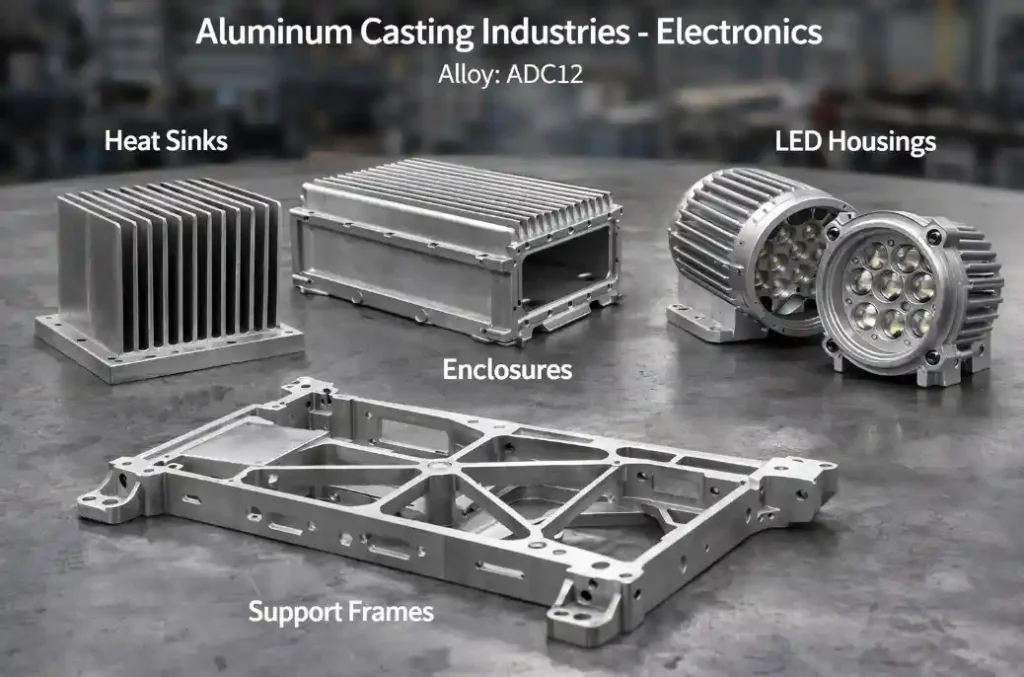
Typical Applications
- Heat sinks
- Enclosures
- LED housings
Recommended Alloys
ADC12 is preferred for its excellent thermal performance and castability.
Micro Case:
We redesigned them into a single ADC12 die-cast heat sink.
We redesigned into a single ADC12 die-cast heat sink.
- Heat dissipation improved by 20–30%
- Assembly time reduced by 30%+
- Cost reduced by 10–15%
Results may vary depending on design, alloy selection, and production conditions.
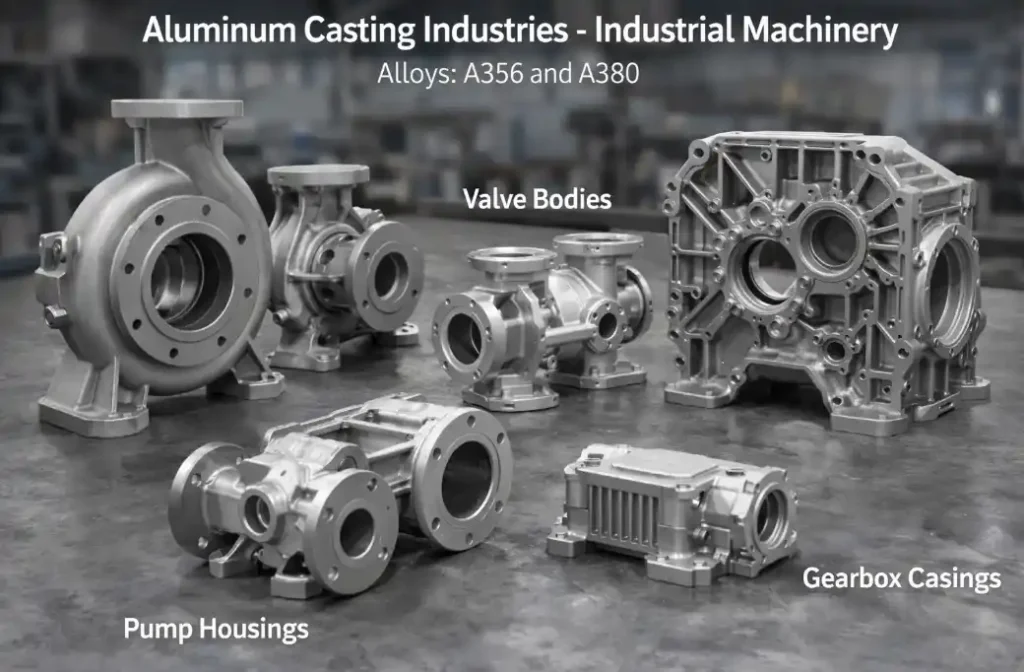
⚙️ 4. Industrial Machinery Industry
Industrial equipment requires durable and corrosion-resistant components for long-term operation.
Typical Applications
- Pump housings
- Valve bodies
- Gearbox casings
Recommended Alloys
A356 and A380 are commonly used depending on strength and cost requirements.
Micro Case:
Frequent maintenance due to corrosion and wear.
We adopted A356 casting with optimized flow design.
- Service life increased by 20%+
- Maintenance reduced by 15–25%
- Cost reduced by ~10%
Results may vary depending on design, alloy selection, and production conditions.
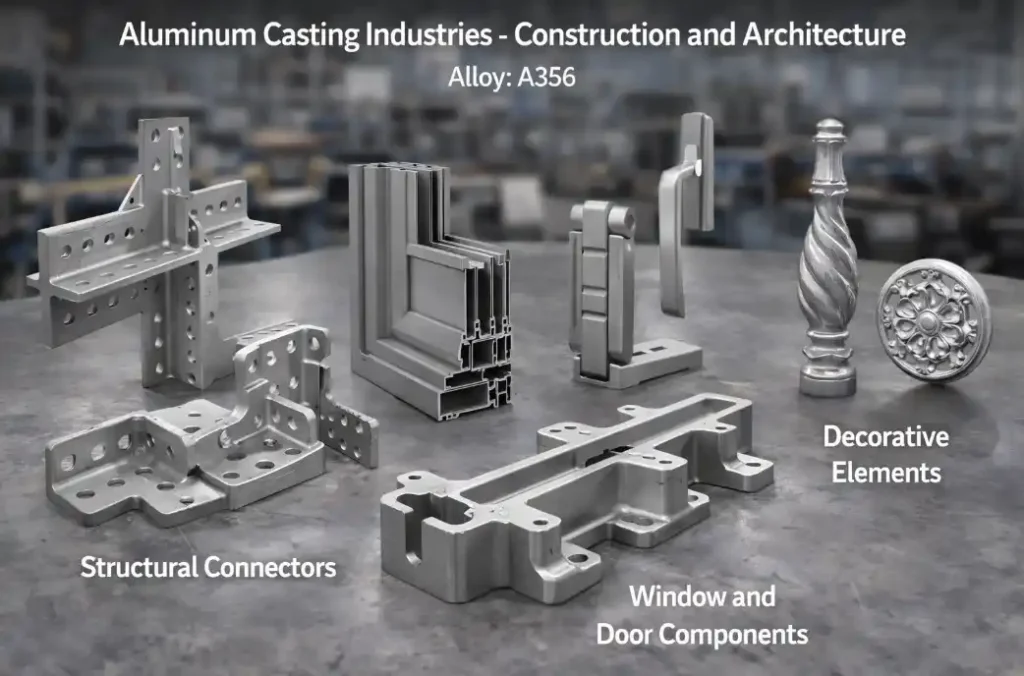
🏗️ 5. Construction and Architecture Industry
Aluminum casting is widely used for both structural and decorative building components.
Typical Applications
- Structural connectors
- Window and door components
- Decorative elements
Recommended Alloys
A356 is commonly used for its corrosion resistance.
Micro Case:
Outdoor connectors prone to corrosion failure.
We switched to A356 gravity casting components.
- Corrosion failures reduced by 30%+
- Service life extended by 2–3×
- Maintenance cost reduced by 20%
Results may vary depending on design, alloy selection, and production conditions.
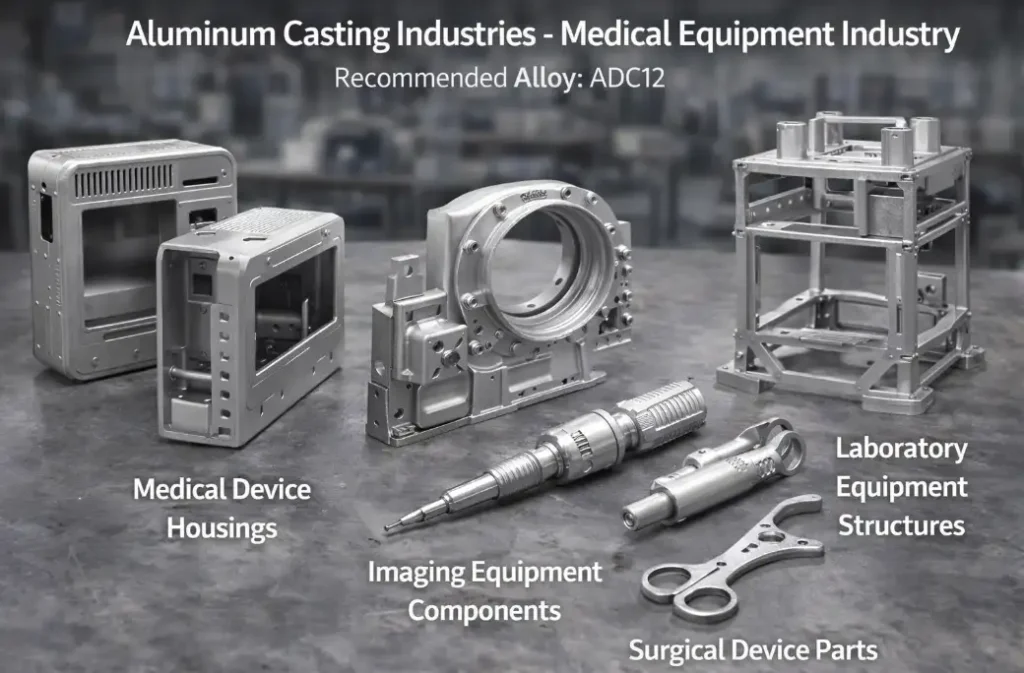
🏥 6. Medical Equipment Industry
Medical applications demand high precision and reliability.
Typical Applications
- Device housings
- Imaging equipment components
Recommended Alloys
ADC12 with secondary machining for precision requirements.
Micro Case:
Strict tolerance and surface quality requirements.
We used precision ADC12 die casting + CNC machining.
- Accuracy improved to ±0.02 mm
- Defect rate reduced by 20–30%
- Assembly efficiency improved by 15%
Results may vary depending on design, alloy selection, and production conditions.
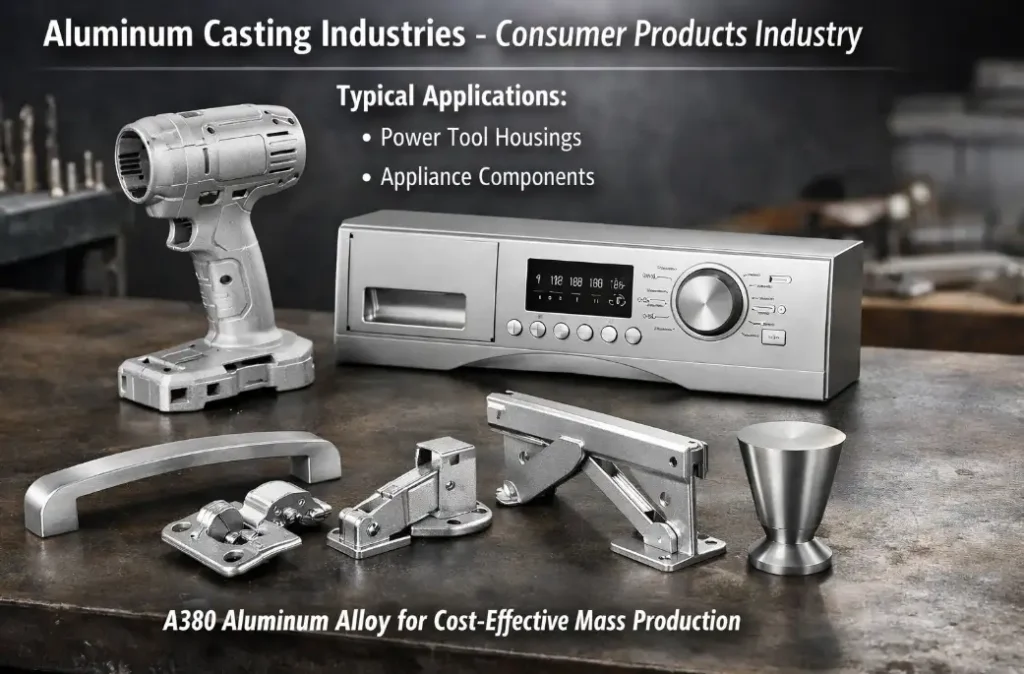
🛠️ 7. Consumer Products Industry
Consumer products require a balance between cost, design, and durability.
Typical Applications
- Power tool housings
- Appliance components
- Furniture fittings
Recommended Alloys
A380 is widely used for mass production due to cost efficiency.
Micro Case:
They needed lighter products without increasing cost.
We adopted A380 die casting with an optimized design.
- Weight reduced by 15–25%
- Production efficiency increased by 20%+
- Unit cost reduced by 10–15%
Results may vary depending on design, alloy selection, and production conditions.
How Aluminum Casting Applications Differ Across Industries
Aluminum casting applications vary by industry—in part design, alloy selection, performance requirements, and production volume.
The table below helps engineers and buyers quickly identify the right approach for their application.
| Industry | Typical Parts | Recommended Alloy | Key Benefit | When to Use Aluminum Casting |
|---|---|---|---|---|
| Automotive | Engine parts, EV housings | A380 / ADC12 | Lightweight | High-volume structural parts |
| Aerospace | Structural brackets | A356 | High strength | Weight-critical applications |
| Electronics | Heat sinks, enclosures | ADC12 | Thermal conductivity | Complex thin-wall designs |
| Machinery | Pumps, valves | A356 / A380 | Durability | Corrosion-resistant components |
| Construction | Frames, connectors | A356 | Corrosion resistance | Outdoor structures |
| Medical | Device housings | ADC12 | Precision | Tight tolerance parts |
| Consumer | Tool housings | A380 | Cost-effective | Mass production |
As shown above, aluminum casting industries prioritize different factors. Automotive and consumer products focus on cost and volume, while aerospace and medical products emphasize strength and precision.
Selecting the right solution requires balancing performance, cost, and manufacturability. That’s why many companies work with experienced aluminum casting suppliers early in the design stage.
How to Choose the Right Aluminum Casting Supplier for Your Industry
Across aluminum casting industries, supplier selection is one of the most critical decisions for ensuring project success. Choosing the right aluminum casting supplier can have a direct impact on product quality, cost, and lead time. While many suppliers offer similar services on the surface, the differences often become clear during production.
Here are a few key factors to consider:
1. Industry Experience
Not all suppliers understand every industry. For example, automotive and medical projects require very different levels of precision and quality control.
Working with a supplier experienced in your specific aluminum casting industry can reduce risks significantly.
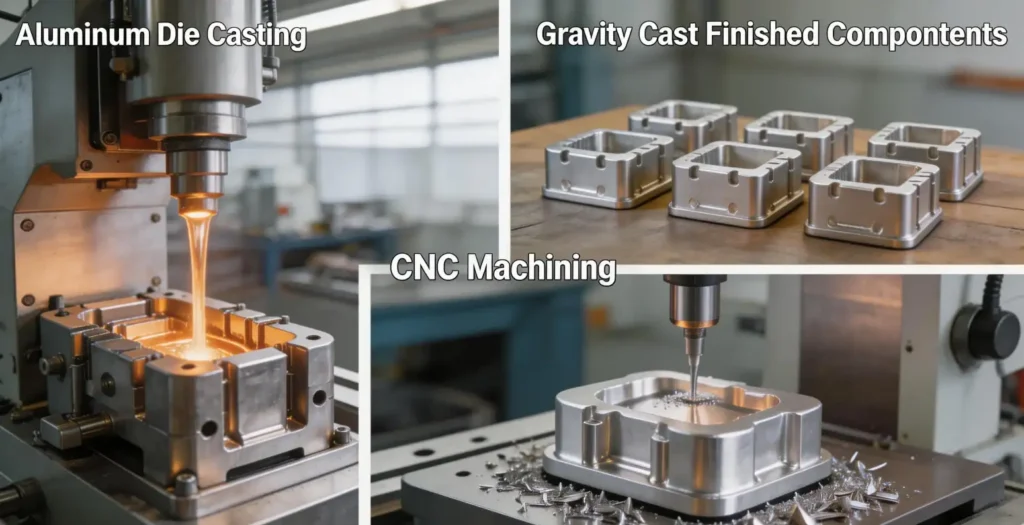
2. Manufacturing Capabilities
A reliable partner should offer multiple processes, including:
- Aluminum die casting
- Gravity casting
- CNC machining
This ensures flexibility when developing custom aluminum casting parts.
3. Quality Control System
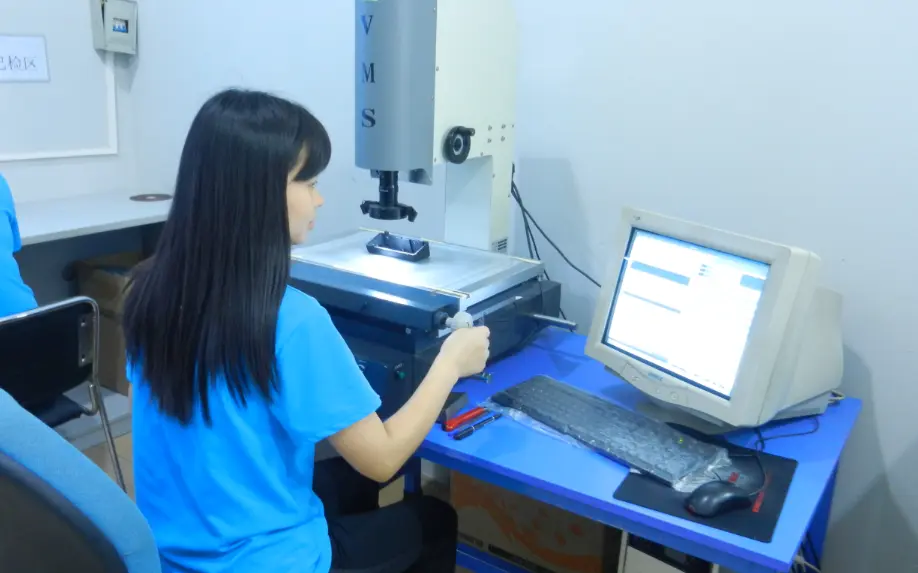
Look for suppliers with clear quality processes, such as:
- Dimensional inspection
- Material certification
- Process control
For high-end applications, this is often a non-negotiable requirement.
4. Customization and Engineering Support
A strong aluminum casting manufacturer should not only produce parts but also help optimize designs for manufacturability.
This is especially valuable for reducing cost and improving performance in early project stages.
5. Lead Time and Communication
Fast response and clear communication are often overlooked but critical in real projects. Delays in tooling or production can impact your entire supply chain.
If you’re sourcing OEM aluminum casting, choosing a responsive supplier can save both time and cost.
FAQs About Aluminum Casting Industries
What industries use aluminum casting the most?
The automotive and transportation industries use aluminum casting the most, accounting for over 50% of the market share, followed by industrial machinery and building/construction.
Why is aluminum preferred over steel in many industries?
Aluminum is preferred because it is 1/3 the weight of steel, naturally resists rust (corrosion), and conducts heat and electricity much better than steel.
Which casting process is best for high-precision parts?
Die casting is the best process for high-precision, high-volume parts. It can achieve tolerances as tight as ±0.1mm, whereas sand casting is generally ±0.5mm.
Is aluminum casting suitable for high-precision medical parts?
Yes. Aluminum casting is suitable for medical parts due to its ability to create complex, lightweight shapes that are easy to sanitize. Many suppliers offer CNC machining post-casting to achieve tolerances of ±0.01mm.
What is the global market size for aluminum casting?
The global aluminum casting market was valued at approximately $5.8 Billion in 2024 and is projected to reach $8.48 Billion by 2031, growing at a CAGR of 5.6%.
Conclusion
Aluminum casting plays a critical role across industries—from automotive and aerospace to electronics and consumer products. Its ability to combine lightweight properties, strength, and design flexibility makes it one of the most versatile manufacturing solutions available today.
As aluminum casting industries continue to evolve, the demand for high-quality, customized components is increasing. For businesses looking to stay competitive, choosing the right supplier is just as important as selecting the right material or process.
👉 If you’re developing a new project or optimizing existing parts, working with an experienced partner can help reduce cost, improve performance, and accelerate production. Discuss your requirements with a professional team to explore the best solution.