
The Secret to High-Precision, Low-Cost Aluminum Parts
When it comes to manufacturing precision components, aluminum turning has become the secret weapon for factories looking to balance quality and cost. For those working with die casting parts, integrating aluminum turning as a secondary process can significantly enhance surface finish and dimensional accuracy.
Many engineers face a dilemma: Die cast molding offers speed and shape complexity, but often lacks the micron-level precision required for high-end applications. On the other hand, full CNC machining from solid billets is expensive for mass production.
The “Sweet Spot” lies in a hybrid approach. By strategically using aluminum turning as a secondary process for your die casting parts, you can achieve aerospace-level tolerances while slashing overall production costs by 30% or more.
Minimizing Material Waste: From "Block Cutting" to "Near-Net Shape"
Traditional CNC machining starts with a solid aluminum billet, where you pay for material that ends up as scrap. However, the process of casting a die allows for “Near-Net Shape” production.
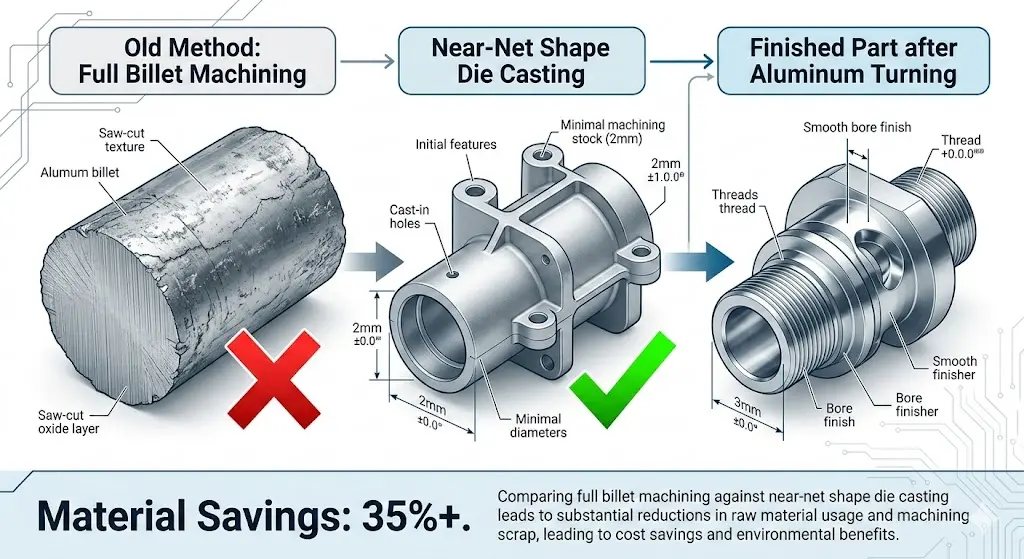
The Advantage: We design the die casting mold to produce a part that is already 95% close to the final dimensions.
Precision Turning: We then use aluminum turning to remove only the last 0.5mm of material on critical diameters.
The Saving: You aren’t paying for wasted metal. Reducing raw material consumption is the fastest way to lower the unit price of your die casting components.
Real-World Example: Automotive Oil Pump Housing
To illustrate the savings, consider a project for a Tier-1 automotive client. Originally, this oil pump housing was designed for full CNC machining. By switching to our “near-net shape die casting + precision turning” approach, the raw material weight required per part dropped from 1.2kg to just 0.7kg.
Result: The customer achieved a 34% reduction in per-unit material costs immediately.
Boosting Cycle Time: The Efficiency of Turning vs. Milling
For symmetrical aluminium die casting components, turning is the undisputed “speed king.”
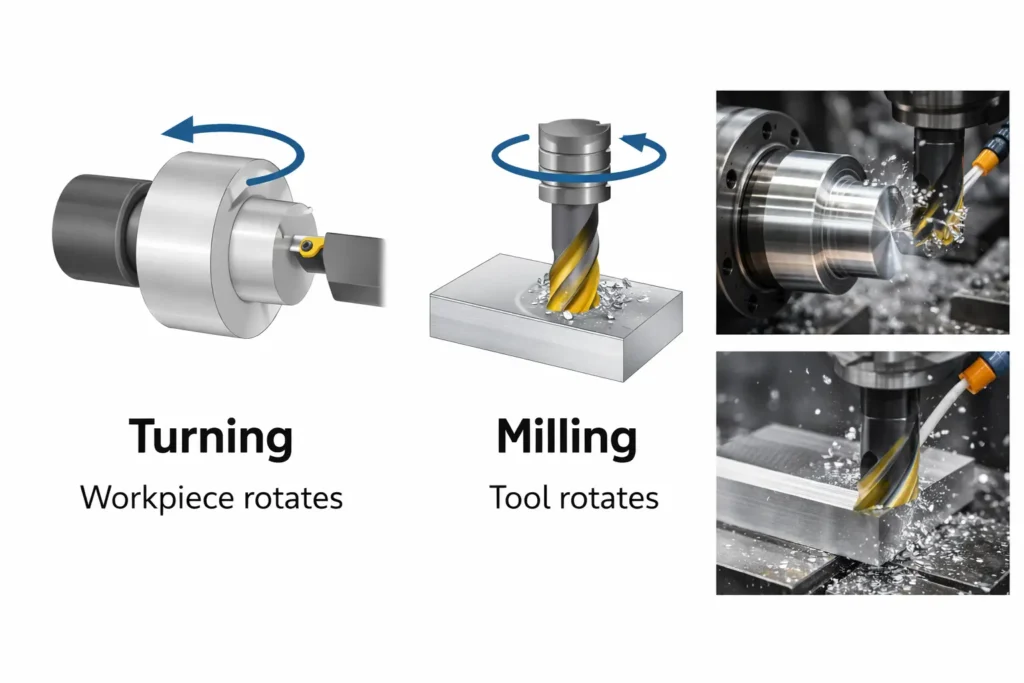
High-Speed Rotation: Turning rotates the workpiece against a stationary tool, allowing for much faster material removal than 5-axis milling.
The Saving: For parts like motor housings or pulleys, turning a pre-shaped blank is 40-60% faster. Shorter machine hours mean lower labor overheads passed on to you.
Extending Tool Life During the Aluminum Turning Process
Die-cast alloys like ADC12 contain silicon, which can be abrasive. However, a professional setup for aluminum turning is more tool-friendly than heavy milling.
Continuous Cutting: Unlike milling where the tool hits the metal repeatedly, turning offers a continuous cut, reducing thermal shock to the carbide inserts used on die cast molding finishing.
The Saving: Fewer tool changes and longer-lasting inserts reduce the “consumables” cost hidden in your manufacturing invoice.
Optimizing Surface Integrity via Precision Aluminum Turning
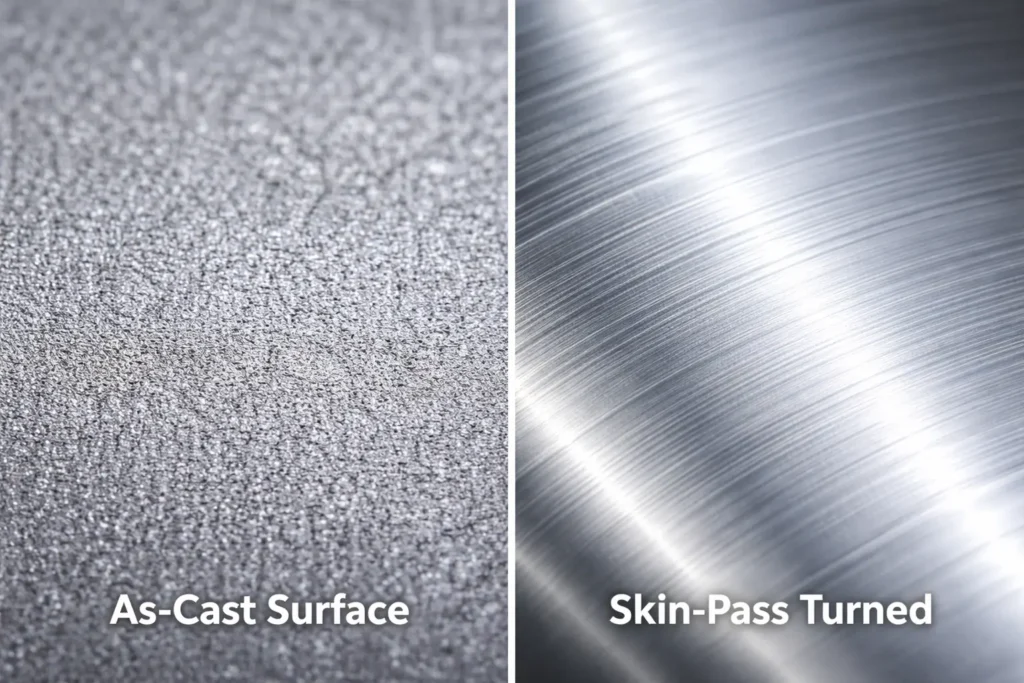
One common challenge in casting a die is internal porosity. If you CNC mill too deep into a casting, you risk exposing air bubbles.
Turning Strategy: Our precision turning allows for controlled, shallow “skin-pass” cuts. This maintains the dense, structural “chilled skin” of the die casting mold surface.
The Saving: A lower reject rate (scrap rate) means you only pay for perfect, high-performance die casting parts.
Supply Chain Integration: One Shop, One Responsibility
Shipping die casting components from a foundry to a separate CNC shop adds “invisible costs”: double packaging, freight, and the risk of “finger-pointing” between vendors.
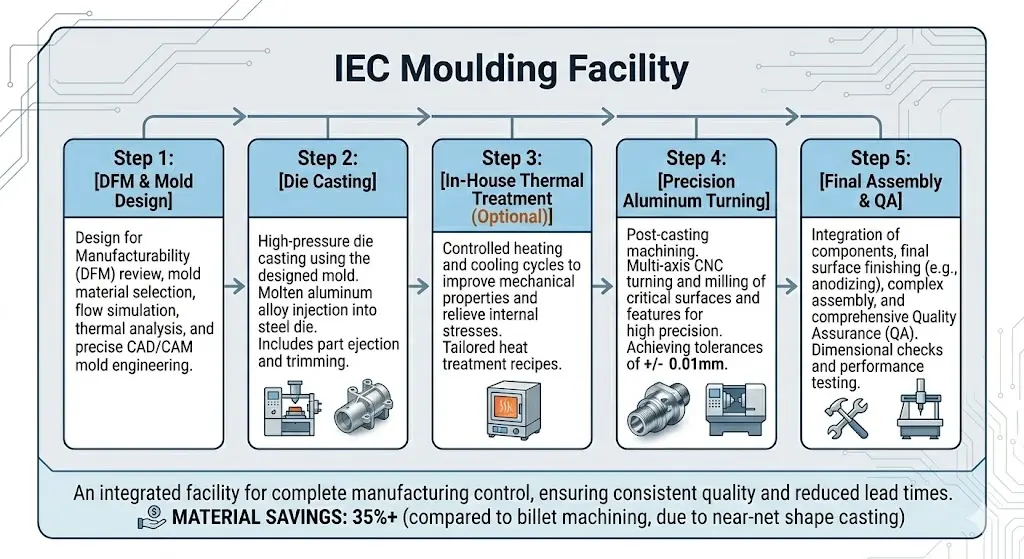
The In-House Advantage: When we perform aluminum turning in the same facility where we manage the die casting mold, we take 100% responsibility for the final fit.
The Saving: You eliminate secondary logistics costs (typically 5-10% of total spend) and streamline your quality control process for all aluminium die casting components.
Integrated Logistics Success: Industrial Motor End Bells
A European industrial motor manufacturer was sourcing die castings from Foundry A and shipping them to CNC Shop B. When they consolidated their production with IEC Moulding for integrated die casting and turning, they eliminated two internal transport legs and streamlined inspection.
Result: Total production lead time was cut by 10 days, and the overall project budget saw a total cost savings of 29.5%, while maintaining zero rejects for final dimensional fit.
Frequently Asked Questions about Aluminum Turning
Q1: Which aluminum alloys are best for turning after die casting?
A1: Alloys like ADC12, A380, and AlSi10Mg are excellent candidates for post-casting aluminum turning. These materials offer a good balance of fluidity during the casting a die process and excellent machinability during precision turning.
Q2: Can aluminum turning achieve tighter tolerances than die casting alone?
A2: Absolutely. While die cast molding typically achieves tolerances of ±0.1mm, our high-speed aluminum turning centers can reach ±0.01mm, making them ideal for bearing seats and sealing surfaces in aluminium die casting components.
Is Aluminum Turning Right for Your Project?
If your part has circular features, internal bores, or high-precision threads, combining the speed of die cast molding with the precision of aluminum turning is the most cost-effective way to scale.
At IEC Moulding, we master the entire lifecycle—from casting a die to the final precision turn—to ensure your project stays under budget without compromising quality.
Ready to see how much you can save?