When buyers search for custom castings, they are usually looking for more than just a definition. Some want to understand how custom metal castings work, others are comparing different casting processes, and many are trying to find a reliable casting manufacturer for OEM parts.
Custom castings are widely used to produce complex metal components with consistent quality and cost efficiency, especially in industries like automotive, machinery, and electronics. From aluminum die casting parts to precision investment castings, the right solution depends on design requirements, production volume, and material selection.
In this guide, we’ll walk through the custom casting process, common materials, typical applications, and how to choose the right supplier for your project.
What Are Custom Castings?
Custom castings are metal components produced using molds specifically designed based on customer drawings or technical requirements. Unlike standard off-the-shelf parts, they are engineered for OEM applications that require precise dimensions, complex geometries, and consistent quality.
Compared with CNC machining, which removes 70–90% of raw material, custom casting enables near-net-shape manufacturing—significantly reducing material waste and machining time.
👉 This makes custom castings the preferred solution for high-volume industries such as automotive, EV, and industrial equipment.
🔍 Key Features of Custom Castings
- 🧩 Design Flexibility – Easily create complex shapes that are difficult with machining.
- ⚙️ High Repeatability – Ideal for mass production with consistent quality.
- 💰 Cost Efficiency at Scale – Lower unit cost in high-volume production.
- 🪶 Material Versatility – Supports aluminum, zinc, magnesium, steel, and more.
💡 When Should You Choose Custom Castings?
Custom casting is typically the best option when:
- 📐 Your part has a complex structure or thin walls.
- 📦 You need medium to high production volumes.
- 🎯 You require consistent quality across batches.
- 🏭 You are developing OEM or private-label products.
Types of Custom Casting Processes
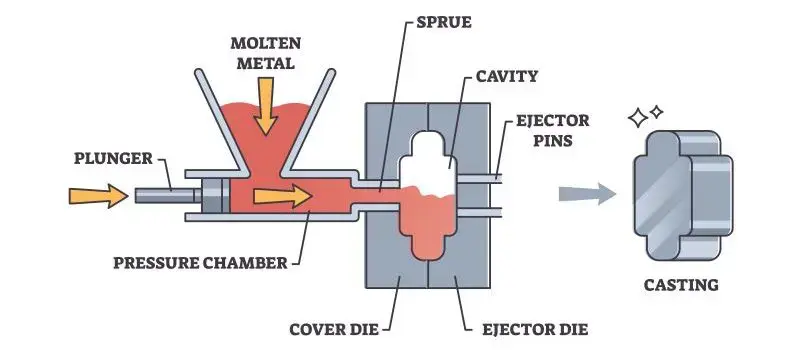
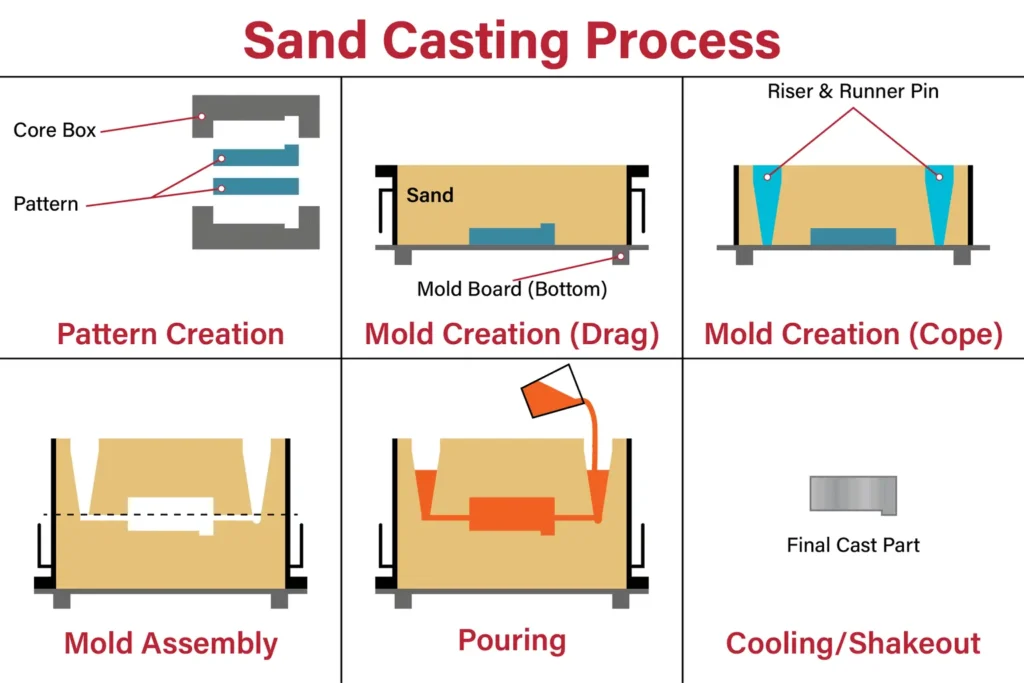
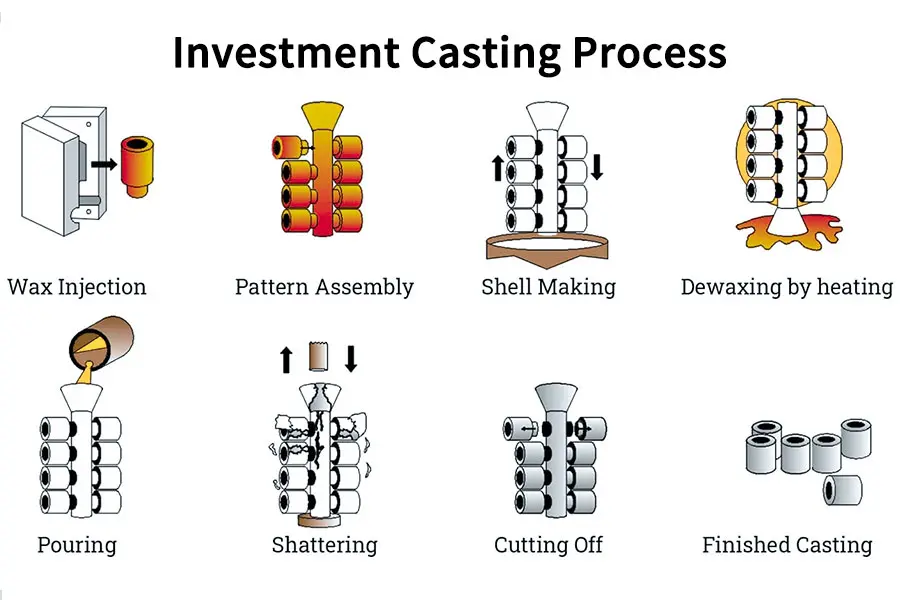
Different custom casting processes are used depending on part complexity, material requirements, production volume, and cost considerations. Choosing the right method is critical to achieving the desired balance between precision, efficiency, and budget.
🔩 Die Casting (Best for High-Volume Precision Parts)
Die casting is one of the most widely used methods for producing custom castings, especially for aluminum and zinc alloys. It involves injecting molten metal into a hardened steel mold under high pressure.
Key advantages:
- ⚙️ High dimensional accuracy and tight tolerances.
- 🔁 Excellent repeatability for mass production.
- ✨ Smooth surface finish, reducing post-processing.
- 🚀 Fast production cycles.
Limitations:
- 💰 High initial tooling cost – Steel molds require significant upfront investment, making it uneconomical for low-volume production (typically <1,000–2,000 pcs).
- 🫧 Porosity risk – Air entrapment during high-speed injection can cause internal voids. This limits weldability and may require vacuum impregnation for pressure-tight applications.
- 📏 Size constraints – Limited by machine tonnage; very large parts may exceed die casting machine capacity.
- 🔧 Heat treatment restrictions – Conventional high-pressure die castings cannot be fully solution heat-treated due to blistering from entrapped gas (though high-vacuum processes mitigate this).
Typical applications:
Automotive parts, electronic housings, motor components, consumer products.
👉 Best for: High-volume OEM parts with complex geometry and consistent quality requirements.
🏗️ Sand Casting (Best for Large & Low-Cost Parts)
Sand casting is a traditional and flexible casting method that uses sand molds to form metal parts. It is ideal for producing large components or low-volume custom castings.
Key advantages:
- 💰 Low tooling cost.
- 📏 Suitable for large and heavy parts.
- 🧩 Flexible design modifications.
Limitations:
- Lower precision compared to die casting.
- Rougher surface finish.
Typical applications:
Pump housings, engine blocks, and industrial machinery components.
👉 Best for: Large parts, prototypes, or projects with budget constraints.
🎯 Investment Casting (Best for Complex & High-Accuracy Parts)
Also known as lost-wax casting, investment casting is used to produce highly detailed and complex custom metal castings with excellent surface quality.
Key advantages:
- 🔍 Superior precision and fine details.
- 🧼 Smooth surface finish.
- 🧱 Suitable for complex geometries.
Limitations:
- Higher cost compared to sand casting.
- Longer production lead time.
Typical applications:
Medical components, aerospace parts, precision instruments.
👉 Best for: Intricate designs and high-performance components.
📊 Comparison of Custom Casting Processes
| Process | Precision | Cost | Volume Suitability | Surface Finish | Typical Materials |
|---|---|---|---|---|---|
| Die Casting | High | Medium (low at scale) | High volume | Smooth | Aluminum, Zinc |
| Sand Casting | Low–Medium | Low | Low–Medium | Rough | Iron, Steel |
| Investment Casting | Very High | High | Medium | Very smooth | Steel, Alloys |
💡 How to Choose the Right Casting Process?
Selecting the right process depends on your specific project requirements:
- 📦 High volume + tight tolerance → Die casting.
- 🏗️ Large size + low cost → Sand casting.
- 🎯 Complex design + high precision → Investment casting.
In many cases, experienced casting manufacturers will recommend the most suitable process based on your drawings, application, and budget.
Common Materials Used in Custom Castings
Material selection plays a critical role in the performance, durability, and cost of custom castings. Different metals offer unique mechanical properties, weight advantages, and surface characteristics, making them suitable for specific applications.
In custom metal casting projects, choosing the right material depends on factors such as strength requirements, corrosion resistance, weight, production volume, and budget.
📊 Material Properties for Custom Castings
| Material | Tensile Strength (MPa) | Elongation (%) | Weight | Key Advantage | Typical Use |
|---|---|---|---|---|---|
| Aluminum A380 | ~310 | 3–5% | Light | Balanced performance | General casting |
| Aluminum ADC12 | ~280 | 1–3% | Light | Excellent flowability | Thin-wall parts |
| Zinc Alloy | ~350 | 7–10% | Medium | High precision | Small parts |
| Magnesium | ~220 | 2–5% | Very Light | Lightweight + EMI shielding | Electronics |
| Steel/Iron | 400+ | 10–20% | Heavy | High strength | Structural parts |
📐 Material Selection Based on Wall Thickness
- Thin walls (<2mm) → ADC12
- Medium walls (2–5mm) → A380
- Thick sections (>5mm) → A356 or steel
👉 Incorrect material choice is a common cause of defects in custom castings.
🪶 Aluminum Alloys (Most Widely Used)
Aluminum is the most popular material for custom castings, especially in aluminum die casting applications. It offers an excellent balance between strength, weight, and cost.
Key benefits:
- 🪶 Lightweight with good strength-to-weight ratio.
- 🛡️ Strong corrosion resistance.
- ⚙️ Good machinability and thermal conductivity.
- 💰 Cost-effective for high-volume production.
Common grades and expert usage notes:
A380: General-purpose die casting. Note: Higher copper content may affect anodizing results.
ADC12: Widely used in Asia markets. Excellent for thin walls.
A356: Better mechanical properties. Preferred when welding or pressure tightness (leak-proof) is required.
👉 Typical uses: Automotive parts, motor housings, electronic enclosures.
⚡ Zinc Alloys (Excellent Surface Finish)
Zinc is another widely used material in custom castings, particularly for small, high-precision components.
Key benefits:
- ✨ Excellent surface finish and dimensional accuracy.
- 🔧 High strength and impact resistance.
- 🔁 Longer tool life in die casting (up to 1 million shots).
Limitations:
- Heavier than aluminum.
- Not suitable for high-temperature environments.
👉 Typical uses: Hardware fittings, connectors, decorative components.
🚀 Magnesium Alloys (Ultra-Lightweight Option)
Magnesium is one of the lightest structural metals used in custom metal castings. It is ideal for applications where weight reduction is critical.
Key benefits:
- 🪶 Extremely lightweight.
- ⚙️ Good strength-to-weight ratio.
- 📡 Excellent EMI shielding properties.
Limitations:
- Higher material cost.
- Requires specialized casting expertise (SF6 cover gas handling).
👉 Typical uses: Electronics housings, aerospace components.
🏗️ Steel & Iron (High Strength Applications)
Steel and iron are commonly used in sand casting and investment casting for applications that require high strength and durability.
Key benefits:
- 💪 Excellent mechanical strength.
- 🔥 High temperature resistance.
- 🧱 Suitable for heavy-duty applications.
Limitations:
- Heavier weight.
- More machining may be required.
👉 Typical uses: Industrial machinery, structural components, heavy equipment.
💡 How to Choose the Right Material?
Selecting the right material for custom castings depends on your application priorities:
- 🪶 Weight reduction → Aluminum or magnesium.
- 💰 Cost efficiency → Aluminum or iron.
- 🎯 High precision small parts → Zinc alloys.
- 💪 High strength & durability → Steel or iron.
In practice, aluminum alloys are often the preferred choice for OEM custom castings due to their versatility, availability, and overall cost-performance balance.
How the Custom Casting Process Works (Step-by-Step)
The custom casting process involves a series of well-controlled steps to transform a design concept into finished metal components. While different casting methods may vary slightly, the overall workflow for custom metal castings typically follows these stages:
1️⃣ Design & Engineering
The process begins with a 2D drawing or 3D CAD file provided by the customer. At this stage, the casting manufacturer reviews the design for manufacturability (DFM), ensuring the part can be produced efficiently using the selected casting process.
📌 Key focus: wall thickness, draft angles, tolerances, and material selection
2️⃣ Mold Tooling Production
Once the design is finalized, a custom mold (tooling) is created. The type of mold depends on the casting method:
- Die casting → hardened steel molds
- Sand casting → sand molds or patterns
- Investment casting → wax patterns and ceramic shells
High-quality tooling is critical for achieving consistent results in custom casting production.
3️⃣ Material Selection
Choosing the right material is essential for performance and cost control. Common options include:
- Aluminum alloys (lightweight and corrosion-resistant)
- Zinc alloys (excellent surface finish)
- Magnesium alloys (ultra-lightweight)
- Steel or iron (high strength applications)
The selection depends on the application, mechanical requirements, and production volume.
4️⃣ Casting Process Execution
Molten metal is injected or poured into the mold under controlled conditions. This is the core step where the actual custom casting takes shape.
- In aluminum die casting, molten metal is injected under high pressure
- In sand casting, metal is poured into a sand mold
- In investment casting, molten metal fills a ceramic shell
Each method offers different advantages in terms of precision, cost, and scalability.
5️⃣ Cooling, Ejection & Trimming
After solidification, the casting is removed from the mold. Excess material, such as gates, runners, and flash, is trimmed off to achieve the basic part shape.
This step ensures the custom cast component meets dimensional and structural requirements before further processing.
6️⃣ Secondary Machining & Surface Finishing
Depending on the application, additional processes may be required:
- CNC machining for tight tolerances
- Drilling and tapping
- Surface treatments (powder coating, anodizing, polishing)
These operations enhance both functionality and appearance.
7️⃣ Quality Inspection & Testing
Before delivery, all custom castings undergo strict quality control procedures, which may include:
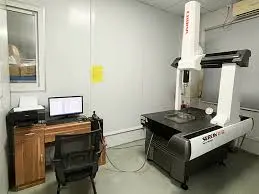
- Dimensional inspection (CMM)
- X-ray or pressure testing
- Surface and visual inspection
Reliable casting manufacturers implement full quality assurance systems to ensure consistency across production batches.
🔄 Summary of the Custom Casting Process
👉 In short, custom castings move through design → tooling → material selection → casting → finishing → inspection to ensure high-quality OEM parts that meet exact specifications.
Design & Tolerance Guidelines for Custom Castings
Achieving high-quality custom castings starts with proper design. Unlike CNC machining, where toolpaths control precision, casting performance is heavily influenced by geometry, material behavior, and mold design.
A well-optimized design not only reduces defects but also lowers tooling cost and improves production stability.
🧠 Key Design for Manufacturability (DFM) Principles
Following DFM best practices ensures consistent quality and minimizes production risks:
1. Maintain Uniform Wall Thickness
Sudden thickness changes (e.g., 5 mm → 1.5 mm) can cause shrinkage, porosity, and internal stress.
👉 Recommended: Keep wall thickness as consistent as possible.
2. Apply Proper Draft Angles
Draft angles allow easy part ejection and prevent mold damage.
- Aluminum die casting: ≥1.5°
- Deep cavities: ≥2–3°
👉 Insufficient draft increases tool wear and defect rates.
3. Use Fillets Instead of Sharp Corners
Sharp corners create stress concentration and poor metal flow.
👉 Recommended: Add fillets (R angles) to improve strength and fill behavior.
4. Optimize Parting Line Location
The parting line directly affects dimensional accuracy and surface quality.
👉 Best practice:
- Avoid critical features across parting lines
- Keep parting surfaces as simple as possible
5. Design for Metal Flow & Solidification
Proper flow reduces defects such as cold shuts and air entrapment.
👉 Consider:
- Gate location
- Flow path length
- Cooling uniformity
📏 Typical Tolerances (ISO 8062-3)
Dimensional tolerances in aluminum die casting are governed by ISO 8062-3, the international standard that defines tolerance grades for castings. Casting tolerances are influenced by thermal shrinkage, mold wear, and process variation—unlike machining, where tolerances are fixed by toolpath precision.
The values below represent general as-cast linear tolerances per ISO 8062-3 DCTG (Degree of Casting Tolerances Grade) guidelines for aluminum alloys:
| Dimension Range | Typical Tolerance |
|---|---|
| 0–25 mm | ±0.10 mm |
| 25–50 mm | ±0.15 mm |
| 50–100 mm | ±0.20 mm |
Secondary Operations & Surface Finishing
Even with near-net-shape casting, most OEM components require secondary operations to meet final dimensional, functional, and aesthetic requirements.
Choosing the right post-processing strategy is critical—not only for product performance, but also for overall cost control.
🔧 Why Secondary Operations Are Necessary
While custom castings provide excellent base geometry, additional processes are often required for:
- 🎯 Tight tolerances beyond casting capability
- 🛡️ Corrosion and wear resistance
- ✨ Surface appearance and texture consistency
- 🔒 Sealing performance (leak-proof parts)
👉 In practice, nearly all high-quality OEM castings involve some level of post-processing.
⚙️ Common Secondary Operations
| Process | Function | When to Use |
|---|---|---|
| CNC Machining | Achieve tight tolerances (±0.02 mm) | Critical dimensions, threads |
| Drilling & Tapping | Create holes and threads | Assembly features |
| Shot Blasting | Clean surface, remove oxide | Pre-treatment |
| Vibratory Deburring | Smooth edges | Small or complex parts |
| Vacuum Impregnation | Seal micro-porosity | Pressure-tight parts |
🎨 Surface Finishing Options
| Process | Key Benefit | Typical Applications |
|---|---|---|
| Anodizing | Corrosion resistance + hardness | Aluminum parts |
| Powder Coating | Durable + aesthetic finish | Automotive, consumer products |
| Polishing | Improved appearance | Decorative components |
| Painting | Cost-effective protection | General industrial use |
🎯 How to Choose the Right Finishing Strategy
Selecting the right combination depends on your product requirements:
- High precision required → CNC machining + inspection
- Outdoor/harsh environment → Anodizing or powder coating
- Leak-proof components → Vacuum impregnation
- Consumer-facing products → Polishing + coating
👉 The optimal solution often involves multiple processes combined.
💡 Cost Optimization Tip (Very Important)
One of the most effective ways to reduce total cost is:
👉 Design parts with post-processing in mind from the beginning
For example:
- Add machining allowance (0.3–0.5 mm) instead of forcing tight as-cast tolerances
- Avoid unnecessary cosmetic requirements on non-visible surfaces
- Standardize surface finishing across parts
✅ This approach can reduce total manufacturing cost by 10–25%
🚀 One-Stop Manufacturing Advantage
Working with a supplier that offers in-house casting + machining + finishing provides:
- Better dimensional consistency
- Shorter lead times
- Lower logistics cost
- Simplified quality control
👉 Need help selecting the right finishing process?
Send us your drawings and application requirements—we’ll recommend the most cost-effective manufacturing solution.
Key Applications of Custom Castings
Custom castings are widely used across a range of industries where complex shapes, structural strength, and cost efficiency are required.
🚗 Automotive Applications
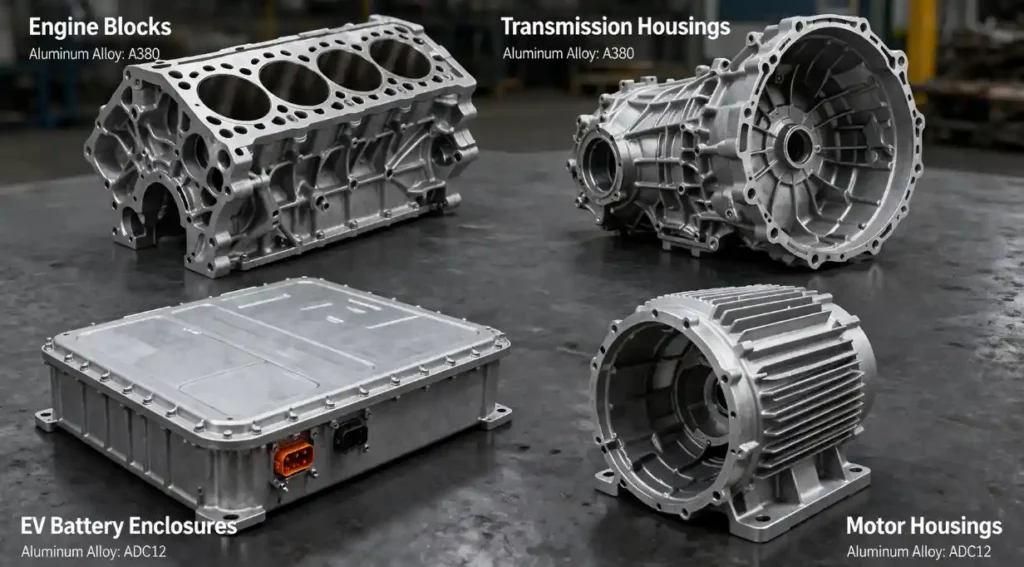
- Engine brackets: Transitioning from forged steel to aluminum castings for up to 30% weight reduction.
- EV motor housings: Requiring high thermal conductivity and dimensional stability.
👉 Casting enables integration of multiple components into a single structure.
🏭 Industrial Machinery
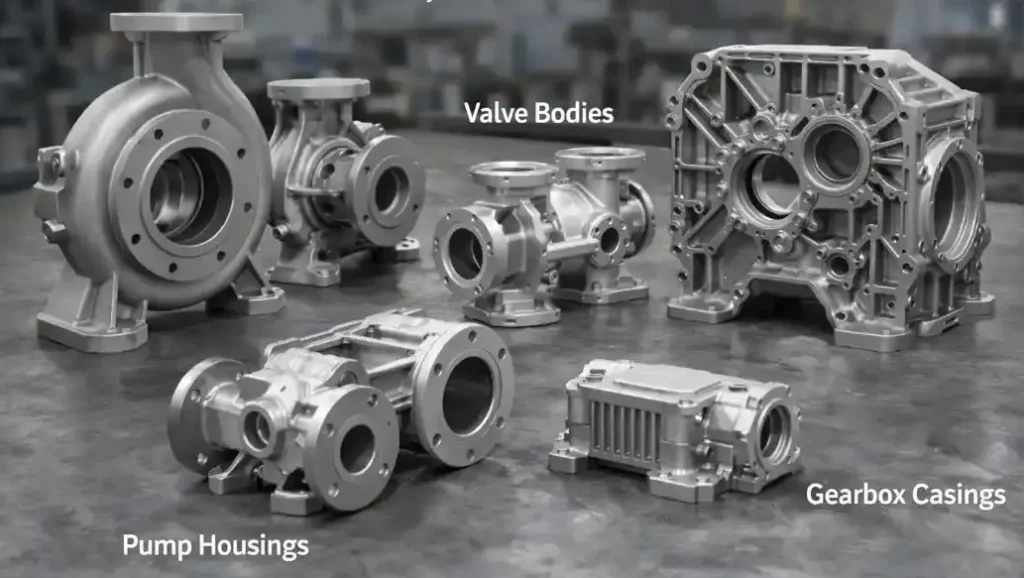
Custom castings are widely used in heavy-duty and precision machinery.
- Typical parts: Pump housings, valve bodies, gearbox components.
- Why casting? Provides strength for high-load operations while reducing machining time.
⚡ Electronics & Enclosures
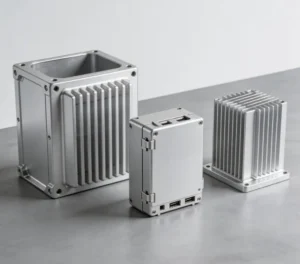
With the rapid growth of electronics and EV systems, demand for precision cast housings continues to increase.
- Typical parts: Aluminum enclosures, heat sinks, and 5G base station housings.
- Why casting? Aluminum die casting offers excellent thermal conductivity and inherent EMI shielding.
🏥 Medical Equipment
Medical applications require precision, cleanliness, and reliability.
- Typical parts: Imaging equipment components, surgical instrument parts.
- Why casting? Investment casting ensures tight tolerances and high-quality surface finishes.
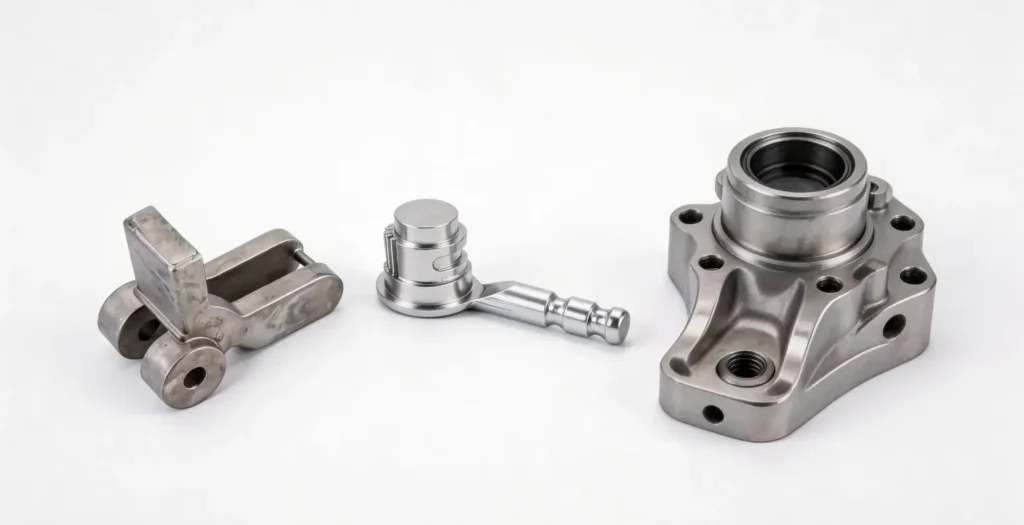
How to Choose the Right Custom Casting Supplier
Choosing the right supplier is just as important as selecting the right casting process. A reliable custom casting manufacturer can help you optimize design, reduce costs, and ensure consistent product quality across production runs.
🔍 5 Key Factors to Evaluate a Casting Supplier
When sourcing custom castings, it’s important to look beyond price. The following factors should be carefully evaluated:
🧠 Engineering & DFM Capability
Can they provide a Mold Flow Analysis report before cutting steel to predict porosity?
Do they suggest improvements to reduce defects or cost (e.g., wall thickness optimization)?
🏭 Tooling & Manufacturing Capability
Do they design and produce molds in-house?
What grade of die steel (H13 vs. 8407) do they use, and what is their heat treatment protocol?
🧪 Material Expertise
Are they familiar with the nuances of A380 vs. ADC12 vs. A356 for specific applications?
Do they use OES spectrometers to verify alloy chemistry?
📏 Quality Control System
Do they have certifications such as ISO 9001 or IATF 16949?
Can they provide a CpK study for Critical-to-Quality dimensions?
⏱️ Lead Time & Production Capacity
- Can they handle your required production volume?
- Are they flexible with scaling orders from prototype to mass production?
🚩 Supplier Red Flags to Watch
- ❌ No vacuum impregnation capability → risk of leakage defects.
- ❌ Limited machine tonnage → restricts part size.
- ❌ No DFM feedback → indicates low engineering capability.
✅ Quick Supplier Checklist
If you want a quick evaluation, use this checklist:
- ✔ Engineering support (DFM with porosity prediction).
- ✔ In-house tooling and stable production.
- ✔ Material expertise across multiple alloys.
- ✔ Certified quality management system.
- ✔ CpK ≥ 1.33 capability on tight tolerances.
- ✔ Reliable lead time and capacity.
- ✔ Proven OEM project experience.
💡 Expert Tip from IEC MOULD
A qualified casting supplier doesn’t just manufacture parts—they help you optimize design, reduce defects, and control total cost across the entire product lifecycle.
👉 Need help evaluating your current supplier or project?
Send us your drawings for a free technical review and cost analysis.
Custom Castings vs Other Manufacturing Processes
📊 Process Comparison
| Process | Precision | Cost | Volume | Lead Time | Best For |
|---|---|---|---|---|---|
| Custom Castings | High | Medium (low at scale) | High | 4–8 weeks tooling | Complex parts |
| CNC Machining | Very High | High | Low | 1–2 weeks | Precision parts |
| Forging | Medium | Medium–High | High | Medium | Strength parts |
| Fabrication | Medium | Medium | Low | Fast | Large structures |
While the table above provides a quick reference, the decision between casting, machining, forging, and fabrication is rarely black and white. Each process carries hidden cost drivers that only become apparent during production ramp-up.
Below we break down each comparison with the engineering context that OEM buyers and design engineers need to consider.
🔧 Custom Castings vs CNC Machining
This is the most common crossroad for OEM component sourcing.
| Factor | Custom Castings | CNC Machining |
|---|---|---|
| Material Utilization | >90% (near-net-shape) | <30% (subtractive waste) |
| Complex Internal Geometry | Excellent (cores/slides) | Limited by tool access |
| Surface Finish (As-Processed) | 32–63 Ra typical | 16–32 Ra achievable |
| Scalability | High (marginal cost decreases) | Low (linear cost scaling) |
| Initial Investment | Tooling ($10k–$50k+) | Minimal fixturing |
⚒️ Custom Castings vs Forging
Forging is often specified for high-strength structural applications, but it imposes significant geometry constraints.
| Factor | Custom Castings | Forging |
|---|---|---|
| Mechanical Strength | Good (directional control via gating) | Excellent (grain flow alignment) |
| Design Complexity | High (complex internal cavities) | Low (primarily 2D profile shapes) |
| Dimensional Tolerance | Tight (±0.10mm as-cast) | Loose (requires heavy machining) |
| Material Range | Aluminum, Zinc, Mg, Iron | Primarily Steel, Aluminum |
🛠️ Custom Castings vs Fabrication (Welding/Assembly)
Fabrication involves cutting, bending, and welding individual stock pieces together.
| Factor | Custom Castings | Fabrication |
|---|---|---|
| Part Consolidation | High (one-piece complex structure) | Low (multiple components assembled) |
| Labor Intensity | Low (automated casting cell) | High (skilled welders/fitters) |
| Repeatability | Excellent (same mold every shot) | Variable (weld distortion, fit-up gaps) |
| Production Volume | Medium to High | Low to Medium |
💡 Cost Break-Even Insight
- <500 units → CNC machining
- 500–5,000 units → depends
- 5,000 units → casting is most cost-effective
How to Make the Right Choice
As a die casting specialist, I advise clients to ask three questions before finalizing a manufacturing process:
Is the design frozen?
Yes → Casting. No → CNC or fabrication for iteration.Can this part be one piece instead of an assembly?
Yes → Casting usually wins by eliminating fasteners and assembly labor.What is the true 3-year volume forecast?
Aggressive ramp-up → Invest in casting tooling early. Steady low volume → Stay with CNC.
👉 Still unsure? A professional DFM review can provide a costed BOM comparison between casting and alternative processes before you commit to tooling.
FAQs About Custom Castings
What are custom castings?
Custom castings are metal components produced using molds designed specifically from customer drawings or specifications. They are widely used in OEM manufacturing to create complex shapes with consistent quality, especially in medium to high-volume production.
What is the custom casting process?
The custom casting process typically includes design review, mold tooling production, material selection, casting, finishing, and quality inspection. Each step ensures that the final metal part meets required specifications, performance standards, and production consistency.
Casting vs machining: which is better?
Custom casting is more cost-effective for complex shapes and high-volume production, while CNC machining offers higher precision for low-volume or highly detailed parts. The best choice depends on part complexity, tolerance requirements, and production quantity.
What is the best material for custom castings?
Aluminum is the most commonly used material due to its lightweight, corrosion resistance, and cost efficiency. Other materials such as zinc, magnesium, and steel are selected based on strength requirements, application environment, and design needs.
How much do custom castings cost?
The cost of custom castings depends on material type, part complexity, tooling requirements, and production volume. While initial mold costs may be higher, the unit cost becomes significantly lower in large production runs.
Is die casting good for low volume?
Die casting is generally more suitable for medium to high-volume production due to tooling costs. For low-volume projects, CNC machining or sand casting may be more economical, depending on the part design and budget.
What is the difference between die casting and sand casting?
Die casting uses high-pressure metal injection into steel molds, offering high precision and smooth surfaces. Sand casting uses sand molds and is better suited for larger parts and lower production volumes, but with lower accuracy and rougher finishes.
Get Custom Casting Solutions for Your OEM Projects
If you are sourcing custom castings for an OEM project, having the right technical support from the beginning makes a significant difference in both cost and product performance.
🤝 What You Can Expect from a Professional Casting Partner
📐 DFM Analysis: We review your 3D file for parting line shift, draft optimization, and porosity hotspots.
⚙️ Process Recommendation: We don’t just provide die casting; we recommend the right process for your volume.
🏭 Quality Assurance: Full CMM reports and material certifications with every shipment.
Ready to turn this guide into actual parts?
If you have drawings, samples, or even just an initial idea, you can start by discussing your requirements. Typical information to prepare:
2D drawings or 3D CAD files (STEP/IGS).
Material or performance requirements.
Estimated order quantity.
With this information, a professional team can quickly evaluate your project and provide practical recommendations.