Skip to content
Die Casting vs CNC for Drone Parts: How to Choose
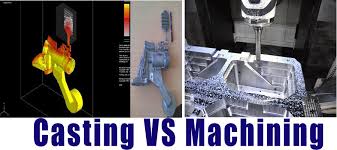
When working on drone parts, one question comes up almost every time: Should this part be die cast, or machined from solid?
There’s no one-size-fits-all answer. It really depends on your project stage, part complexity, and how many units you plan to produce. From our experience at IEC MOULD, die casting and CNC machining are usually used at different stages rather than being direct replacements.
Quick Comparison (Fast Engineering Reference)
For engineers and procurement teams who need a fast check, the table below gives a clear snapshot:
| Factor | Die Casting | CNC Machining |
|---|---|---|
| Production Volume | High (1,000+ units) | Low (<50 units) |
| Tooling Cost | High upfront investment | None |
| Unit Cost | Low at scale | High |
| Part Complexity | Excellent (thin walls, ribs, integrated features) | Limited by machining access; may need multiple setups |
| Tolerance | Good (±0.05mm typical) | Very high (±0.01mm possible) |
| Flexibility | Low after tooling | Very high; easy to modify |
💡 Tip: This table is a quick reference. The real decision comes down to how these factors interact in your project.
Key Factors Explained
📊1. Production Volume
Volume often determines which process is more economical.
- Small batches (<50 pcs) → CNC machining is usually easier and cheaper. No tooling needed, quick turnaround, and easy to adjust design.
- Medium to large batches (1,000+ pcs) → Die casting becomes cost-effective. The upfront mold cost pays off as the unit price drops and production stabilizes.
🧩2. Part Complexity
Drone parts rarely stay simple. You often deal with:
- Thin walls
- Ribs for strength
- Mounting features
- Weight-saving pockets
With CNC machining, these features can be made, but it usually requires multiple setups or even splitting the part into several pieces.
With die casting, many of these features can be formed in a single shot, which reduces assembly and improves alignment.
🔄3. Design Stability
How stable your design is can make a huge difference.
- If the design is still evolving → CNC is safer. Quick changes are possible without impacting tooling.
- If the design is finalized → Die casting is more efficient and predictable. Making tooling too early before the design stabilizes is one of the biggest causes of extra cost and delays in drone projects.
💰4. Cost Structure
Cost is not just the unit price:
- CNC machining: No upfront tooling cost, but each part takes more time to produce; cost scales linearly with quantity.
- Die casting: Higher initial investment for tooling, but unit cost drops quickly at scale; great for larger volumes.
Practical Insight from IEC MOULD
In many projects we’ve worked on:
- Customers start with CNC prototypes. The parts work, but costs or assembly complexity are higher than expected.
- We analyze whether parts can be combined, wall thickness optimized, and designs adjusted for die casting.
Even small changes at this stage can save weeks of rework and significantly reduce cost.
A short engineering discussion early on can make a huge difference.
To better understand the structure and applications of drone components, you can explore our detailed guide on drone die casting parts.
When NOT to Use Die Casting
Even though die casting is excellent for drone parts, there are situations where it’s not the best choice. From our experience at IEC MOULD, knowing these limits early can save a lot of time, cost, and frustration.
1. Very Low Production Volume
- If you only need a handful of parts (e.g., prototypes or small test batches), die casting often doesn’t make sense.
- The tooling cost is too high compared to the number of units.
- CNC or 3D printing is usually faster, cheaper, and more flexible at this stage.
💡 Tip: For first prototypes, focus on speed and flexibility rather than per-unit cost.
2. Designs Still in Development
- Die casting works best when the design is stable.
- If you’re still testing, tweaking, or iterating, making a mold too early can cause extra cost and wasted tooling.
- Every design change after tooling means extra machining, modifications, or even a new mold.
🛠️ Practical Note: Many of our customers come to us after early CNC prototypes because the initial design wasn’t ready for tooling. Adjustments at that stage are much easier and cheaper.
3. Extremely Tight Tolerances
- Die casting is precise, but not as precise as CNC machining.
- For features that require ultra-high accuracy (±0.01mm or better), CNC or post-machining is usually necessary.
- Trying to achieve these tolerances directly with die casting can lead to defects or rejected parts
📏 Rule of Thumb: Die casting is great for ±0.05mm tolerances, but tighter than that? Plan for CNC finishing.
4. Very Small or Thin Features
- Features that are too small, thin, or intricate may not fill properly in the die casting process.
- Parts like extremely fine mounting tabs, micro-holes, or extremely thin ribs can cause warping, misruns, or porosity issues.
- CNC or additive manufacturing might handle these features better.
🔬 Engineering Insight: Always review the design with your die casting engineer early. Small adjustments in wall thickness or fillets can make a part castable and save a lot of post-processing.
5. Short Project Timelines
- If you need parts within a few weeks, die casting may not be feasible because:
- Mold design & manufacturing takes time
- Trial shots and mold tuning are required
- CNC or 3D printing can produce parts much faster for immediate testing.
⏱️ Tip: Use die casting for mass production or long-term runs, not last-minute prototyping.
Summary
Die casting is powerful, but it has limits:
- Best for stable designs, medium-to-high volumes, and parts that fit its capabilities
- Avoid if your project is low volume, rapidly changing, or requires extreme precision
At IEC MOULD, we always guide customers early: sometimes CNC is the right first step, and we plan die casting once the design is fully validated. This approach saves cost, time, and frustration down the line.
How to Optimize Drone Parts for Die Casting
Once your project reaches the stage where die casting makes sense, the next step is design optimization. From years of experience at IEC MOULD, small adjustments in design can save time, cost, and production headaches.
1. Wall Thickness Matters
- Keep walls uniform where possible. Sudden changes in thickness can lead to porosity or warping.
- For very thin walls, consider ribbing for strength, instead of making the wall thicker.
- For thicker sections, add holes or hollow areas to reduce weight and minimize shrinkage.
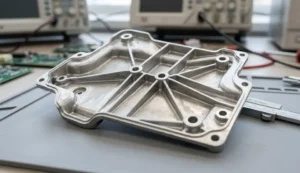
💡 Tip: Consistent wall thickness improves material flow in the mold and reduces post-processing.
2. Integrate Features When Possible
- Die casting allows you to combine multiple functions into a single part.
- Examples: mounting points, ribs, brackets, or alignment features.
- This reduces the number of separate parts, cuts assembly time, and improves overall reliability.
🛠️ Practical Note: At IEC MOULD, we often take parts that were originally designed as multiple CNC pieces and redesign them into single die-cast components, saving our clients both cost and assembly complexity.
3. Fillets and Radii Are Your Friends
- Sharp corners are hard to fill in die casting and can cause stress concentration or cracks.
- Use fillets at all junctions and transitions. Even small radii (0.5–1mm) can make a huge difference in castability.
- This also improves part strength and reduces the chance of defects.
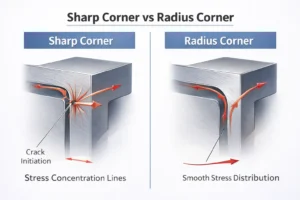
🔧 Engineering Insight: Parts with smooth transitions are easier to cast consistently, reducing trial shots and rework.
4. Draft Angles for Easy Ejection
- Always design draft angles (slight tapers) on walls that contact the mold.
- Without proper draft, the part may stick in the mold, causing damage or extra finishing work.
- Typical draft angles: 1–3°, depending on part height and surface finish.
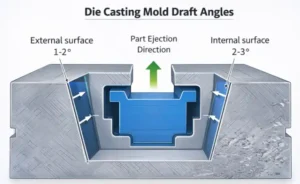
📐 Tip: Adding a draft early saves time and money during mold testing.
5. Minimize Small, Fragile Features
- Tiny tabs, holes, or very thin ribs can break during ejection or require CNC finishing.
- Combine or slightly enlarge small features to ensure structural integrity.
- Die casting is excellent for complex geometry, but micro-details still have limits.
🔬 Engineering Insight: Review these features with your die casting engineer to ensure they are manufacturable and won’t add hidden costs.
6. Material Choice and Heat Treatment
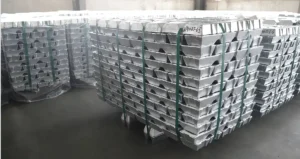
- Aluminum alloys commonly used for drones: ADC12, A380, or similar.
- Depending on strength, weight, and corrosion requirements, you may need T5/T6 heat treatment after casting.
- Proper alloy selection and post-processing help reduce warping, improve strength, and increase durability.
Optimizing drone parts for die casting is about designing with the process in mind, not just copying CNC designs. Key takeaways:
- Keep wall thickness uniform
- Integrate features to reduce assembly
- Add fillets and draft angles
- Avoid fragile micro-details
- Choose the right alloy and post-processing
Following these guidelines early in the project ensures faster mold trials, lower defect rates, and cost-effective production.
Common defects in die casting can significantly impact drone performance. Learn more about typical issues in drone die casting parts.
Real Cost Comparison: Die Casting vs CNC for Drone Parts
When it comes to choosing between die casting and CNC machining, cost is usually the deciding factor—but it’s also where many misunderstandings happen.
A lot of people compare only the price per part, but in reality, the cost structure is completely different.
The Real Difference in Cost Structure
Here’s how the two processes typically compare:
| Cost Element | Die Casting | CNC Machining |
|---|---|---|
| Tooling Cost | High upfront (mold required) | None |
| Unit Cost | Low at scale | High |
| Setup Cost | One-time | Repeated for each batch |
| Scalability | Excellent | Limited by machining time |
💡 Tip: CNC looks cheaper at the beginning, but die casting becomes much more economical as volume increases.
How Volume Changes Everything
In most drone projects, the break-even point depends on part complexity, but a general rule looks like this:
- 1–100 pcs → CNC is usually cheaper and faster
- 500–1,000 pcs → Costs start getting close
- 5,000+ pcs → Die casting clearly becomes the better option
At higher volumes, the mold cost is spread across more parts, and the unit price drops significantly.
A Simple Way to Think About It
Instead of asking “Which is cheaper?”, it’s better to ask:
- How many parts will we need over the product lifecycle?
- Can we reduce assembly by combining parts?
- Will this design stay stable long enough to justify tooling?
Because in many cases, the biggest savings don’t come from machining cost—they come from:
- Fewer components
- Less assembly work
- Better consistency in production
Hidden Costs People Often Miss
From what we’ve seen at IEC MOULD, there are a few cost factors that are easy to overlook:
1.Assembly Cost
CNC parts are often made separately and assembled later.
Die casting can combine multiple features into one part, reducing labor and alignment issues.
2. Machining Time
Even if CNC looks simple, complex drone parts can require:
- Multiple setups
- Long machining cycles
This adds up quickly as volume increases.
3. Rework and Consistency
- CNC parts vary depending on setup and operator
- Die casting, once stable, delivers high repeatability
This reduces scrap rate and quality issues in production.
4. Design Inefficiencies
Sometimes a part is kept as CNC simply because that’s how it started.
But with a few design changes, it could be converted to die casting and reduce cost significantly.
💡 Practical Insight from IEC MOULD
In quite a few projects we’ve worked on, customers initially chose CNC because it was simpler to start with. That works well in early stages. But once volume increases, the cost difference becomes hard to ignore. We often help customers:
- Review existing CNC parts
- Identify opportunities for part integration
- Adjust designs for die casting
In many cases, the final result is not just a cheaper part, but a simpler and more robust product overall.
- CNC is ideal for low volume and flexibility
- Die casting is ideal for high volume and cost efficiency
- The real decision depends on total cost over time, not just unit price
👉 If your project is moving toward larger production, it’s worth evaluating die casting early—before costs lock in.
👉 If you are evaluating suppliers, you may also find our guide on drone die casting supplier helpful for deeper insights.
Top 10 Drone Aluminum Parts: Process & Cost Analysis
Instead of just listing parts, it’s more useful to look at how each part is actually made in real projects, and whether die casting really makes sense.
In many cases, the answer is not simply “yes” or “no”—it depends on volume, design, and function.
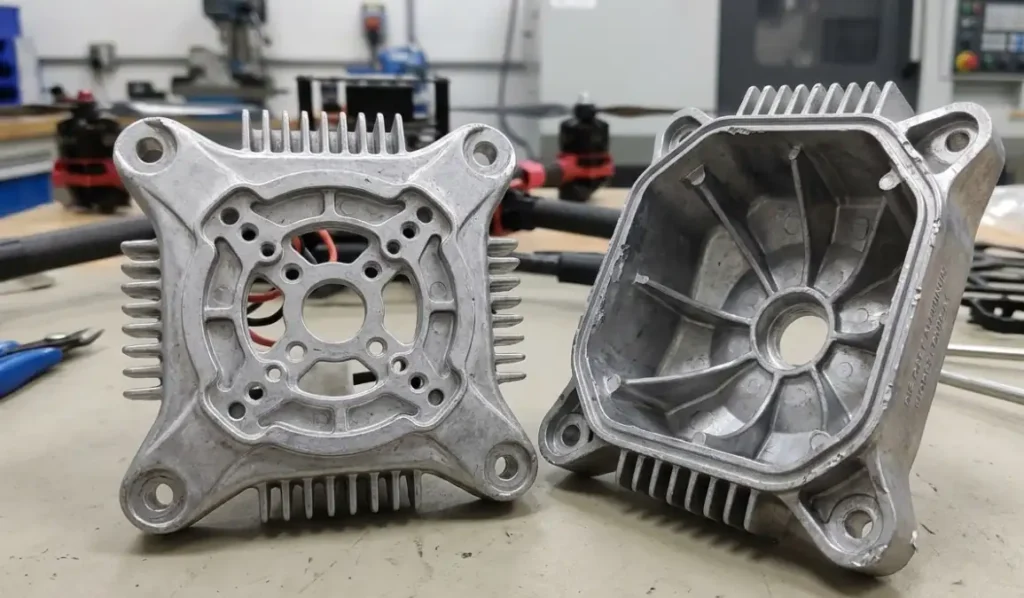
1. Drone Motor Mount Housing
This is one of the most common structural parts in drones.
Typical choice:
Low volume → CNC
High volume → Die casting
Why die casting works:
Complex geometry (mounting holes, ribs)
Needs good strength-to-weight ratio
What we often see:
CNC versions require multiple setups. With die casting, these features can be formed in one shot.
2. Drone Arm / Frame
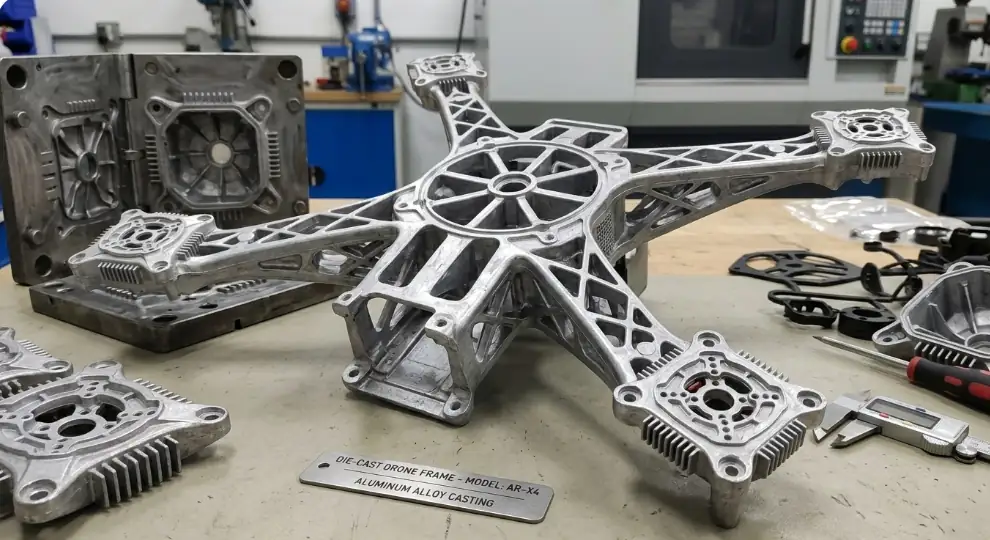
Drone arms need to balance strength and weight.
Typical choice:
Prototyping → CNC
Mass production → Die casting (sometimes extrusion + machining)
Key consideration:
Long, thin structures can deform if not designed properly
Practical note:
Some designs are better suited for extrusion instead of die casting—this is often overlooked.
3. Drone Camera Gimbal Housing
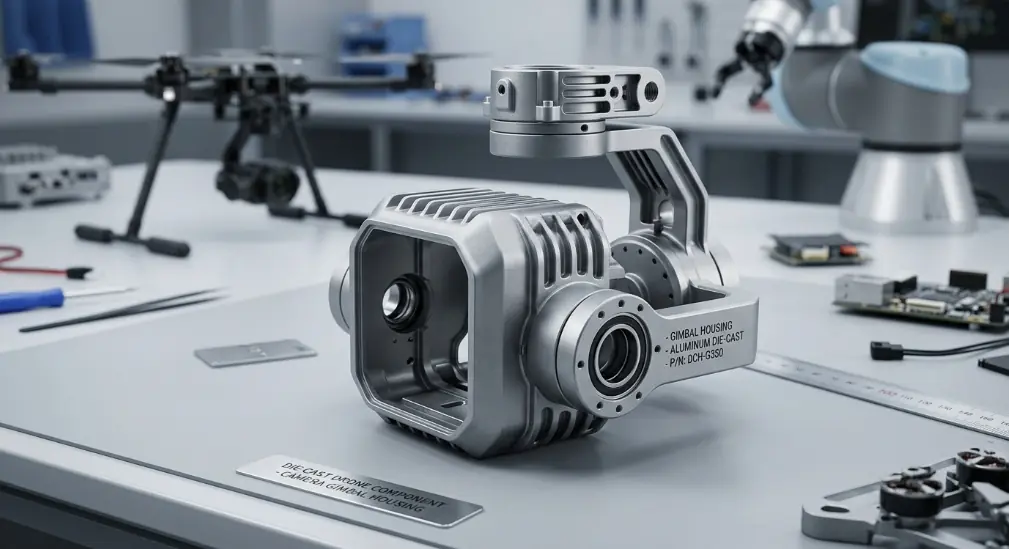
This part usually has complex internal geometry and aesthetic requirements
Typical choice:
Small batches → CNC
Larger runs → Die casting
Why die casting helps:
Smooth surface finish
Good for integrating multiple mounting features
4. Drone Battery Enclosure
Battery housings need to be light, strong, and sometimes heat-resistant.
Typical choice:
Both CNC and die casting are used
Die casting advantage:
Can integrate structural ribs and mounting points
Reduces assembly parts
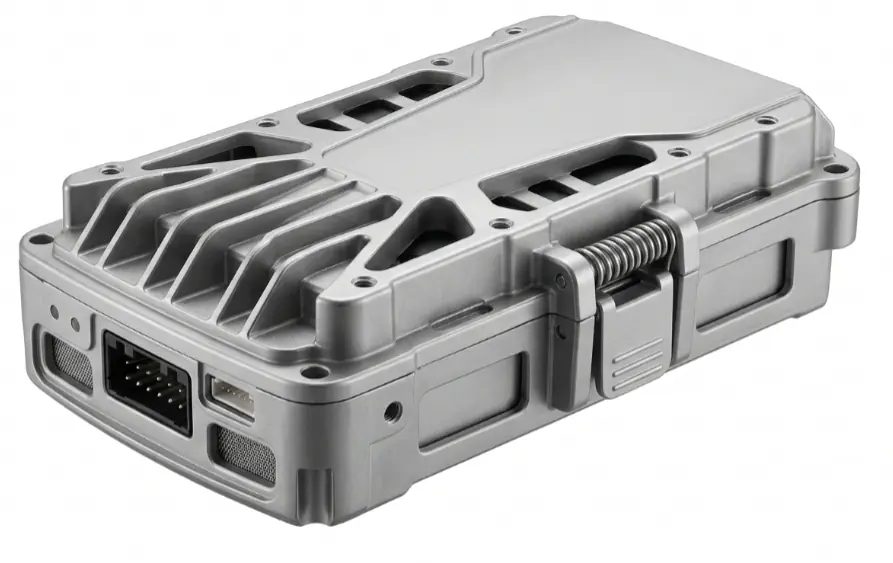
5. Drone Flight Controller Housing
This part protects sensitive electronics.
Typical choice:
Often die cast for production
Key factors:
EMI shielding
Dimensional stability
Engineering note:
Consistency matters more than ultra-high precision here.
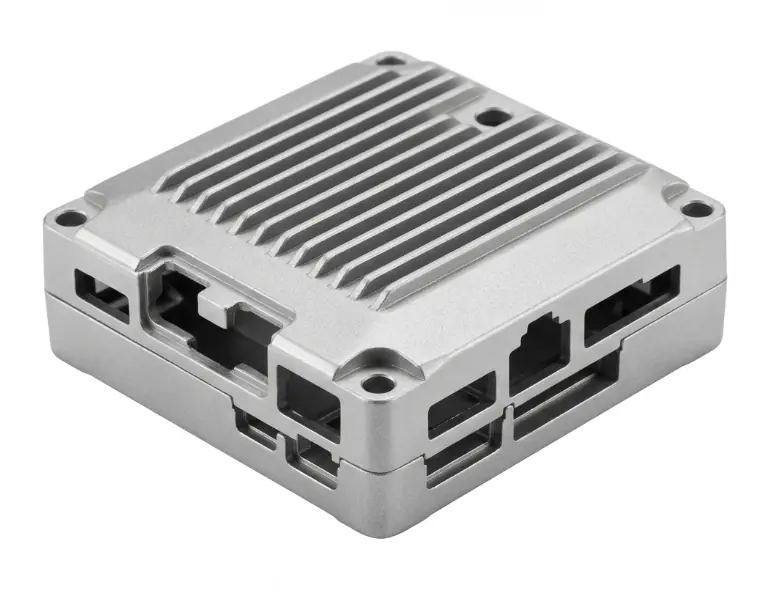
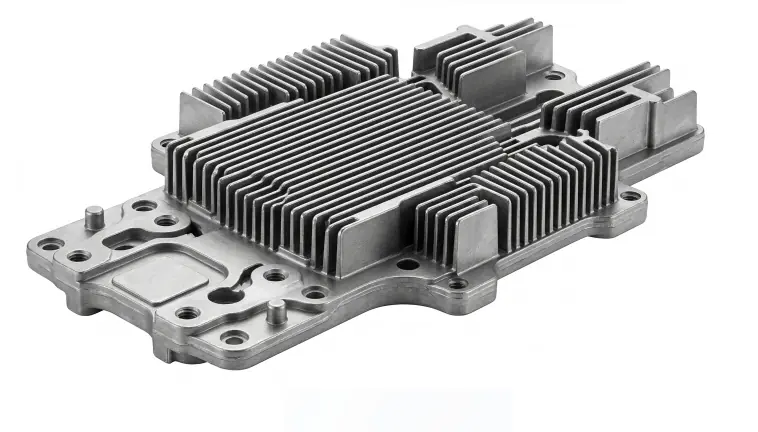
6. Drone Heat Sink Components
Thermal management is critical in drones.
Typical choice:
CNC for simple designs
Die casting for complex fins or integrated structures
Trade-off:
Very fine fins are still better done with CNC or extrusion
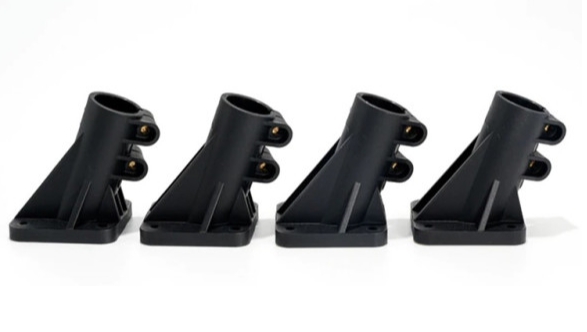
7. Drone Landing Gear Joints
These parts absorb impact during landing.
Typical choice:
Die casting is common
Why:
Requires strength
Often includes multiple connection points
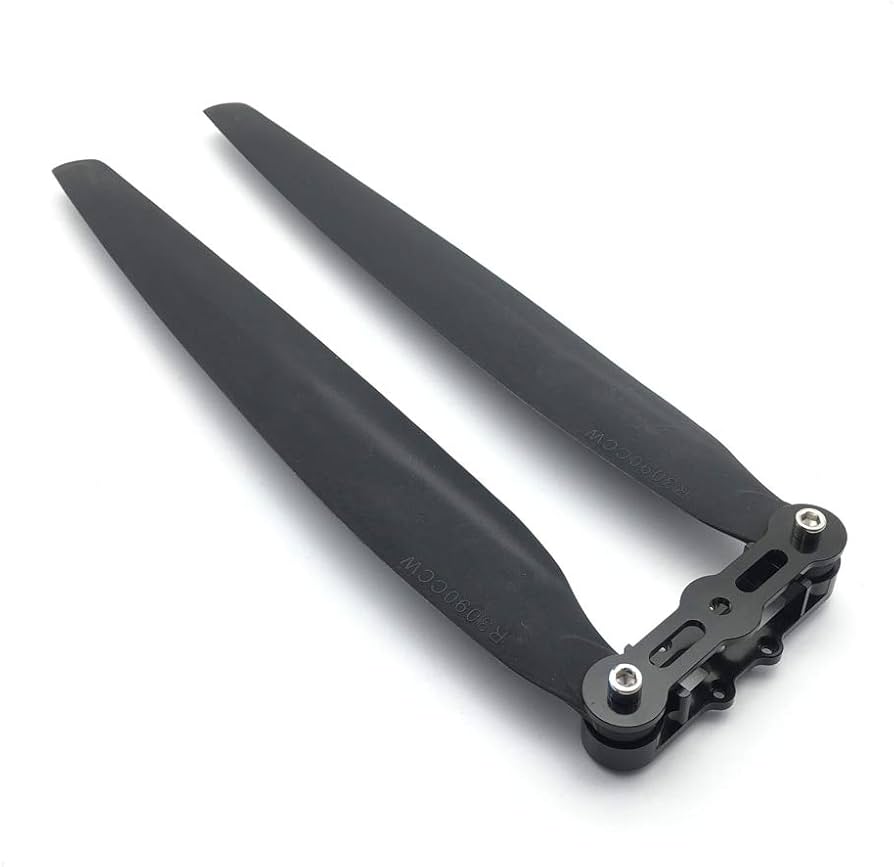
8. Drone Propeller Hub
This is a high-precision rotating component.
Typical choice:
CNC machining is usually preferred
Why NOT die casting:
Tight tolerances
Balance requirements
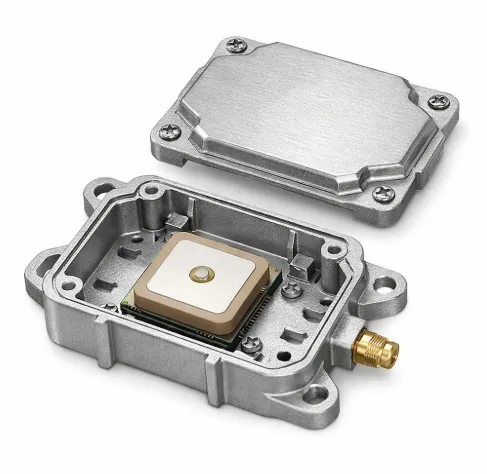
9. Drone GPS Module Housing
Small enclosure for sensitive electronics.
Typical choice:
Both CNC and die casting
Die casting advantage:
Consistency in large batches
Better cost at scale
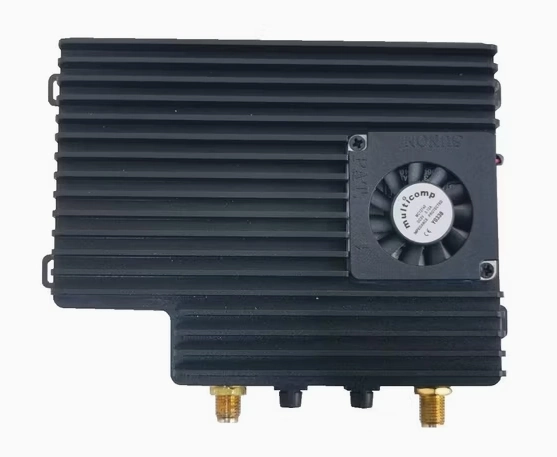
10. Drone Communication Module Housing
Used for signal transmission components.
Typical choice:
Often die cast in production
Key considerations:
Heat dissipation
Shielding performance
What These Examples Tell Us
Looking across these parts, a few patterns become clear:
Die casting works best for:
- Structural components
- Complex geometries
- High-volume production
CNC is still better for:
- Precision-critical parts
- Low-volume production
- Parts under active design changes
In real projects, we rarely see customers get everything right from the beginning.
A common situation is:
- Parts start as CNC
- Assembly becomes complex
- Cost increases with volume
At that point, we help evaluate:
- Which parts can be converted to die casting
- Whether multiple components can be combined
- How to reduce machining and assembly steps
Sometimes converting just one or two key parts makes a noticeable difference in overall cost and production efficiency.
FAQ: Die Casting for Drone Aluminum Parts
At what volume does die casting become more cost-effective than CNC?
In most cases, die casting starts to make sense somewhere between 1,000 to 5,000 parts, depending on the design.
For very simple parts, the break-even point might be higher. For complex parts with multiple features, it can be lower.
What really matters is not just the number of parts, but:
- How complex the geometry is
- How much machining is required
- Whether parts can be combined
👉 If the design allows integration, die casting can become cost-effective earlier than expected.
Can die casting achieve tight tolerances for drone parts?
Yes, but within limits.
- Typical die casting tolerance: around ±0.05 mm
- For tighter requirements (e.g., ±0.01 mm), CNC machining is still needed
In practice, many drone parts use a hybrid approach:
- Die casting for the main structure
- CNC machining for critical surfaces or holes
This keeps cost down while maintaining precision where it matters.
Is die casting strong enough for structural drone components?
Yes, for most applications. Aluminum die casting alloys like ADC12 or A380 provide a good balance of:
- Strength
- Weight
- Manufacturability
That said, strength also depends heavily on:
- Wall thickness design
- Rib structure
- Load distribution
👉 A well-designed die-cast part can perform just as well as a machined part in many drone applications.
Can die casting replace CNC machining completely?
Not completely. CNC and die casting are not competitors—they usually work together.
- CNC is better for:
- Prototypes
- High-precision features
- Die casting is better for:
- Mass production
- Complex integrated parts
In most projects, the best solution is a combination of both.
How long does die casting tooling take?
Typically:
- Mold design: 1 week
- Mold manufacturing: 3–5 weeks
- First trial and adjustments: 1 week
👉 Total: around 4–8 weeks, depending on complexity
Compared to CNC, this is longer upfront, but it pays off in production efficiency.
What are the most common defects in die casting, and can they be avoided?
Some common issues include:
- Porosity
- Shrinkage
- Misruns (incomplete filling)
These are usually not random—they are related to:
- Design
- Mold flow
- Process parameters
👉 With proper DFM review and mold design, most of these issues can be minimized early.
Can existing CNC parts be converted to die casting?
Yes, and this is actually very common. However, it’s not a direct copy. The design usually needs adjustments, such as:
- Adding draft angles
- Optimizing wall thickness
- Removing unnecessary machining features
At IEC MOULD, many projects start exactly this way—reviewing CNC parts and adapting them for die casting to reduce cost and simplify production.
Is there a minimum order quantity (MOQ) for die casting?
Technically, no strict MOQ—but in reality:
- For very low quantities, tooling cost makes die casting impractical
- For production runs, customers usually start from 1,000+ units
👉 The right question is not MOQ, but whether the volume justifies the tooling investment.
Have a part in mind?
If you already have drawings or even a rough concept, feel free to share it with us. We can take a quick look and help you understand:
- Whether die casting makes sense
- Where cost can be reduced
- What to watch out for before production