Skip to content
Zinc-Aluminum Alloy: Properties, Applications, and Die Casting Advantages
Quick Overview of Zinc Aluminum Alloy
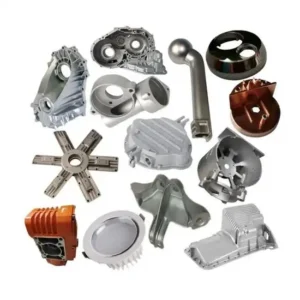
Zinc-aluminum alloy is a zinc-based die casting material known for its high precision, excellent surface finish, and cost efficiency in producing complex components.
| Key Aspect | Summary |
|---|---|
| Material Type | Zinc-based alloy with aluminum and trace elements |
| Main Process | High-pressure die casting |
| Key Advantages | High precision, smooth surface, low machining |
| Cost Efficiency | Lower total cost for small, complex parts |
| Typical Applications | Automotive, electronics, hardware components |
| Best For | Thin-wall, intricate, high-volume production |
👉 Why This Matters
This quick overview helps engineers and buyers rapidly determine whether zinc-aluminum alloy is suitable before evaluating its composition, properties, and detailed performance.
To better understand how this material works, let’s take a closer look at its composition and core characteristics.
Why Engineers Choose Zinc Aluminum Alloy
Engineers choose zinc-aluminum alloy primarily for its ability to deliver high precision, cost efficiency, and excellent surface quality in high-volume production.
Key Reasons:
1️⃣ High Precision
Ideal for complex geometries and thin-wall parts.
2️⃣ Lower Total Cost
Reduces machining, scrap, and tooling wear.
3️⃣ Superior Surface Finish
Minimizes post-processing and supports decorative applications.
4️⃣ High Production Efficiency
Shorter cycle times and longer mold life.
👉 In short: Zinc-aluminum alloy is chosen when precision, efficiency, and scalability are critical.
When Should You Use Zinc Aluminum Alloy?
| Scenario | Recommendation |
|---|---|
| Small precision parts | ✅ Highly recommended |
| Complex geometry | ✅ Best choice |
| Thin-wall design | ✅ Excellent performance |
| High-temperature environment | ❌ Not recommended |
| Large structural parts | ⚠ Consider aluminum |
👉 Looking for a reliable zinc aluminum alloy die casting supplier? Contact us for engineering support and a fast quotation.
What Is Zinc Aluminum Alloy?
Zinc-aluminum alloy, often referred to as ZAMAC in certain industrial standards, is a high-performance metal alloy widely used in die casting to produce precision components. By combining the strength and corrosion resistance of zinc with the lightweightness and flowability of aluminum, this alloy offers an ideal balance of mechanical performance, surface finish, and cost efficiency.
1. Composition and Key Characteristics
| Component | Typical Range | Role / Benefit |
|---|---|---|
| Zinc (Zn) | 80–90% | Provides strength, hardness, and dimensional stability |
| Aluminum (Al) | 5–15% | Improves fluidity for die casting and reduces weight |
| Magnesium (Mg) | 0–1% | Enhances corrosion resistance |
| Copper (Cu) | 0–5% | Increases hardness and mechanical strength |
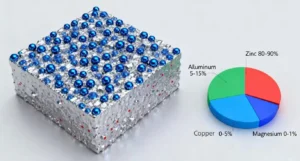
These properties and their ranges make zinc-aluminum alloy ideal for precision die-casting applications in the automotive and electronics industries.
2. Common Grades of Zinc Aluminum Alloy (ZAMAK & ZA Series)
Zinc-aluminum alloys are available in different grades, each designed for specific performance requirements in die casting.
| Grade | Key Characteristics | Typical Applications |
|---|---|---|
| ZAMAK 3 | Best balance of strength and castability | General-purpose die casting |
| ZAMAK 5 | Higher strength and hardness | Automotive and mechanical components |
| ZAMAK 2 | Highest strength, higher copper content | High-load and wear-resistant parts |
| ZAMAK 7 | Improved fluidity and surface finish | Thin-wall and decorative components |
| ZA Series | Higher aluminum content, enhanced strength | Structural and engineering parts |
👉 Engineering insight:
Among these, ZAMAK 3 is the most widely used due to its excellent balance of performance, cost, and casting stability, while ZAMAK 5 is preferred when additional strength is required.
Key Takeaway
Zinc-aluminum alloy is not just a material—it is a carefully engineered system of alloy composition and standardized grades. By selecting the right grade and controlling composition, manufacturers can achieve optimal performance, precision, and cost efficiency in die casting applications.
Key Properties of Zinc Aluminum Alloy
1. What Are the Key Properties of Zinc Aluminum Alloy?
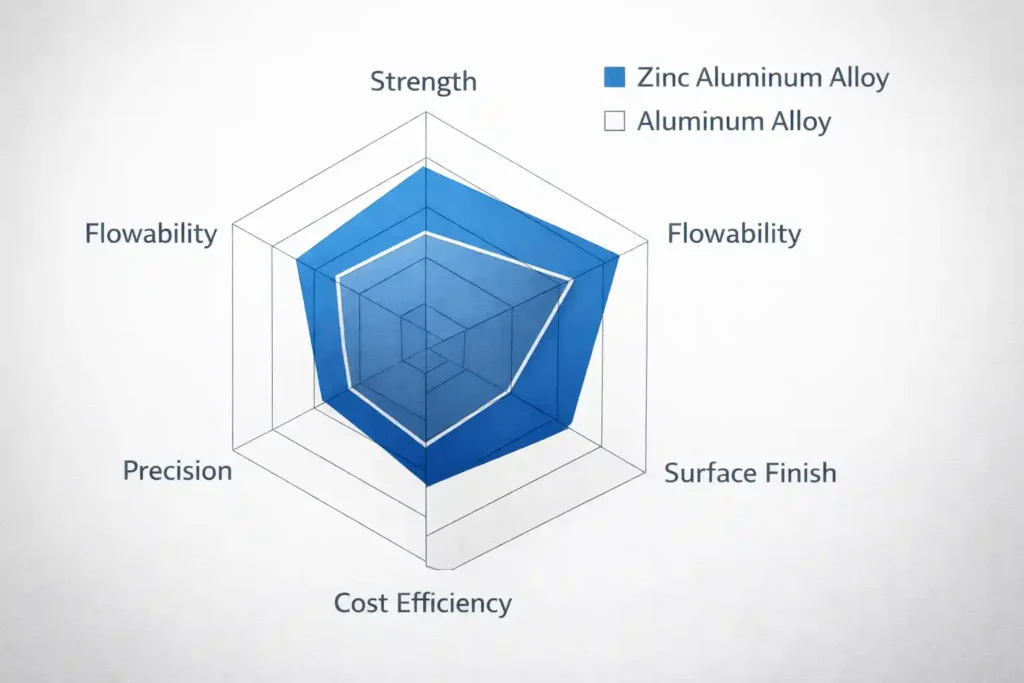
Zinc-aluminum alloy offers a combination of high strength, excellent flowability, precision, and cost efficiency, making it one of the most suitable materials for die casting complex and high-volume components.
2. Key Properties at a Glance
- High Mechanical Strength – Provides durability and wear resistance
- Excellent Flowability – Ideal for thin-wall and complex designs
- High Precision – Achieves tight tolerances with minimal machining
- Smooth Surface Finish – Suitable for plating and decorative applications
- Good Corrosion Resistance – Performs well in indoor and moderate environments
- High Cost Efficiency – Reduces overall production and processing costs
3. Why These Properties Matter in Die Casting
These properties make zinc aluminum alloy particularly effective in high-pressure die casting, where precision, repeatability, and efficiency are critical. Compared to other alloys, it allows manufacturers to:
- Produce complex geometries with fewer defects
- Achieve consistent quality in mass production
- Reduce secondary operations and total cost
4. Zinc Aluminum vs Aluminum – Property Comparison
To better understand how zinc-aluminum alloy performs in real-world manufacturing, it is helpful to compare it directly with aluminum alloy, one of the most commonly used materials in die casting.
The table below highlights the key differences in performance, precision, and cost efficiency between the two materials:
| Property | Zinc Aluminum Alloy | Aluminum Alloy | Why It Matters |
|---|---|---|---|
| Strength | High | Medium | Better wear resistance |
| Flowability | Excellent | Good | More complex designs possible |
| Precision | Very High | High | Less machining required |
| Surface Finish | Excellent | Good | Better for decorative parts |
| Cost Efficiency | High | Medium | Lower total cost |
As shown above, zinc-aluminum alloy outperforms aluminum in several critical aspects, particularly in flowability, precision, and surface finish. These advantages make it especially suitable for small, complex, and high-precision components.
While aluminum remains a strong choice for larger structural parts, zinc-aluminum alloy is often the better option when manufacturers prioritize tight tolerances, reduced machining, and lower overall production costs.
Key Takeaway
Zinc-aluminum alloy is widely used in die casting because of its high strength, excellent flowability, and superior precision, allowing manufacturers to produce complex, thin-wall parts with lower cost and minimal post-processing.
Advantages of Die Casting Zinc Aluminum Alloy
While zinc-aluminum alloy itself offers excellent material properties, its true value is fully realized in the die casting process. Compared to other manufacturing methods and materials, zinc-aluminum die casting delivers significant advantages in precision, efficiency, and overall production cost.
1. Exceptional Precision for Complex Components
Zinc-aluminum alloy enables manufacturers to produce highly detailed parts with tight tolerances in a single casting process.
👉 Why it matters:
- Reduces or eliminates secondary machining
- Ensures consistent part-to-part accuracy
- Ideal for intricate geometries and thin-wall design
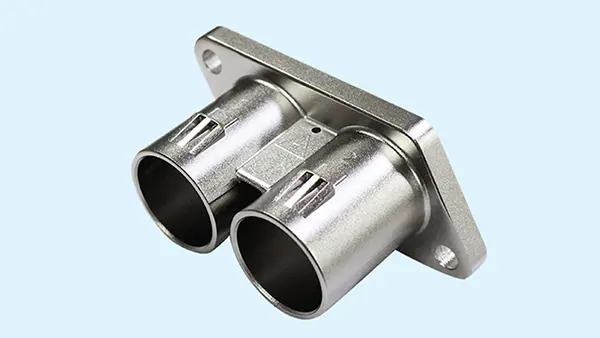
👉 IEC MOULD insight:
We routinely achieve tolerances of ±0.02 mm, even for complex components with fine details.
2. Lower Total Production Cost
One of the biggest advantages is not just material cost, but total cost savings across the entire production cycle.
👉 Cost reduction comes from:
- Less machining required
- Lower scrap rates
- Reduced post-processing
- Longer mold life
👉 Real case:
A hardware manufacturer reduced overall production costs by over 20% after switching from aluminum to zinc-aluminum die casting.
3. Excellent Surface Finish with Minimal Post-Processing
Zinc-aluminum die casting produces parts with smooth, high-quality surfaces directly from the mold.
👉 Why it matters:
- Minimizes polishing and finishing costs
- Ideal for visible or decorative components
👉 Suitable for:
- Electroplating (chrome, nickel, etc.)
- Powder coating
- Painting and cosmetic finishes
4. Faster Cycle Time for High-Volume Production
Zinc-aluminum alloy has a lower melting point than aluminum, enabling faster casting cycles.
👉 Why it matters:
- Increases production efficiency
- Reduces energy consumption
- Shortens lead time
👉 Production insight:
Cycle times are typically 15–30% shorter than those of aluminum die casting.
5. Longer Mold Life and Better Tooling ROI
Compared to aluminum, zinc-aluminum alloy is less aggressive on molds, resulting in longer tool life.
👉 Why it matters:
- Reduces tooling maintenance and replacement costs
- Improves return on investment (ROI) for molds
👉 IEC MOULD insight:
In many cases, mold life can be extended by 30–50% compared to aluminum casting.
6. Ideal for High-Volume Manufacturing
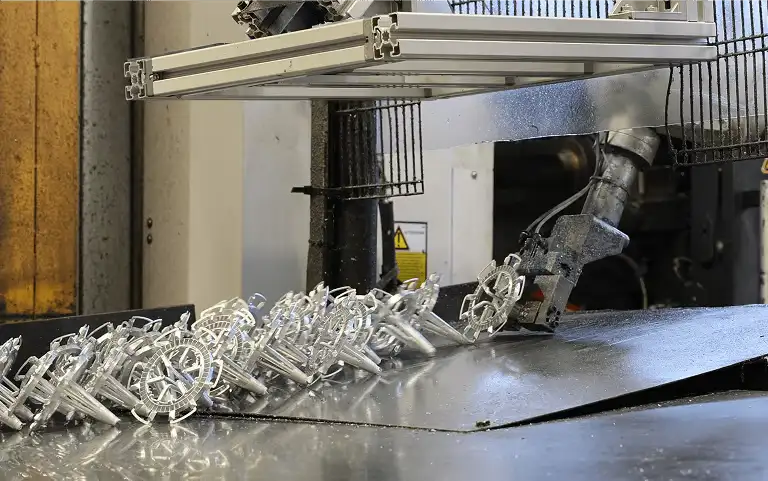
Zinc-aluminum die casting is optimized for mass production with consistent quality.
Why it matters:
- Stable production process
- High repeatability
- Lower per-unit cost at scale
👉 Best suited for:
- Automotive small components
- Electronic housings
- Hardware and consumer products
7. Summary of Key Advantages
| Advantage | Impact on Manufacturing |
|---|---|
| High Precision | Reduces machining and improves consistency |
| Cost Efficiency | Lowers total production cost |
| Surface Quality | Minimizes finishing work |
| Fast Production | Shorter cycle times |
| Long Mold Life | Better tooling ROI |
Key Takeaway
Zinc-aluminum die casting is a highly efficient manufacturing solution, offering precision, speed, and cost advantages in a single process. For manufacturers producing small, complex, and high-volume parts, it provides a clear competitive edge over alternative materials and processes.
Typical Applications Across Industries
Zinc-aluminum alloy is widely used across multiple industries due to its high precision, excellent surface finish, and cost efficiency. It is especially suitable for producing small, complex, and high-volume components where consistency and detail are critical.
Below are the most common industries and applications where zinc-aluminum die casting delivers outstanding results:
1. Automotive Components
Zinc-aluminum alloy is extensively used in the automotive industry for precision parts that require durability and tight tolerances.
👉 Typical applications:
- Door lock components
- Interior decorative trims
- Brackets and housings
- Sensor and connector parts

👉 Why it works:
- High wear resistance for moving parts
- Excellent dimensional stability
- Ideal for mass production with consistent quality
2. Electronics and Electrical Housings
In the electronics industry, zinc-aluminum alloy is widely used for components that require precision and good surface quality.
👉 Typical applications:
- Connector housings
- Switch components
- Heat-dissipation parts
- Shielding enclosures

👉 Why it works:
- High precision ensures reliable assembly
- Smooth surface supports plating and conductivity
- Suitable for miniaturized and complex designs
3. Hardware and Industrial Components
Zinc-aluminum die casting is a preferred solution for hardware products and industrial parts that require strength and durability.
👉 Typical applications:
- Locks and keys
- Handles and hinges
- Gear housings
- Tool components

👉 Why it works:
- Excellent strength and wear resistance
- Cost-effective for large production volumes
- Reduces machining and finishing processes
4. Consumer Products
Many consumer goods rely on zinc-aluminum alloy for both functional and decorative components.
👉 Typical applications:
- Appliance parts
- Bathroom and kitchen fittings
- Decorative trims
- Fashion accessories (buckles, metal parts)

👉 Why it works:
- Superior surface finish for aesthetic appeal
- Supports various coatings and finishes
- Enables complex and stylish designs
5. Industrial Equipment and Machinery
Zinc-aluminum alloy is also used in industrial applications where precision and repeatability are essential.
👉 Typical applications:
- Precision instrument components
- Machine brackets and supports
- Small mechanical parts

👉 Why it works:
- High-dimensional accuracy
- Stable performance in batch production
- Reliable for long-term use
Application Summary Table
| Industry | Typical Products | Key Advantages of Zinc Aluminum Alloy |
|---|---|---|
| Automotive | Locks, brackets, trims | Strength + precision |
| Electronics | Housings, connectors | Precision + surface quality |
| Hardware | Locks, handles, hinges | Durability + cost efficiency |
| Consumer Products | Appliance parts, decorative items | Aesthetics + flexibility |
| Industrial Equipment | Machine parts, supports | Stability + repeatability |
Key Takeaway
Zinc aluminum alloy is the preferred material for industries that require high precision, excellent surface finish, and cost-effective mass production. Its versatility makes it suitable for both functional components and decorative applications, especially where complex geometry and tight tolerances are essential.
When to Choose Zinc Aluminum Alloy vs Other Alloys
Choosing the right material is critical for both product performance and overall cost efficiency. While zinc aluminum alloy offers many advantages, it is not always the best choice for every application.
Understanding when to use zinc aluminum alloy—and when to consider alternatives like aluminum or magnesium—can help manufacturers make smarter decisions.
To simplify material selection, the table below provides a quick reference based on common application scenarios. It helps engineers and buyers quickly determine whether zinc aluminum alloy is the right choice or if alternative materials may be more suitable.
1. Quick Selection Guide
| Application Scenario | Recommended Material |
|---|---|
| Small precision parts | ✅ Zinc Aluminum Alloy |
| Complex geometry | ✅ Zinc Aluminum Alloy |
| Thin-wall design | ✅ Zinc Aluminum Alloy |
| High-temperature environment | ❌ Not recommended |
| Large structural parts | ⚠ Aluminum preferred |
| Lightweight critical applications | ⚠ Magnesium may be considered |
As shown above, zinc-aluminum alloy is the preferred choice for applications that require precision, complexity, and high production efficiency. However, for high-temperature environments or large structural components, alternative materials such as aluminum or magnesium may offer better performance.
Making the right material choice at the early design stage can significantly reduce production costs and improve overall product performance.
2. When Zinc Aluminum Alloy Is the Best Choice
Zinc-aluminum alloy is ideal when precision, detail, and cost control are the top priorities.
👉 Best for:
- Small and medium-sized components
- Complex or intricate designs
- Thin-wall structures
- High-volume production
👉 Why choose it:
- Superior flowability for complex molds
- High dimensional accuracy (reduces machining)
- Excellent surface finish for decorative parts
- Lower total production cost
👉 Typical use cases:
Electronics housings, hardware components, and automotive small parts
3. When Aluminum Alloy Makes More Sense
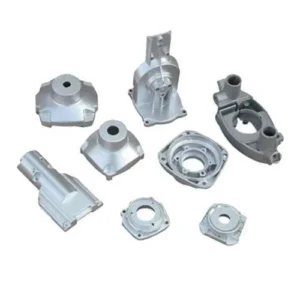
Aluminum is often preferred for larger parts or applications where weight reduction and heat resistance are critical.
👉 Best for:
- Large structural components
- High-temperature environments
- Weight-sensitive applications
👉 Why choose aluminum:
- Lighter weight
- Better thermal performance
- Suitable for larger castings
👉 Limitation compared to zinc aluminum:
- Lower precision
- More machining required
- Shorter mold life
4. When to Consider Magnesium or Other Alloys
Magnesium and other alloys are used in specialized applications where ultra-lightweight is the primary requirement.
👉 Best for:
- Aerospace and high-end electronics
- Applications where weight reduction is critical
👉 Trade-offs:
- Higher material cost
- More complex processing
- Lower surface quality compared to zinc alloys
5. Selection Guide Table
To simplify material selection, the table below provides a quick reference based on common application scenarios. It helps engineers and buyers quickly determine whether zinc aluminum alloy is the right choice or if alternative materials may be more suitable.
| Application Scenario | Recommended Material |
|---|---|
| Small precision parts | ✅ Zinc Aluminum Alloy |
| Complex geometry | ✅ Zinc Aluminum Alloy |
| Thin-wall design | ✅ Zinc Aluminum Alloy |
| High-temperature environment | ❌ Not recommended |
| Large structural parts | ⚠ Aluminum preferred |
| Lightweight critical applications | ⚠ Magnesium may be considered |
As shown above, zinc-aluminum alloy is the preferred choice for applications that require precision, complexity, and high production efficiency. However, for high-temperature environments or large structural components, alternative materials such as aluminum or magnesium may offer better performance.
💡 IEC MOULD Insight:
If your product requires tight tolerances, complex geometry, and high production volume, zinc-aluminum alloy is usually the most cost-effective solution.
If your priority is lightweight or large structural performance, aluminum or magnesium may be more suitable.
Key Takeaway
There is no one-size-fits-all material. However, for most small, precise, and high-volume die casting parts, zinc aluminum alloy provides the best balance of performance, manufacturability, and cost efficiency.
Cost Considerations for Zinc Aluminum Alloy Die Casting
When evaluating zinc-aluminum alloy, many buyers focus only on the material price per kilogram. However, in die casting, the true cost goes far beyond raw material.
To make the right decision, it is essential to consider the total production cost, including machining, tooling, cycle time, and defect rates.
1. Material Cost vs Total Production Cost
At first glance, zinc-aluminum alloy may appear more expensive than aluminum in terms of raw material price. However, it often results in lower overall manufacturing costs.
👉 Why is the total cost lower:
- Less machining is required due to high precision
- Lower scrap rate from better flowability
- Reduced post-processing
- Faster production cycles
👉 IEC MOULD insight:
Focusing only on material cost can be misleading—total cost per part is what truly impacts profitability.
2. Key Cost Factors in Die Casting
| Cost Factor | Zinc-Aluminum Alloy Advantage |
|---|---|
| Machining Cost | Minimal due to near-net shape |
| Scrap Rate | Lower due to excellent mold filling |
| Cycle Time | Shorter, improving productivity |
| Tooling Wear | Reduced, extending mold life |
| Surface Finishing | Less required |
3. Hidden Costs Many Buyers Ignore
Many manufacturers underestimate indirect costs that significantly impact the final price.
👉 Common hidden costs:
- Secondary machining operations
- High rejection rates
- Frequent mold maintenance or replacement
- Surface finishing and polishing
👉 IEC MOULD insight:
By switching to zinc-aluminum alloy, some customers reduce defect rates and eliminate multiple post-processing steps.
4. Real-World Cost Saving Example
A hardware parts manufacturer initially used aluminum die casting for a small, complex component. After switching to zinc-aluminum alloy:
- Machining operations were reduced by 40%
- Scrap rate dropped by 15%
- Overall cost per part decreased by over 20%
👉 Result:
Higher consistency, lower cost, and faster production.
5. How to Reduce Die Casting Costs
Manufacturers can further optimize costs by applying the following strategies:
- Optimize part design for die casting (uniform wall thickness, fewer sharp corners)
- Choose the right alloy based on application needs
- Invest in high-quality tooling to extend mold life
- Work with experienced suppliers to reduce defects and improve efficiency
6. Cost Comparison Overview
| Cost Aspect | Zinc Aluminum Alloy | Aluminum Alloy |
|---|---|---|
| Material Cost | Medium–High | Medium |
| Machining Cost | Low | Medium–High |
| Tooling Life | Long | Medium |
| Production Efficiency | High | Medium |
| Total Cost | Lower (for small complex parts) | Higher |
Key Takeaway
Although zinc-aluminum alloy may have a higher upfront material cost, it often delivers lower total production cost due to reduced machining, faster cycle times, and longer mold life.
For manufacturers producing small, complex, and high-volume components, it is one of the most cost-effective die casting solutions available.
Tips for Successful Zinc-Aluminum Alloy Die Casting
Achieving high-quality results in zinc aluminum alloy die casting depends not only on the material itself but also on proper design, tooling, and process control. The following best practices can help manufacturers improve part quality, reduce defects, and optimize production efficiency.
1. Optimize Part Design for Die Casting
A well-designed part is the foundation of successful die casting. Design decisions directly affect flowability, defect rate, and production cost.
👉 Best practices:
- Maintain uniform wall thickness to avoid shrinkage and porosity
- Avoid sharp corners; use fillets and radii to improve metal flow
- Design proper draft angles for easy mold release
- Minimize unnecessary undercuts to simplify tooling
👉 IEC MOULD insight:
Early design optimization can reduce production costs by 10–20% and significantly improve the yield rate.
2. Control Wall Thickness and Geometry
Zinc aluminum alloy performs exceptionally well in thin-wall applications, but the design must stay within optimal ranges.
👉 Recommended guidelines:
- Typical wall thickness: 0.5 mm – 3 mm
- Keep transitions smooth to avoid stress concentration
- Reinforce critical areas with ribs instead of increasing thickness
👉 Why it matters:
Proper geometry ensures better mold filling, higher strength, and fewer defects.
3. Invest in High-Quality Tooling
Tooling quality has a direct impact on precision, surface finish, and mold life.
👉 Key considerations:
- Use high-grade tool steel for durability
- Apply proper surface treatments (e.g., nitriding)
- Design efficient cooling systems for stable production
👉 IEC MOULD insight:
High-quality molds can extend tool life by 30–50% and ensure consistent part quality over long production runs.
4. Optimize Die Casting Process Parameters
Controlling process parameters is essential for minimizing defects and ensuring repeatability.
👉 Critical parameters:
- Injection speed and pressure
- Mold temperature
- Cooling time
- Molten metal temperature
👉 Why it matters:
Proper parameter control reduces:
- Porosity
- Misruns
- Surface defects
5. Plan Surface Finishing Early
Zinc aluminum alloy offers excellent surface quality, but finishing requirements should be considered during the design stage.
👉 Tips:
- Define surface finish requirements early (decorative vs functional)
- Ensure design supports plating or coating processes
- Avoid features that may cause uneven coating
👉 Common finishing options:
- Electroplating (chrome, nickel)
- Powder coating
- Painting
6. Work with an Experienced Die Casting Partner
Choosing the right supplier can significantly impact project success.
👉 What to look for:
- Proven experience in zinc-aluminum die casting
- Engineering support during the design phase
- Stable quality control system
- Ability to handle high-volume production
👉 IEC MOULD insight:
An experienced partner can help identify potential issues early and reduce development time and cost.
Key Takeaway
Successful zinc aluminum alloy die casting requires a combination of good design, precise tooling, and optimized process control. By following these best practices, manufacturers can achieve higher quality, lower costs, and more efficient production.
Frequently Asked Questions (FAQ)
Is zinc aluminum alloy better than aluminum for die casting?
Zinc aluminum alloy is better than aluminum for small, complex, and high-precision parts. It offers superior flowability, tighter tolerances, and better surface finish. However, aluminum is more suitable for large structural components and high-temperature applications.
What is the typical tolerance for zinc aluminum die casting?
Zinc aluminum die casting can achieve very tight tolerances, typically around ±0.02 mm, depending on part design and tooling quality. This makes it ideal for precision engineering applications.
When should I choose zinc aluminum alloy instead of aluminum?
You should choose zinc aluminum alloy when your product requires high precision, complex geometry, thin walls, and high-volume production. It is the best option when minimizing machining, and the total cost is a priority.
Can zinc aluminum alloy be used for outdoor applications?
Yes, zinc aluminum alloy can be used outdoors, but it typically requires surface treatment, such as plating or coating, to improve corrosion resistance in harsh environments.
What are the disadvantages of zinc aluminum alloy?
The main limitations of zinc aluminum alloy are its higher density and lower heat resistance compared to aluminum. It is not ideal for large parts or high-temperature environments, where aluminum or other alloys may perform better.
Conclusion
Zinc aluminum alloy has become a preferred material in modern manufacturing due to its excellent precision, superior surface finish, and cost efficiency. When combined with high-pressure die casting, it enables the production of complex, high-quality components at scale, making it an ideal solution for industries such as automotive, electronics, hardware, and consumer products.
Throughout this guide, we have explored its key properties, major advantages, typical applications, and cost considerations. The conclusion is clear: for small, intricate, and high-volume parts, zinc-aluminum alloy offers one of the best balances between performance and total production cost.