
Automotive Die Casting is a critical manufacturing process used to produce high-precision and lightweight automotive components for modern vehicles. By injecting molten metal into a steel mold under high pressure, manufacturers can achieve complex shapes, excellent dimensional accuracy, and high production efficiency. Today, automotive die casting is widely used in engine parts, transmission housings, structural components, and EV battery enclosures.
As the automotive industry moves toward lightweight vehicles, electric mobility, and cost-efficient production, automotive die casting continues to play an increasingly important role. In this article, we will explore six key aspects of automotive die casting, including its advantages, material selection, design optimization strategies, applications, and future industry trends.
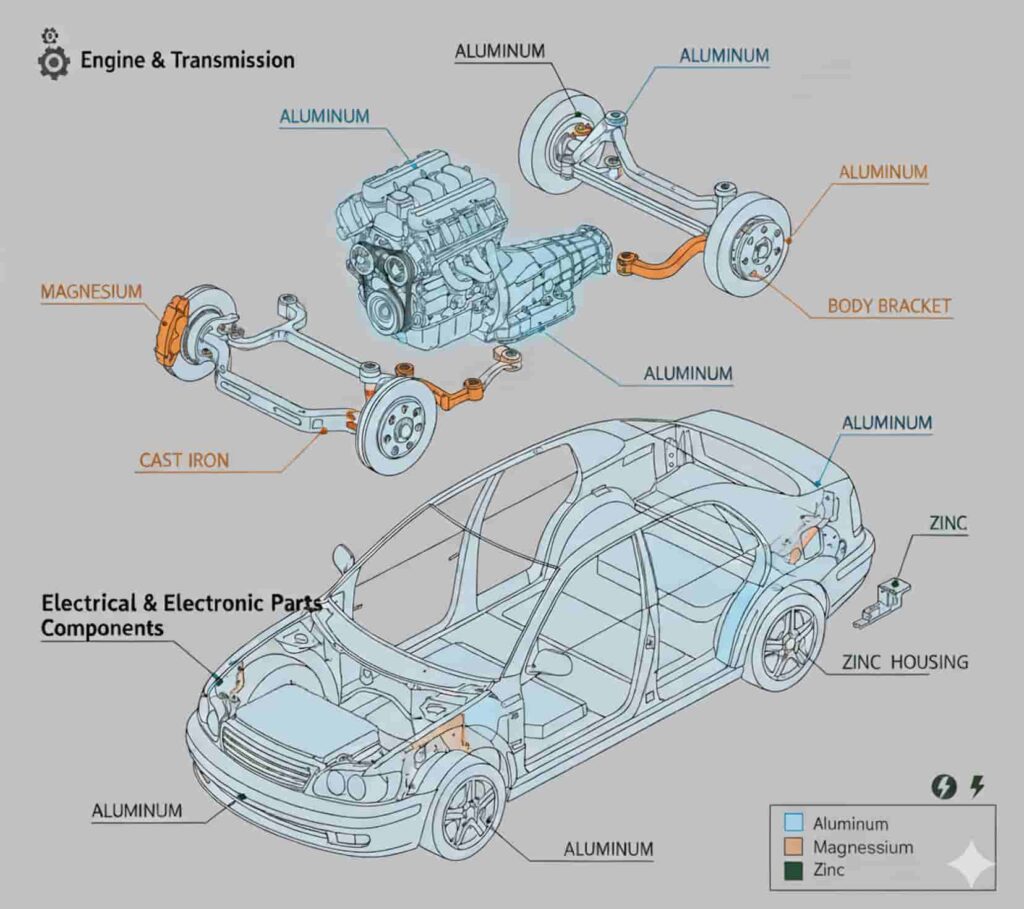
Overview of Automotive Die Casting
Automotive die casting is one of the most widely used manufacturing processes in the automotive industry, particularly for producing lightweight, high-strength, and high-precision metal components. In this process, molten aluminum, magnesium, or zinc alloy is injected into a hardened steel mold under high pressure, enabling the formation of complex geometries with excellent dimensional accuracy and fast production cycles. Compared with traditional machining or forging, automotive die casting provides higher efficiency, lower material waste, and better scalability for mass production, making it a key technology for both conventional vehicles and electric vehicles (EVs). It is widely applied in engine housings, transmission cases, battery enclosures, and structural body components, supporting the industry’s demand for lightweight design and cost-efficient manufacturing.
Among the main die casting methods, High Pressure Die Casting (HPDC), Low Pressure Die Casting (LPDC), and Gravity Die Casting are commonly used in automotive applications. HPDC is the most widely adopted due to its fast cycle time, high productivity, and ability to produce complex parts with tight tolerances, while LPDC is often used for components requiring better porosity control, and gravity casting is suitable for medium-volume production with simpler tooling requirements.
Role in Modern Automotive Manufacturing
Modern automotive production requires components that are lightweight, durable, and suitable for large-scale manufacturing. Die casting helps manufacturers meet these demands by combining design flexibility with high production efficiency.
Key Roles of Automotive Die Casting
✅ Supports high-volume and automated production
✅Ensures consistent quality and dimensional accuracy
✅ Reduces component weight for improved fuel efficiency
✅Enables integrated part design for EV platforms
✅Lowers overall manufacturing and assembly costs
In electric vehicles, die casting technology has become increasingly important for producing battery housings, motor housings, and large structural components. The growing adoption of giga casting further demonstrates how die casting is transforming automotive body manufacturing by replacing multiple welded parts with single-piece castings.
Market Trends & Industry Importance
Several industry trends are driving the rapid growth of automotive die casting worldwide. Vehicle lightweighting remains a major priority as automakers work to improve fuel economy, reduce emissions, and extend EV driving range. Aluminum and magnesium die castings are increasingly replacing heavier steel components in both structural and functional applications.
At the same time, advancements in large-scale die casting technologies are accelerating the adoption of integrated vehicle structures.
Major Industry Trends
📈 Increasing demand for EV battery housings and structural castings
📈 Growing use of aluminum alloys for lightweight vehicles
📈 Replacement of traditional machining and welded assemblies
📈 Development of mega casting and automated production lines
📈 Higher focus on recyclable and sustainable materials
As automotive manufacturers continue to optimize production efficiency and reduce vehicle weight, automotive die casting is expected to remain a core technology in the future of vehicle manufacturing.
Advantages of Automotive Die Casting
Automotive die casting has become a preferred manufacturing solution for modern vehicles due to its ability to combine high efficiency, lightweight performance, precision manufacturing, and cost-effective mass production. Compared with traditional machining, welding, or forging processes, die casting enables manufacturers to produce complex automotive components with shorter production cycles and lower overall costs.
As vehicle designs continue to evolve toward lightweight structures and integrated components, automotive die casting offers significant advantages for both conventional vehicles and electric vehicles.
High Production Efficiency & Short Cycle Time
One of the biggest advantages of automotive die casting is its high production efficiency. The molten metal is injected into the mold cavity at high speed and pressure, allowing rapid filling, cooling, and solidification within a short cycle time.
Why Die Casting Improves Production Efficiency
- ✅ Fast mold filling and cooling process
- ✅ Highly automated manufacturing workflow
- ✅ Consistent production quality in large volumes
- ✅ Reduced manual operations and assembly time
This makes die casting especially suitable for high-volume automotive manufacturing, where millions of identical parts are required each year.
Manufacturing Method | Production Speed | Suitability for Mass Production |
Die Casting | Very High | Excellent |
Machining | Medium | Limited |
Forging | Medium | Moderate |
Welding Assembly | Low | Complex |
Lightweight & Strength Performance
Lightweighting has become a major focus in the automotive industry, especially for electric vehicles and fuel-efficient transportation. Automotive die casting supports this trend by using lightweight alloys such as aluminum and magnesium to replace heavier steel components.
Benefits of Lightweight Die Casting Materials
- ✅ Reduced overall vehicle weight
- ✅ Improved fuel efficiency
- ✅ Extended EV driving range
- ✅ Better thermal performance and corrosion resistance
Aluminum die cast parts are widely used in engine housings, battery enclosures, and transmission cases because they provide an excellent balance between strength and weight.
📌 Example:
Reducing vehicle weight by 10% can significantly improve fuel economy and battery efficiency in electric vehicles.
High Precision & Complex Geometry
Automotive die casting is capable of producing components with tight dimensional tolerances and highly complex shapes that would be difficult or expensive to achieve through traditional manufacturing methods.
Precision Advantages of Die Casting
- ✅ Excellent dimensional repeatability
- ✅ Thin-wall component capability
- ✅ Complex internal and external geometries
- ✅ Smooth surface finish with reduced machining
These advantages allow engineers to integrate multiple functions into a single casting, reducing assembly complexity and improving overall product performance.
Typical Precision Features
Feature | Die Casting Capability |
Thin Walls | Excellent |
Complex Shapes | Excellent |
Surface Finish | High |
Dimensional Consistency | High |
High Material Utilization & Sustainability
Compared with subtractive manufacturing processes, automotive die casting offers high material utilization and generates less production waste. Most excess material, such as runners and overflow sections, can also be recycled and reused in production.
Sustainability Benefits
- ✅ Material utilization can exceed 90%
- ✅ Reduced raw material waste
- ✅ Lower machining requirements
- ✅ Improved energy efficiency in mass production
- ✅ Recyclable aluminum and magnesium alloys
As sustainability becomes increasingly important in automotive manufacturing, die casting helps manufacturers reduce both production waste and environmental impact.
Cost Efficiency in Mass Production
Although die casting tooling requires higher initial investment, the process becomes highly cost-effective in medium- and high-volume production. Once the tooling cost is amortized, the per-part manufacturing cost decreases significantly.
How Die Casting Reduces Manufacturing Costs
- ✅Reduced secondary machining operations
- ✅ Lower labor and assembly costs
- ✅ Faster production cycles
- ✅ Integrated multi-function part design
- ✅ Reduced material consumption
In many automotive applications, a single die cast component can replace multiple welded or machined parts, simplifying production and lowering total manufacturing costs.
Traditional Assembly:
Traditional Manufacturing vs. Die Casting
Traditional Assembly | Die Casting |
Multiple separate components | Single integrated casting |
Welding and fastening required | Fewer secondary operations |
Longer production cycle | Faster manufacturing |
Higher assembly cost | Lower total production cost |
Material Selection in Automotive Die Casting
Material selection is a key factor in automotive die casting because it directly influences part weight, strength, durability, thermal performance, and overall manufacturing cost. Among commonly used materials, aluminum, magnesium, and zinc alloys dominate automotive applications due to their balanced mechanical properties and production efficiency. Selecting the right material helps optimize vehicle performance while maintaining cost efficiency and production reliability.
Material Comparison: Aluminum, Magnesium & Zinc Alloys
Material | Key Characteristics | Advantages | Limitations | Typical Applications |
Aluminum Alloys | Lightweight, good thermal conductivity, corrosion resistant | High strength-to-weight ratio, cost-effective, recyclable | Heavier than magnesium | Engine blocks, transmission housings, EV battery enclosures, structural parts |
Magnesium Alloys | Ultra-lightweight, good damping performance | Lowest density, excellent vibration control | Higher cost, lower corrosion resistance | Steering frames, seat structures, interior supports, electronic housings |
Zinc Alloys | High strength, excellent surface finish, high fluidity | High precision, good wear resistance | Heavier, limited to smaller parts | Locks, handles, decorative trims, brackets |
Material Selection Criteria
Selecting the appropriate material for automotive die casting depends on multiple engineering and production factors. Manufacturers must balance performance requirements, cost efficiency, weight reduction targets, and environmental conditions.
Selection Criteria | Considerations |
Strength vs. Weight | Structural performance vs. lightweight requirements |
Cost vs. Performance | Material cost and manufacturing efficiency |
Thermal Requirements | Heat dissipation and operating temperature |
Corrosion Resistance | Environmental durability and lifespan |
Surface Finish | Appearance and post-processing requirements |
Production Volume | Suitability for mass production |
For example, aluminum alloys are typically used for structural and thermal applications, magnesium alloys for extreme lightweighting, and zinc alloys for high-precision small components. As automotive technology continues to evolve—especially in EV and integrated structural design—material selection remains a critical factor in achieving both performance and cost optimization.
Design Optimization for Cost Reduction
In automotive die casting, product design has a direct impact on cost, tooling complexity, production efficiency, and part quality. A well-optimized design can reduce material usage, shorten cycle time, lower machining requirements, and improve production stability. Applying Design for Manufacturability (DFM) early helps improve manufacturability and reduce total cost for both traditional vehicles and EV applications.
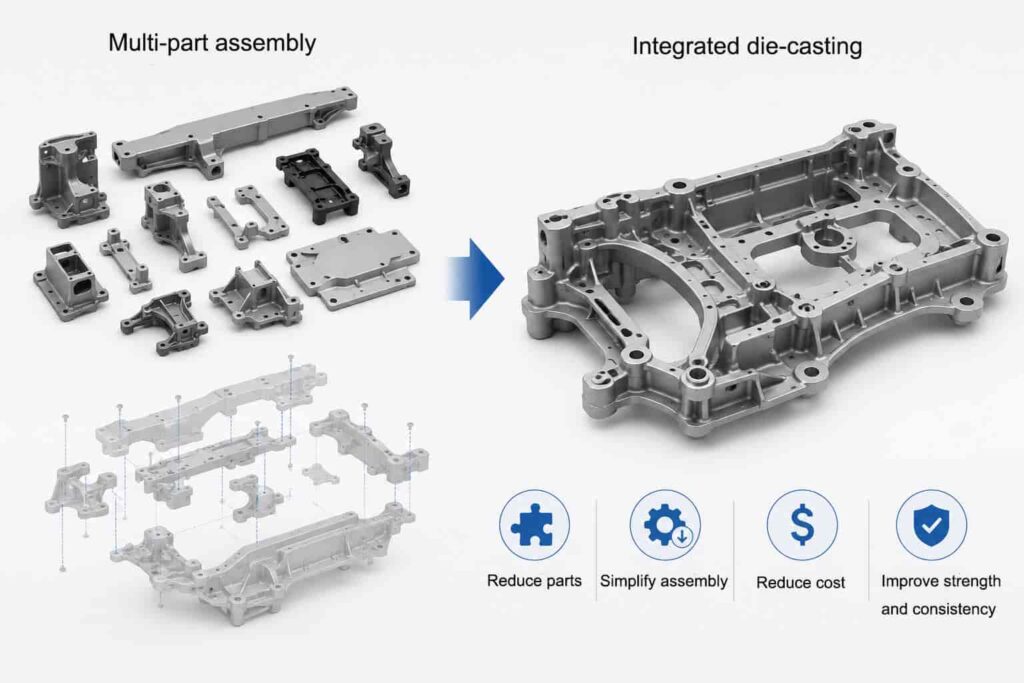
Part Integration & Function Consolidation
Die casting enables multiple parts to be integrated into a single component, reducing assembly steps and cost.
- ✔ Reduce number of parts
- ✔ Replace welded/fastened assemblies
- ✔ Lower labor and assembly cost
- ✔ Improve structural consistency
Integrated designs are especially important in EV structural and giga casting applications.
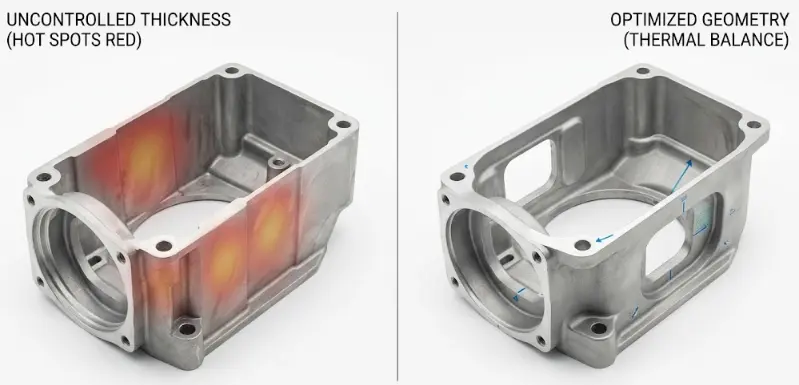
Wall Thickness Optimization
Proper wall thickness ensures stable filling and reduces defects.
- ✔ Maintain uniform thickness
- ✔ Avoid thick sections (shrinkage risk)
- ✔ Avoid thin walls (poor filling)
- ✔ Balance strength and cost
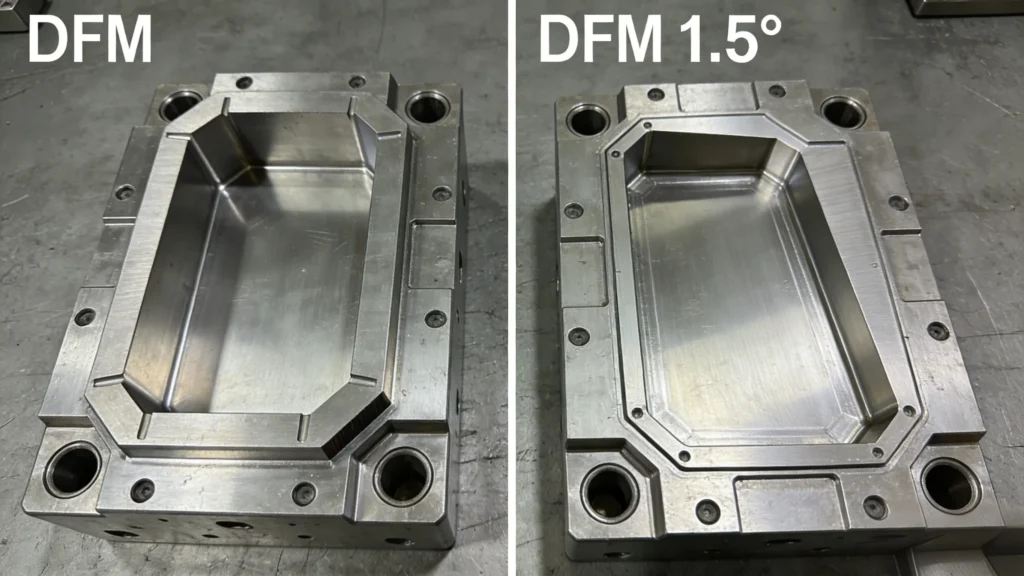
Draft Angle & Parting Line Design
Good draft and parting line design improves mold release and tool life.
- ✔ Easier part ejection
- ✔ Reduced mold wear
- ✔ Better surface quality
- ✔ Improved production stability
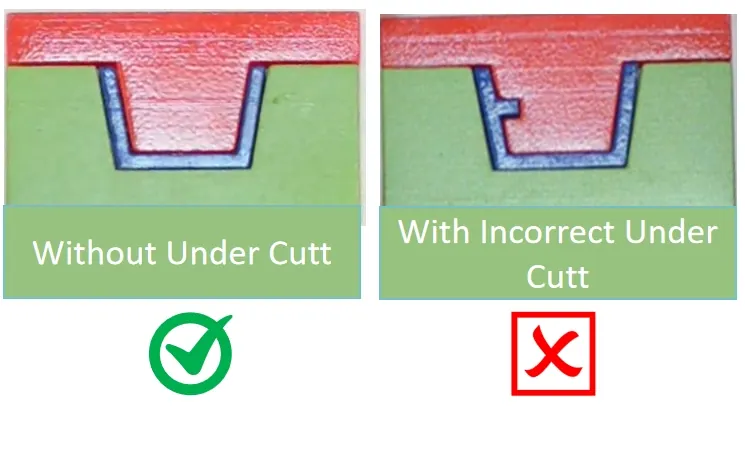
Reduce Undercuts & Complex Features
Simplifying geometry reduces tooling complexity and cost.
- ✔ Reduce side cores/sliders
- ✔ Lower tooling investment
- ✔ Improve cycle stability
- ✔ Reduce defect risk
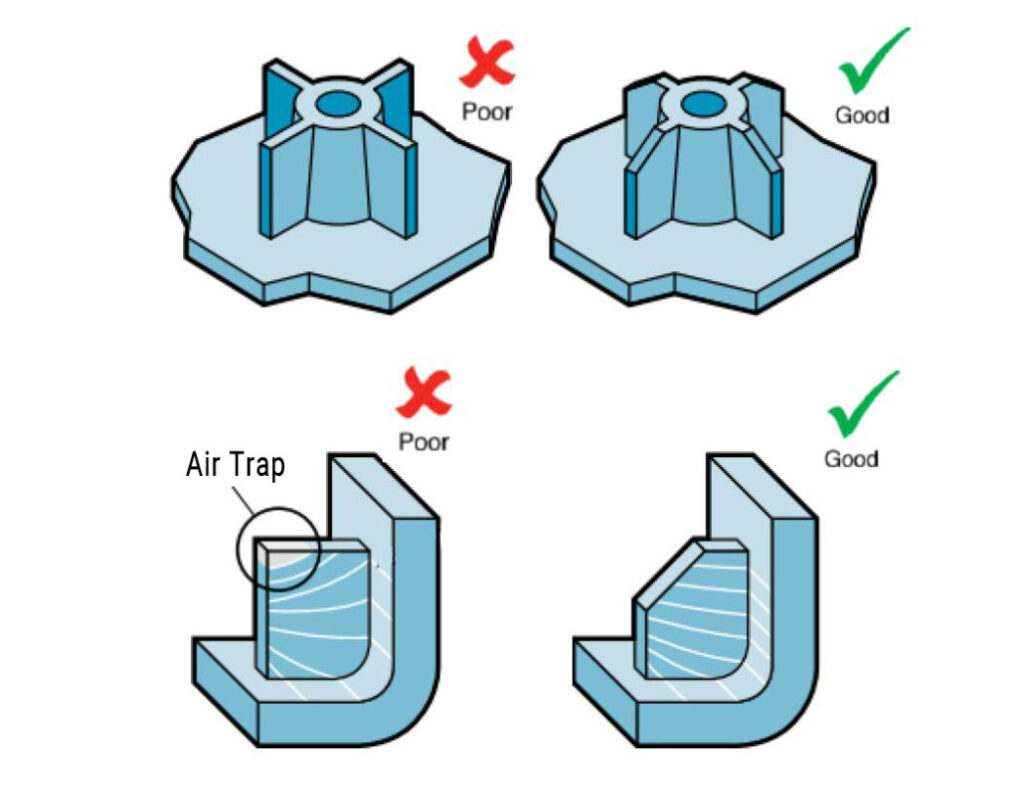
Use Ribs Instead of Thick Sections
Ribs improve strength without increasing weight or material cost.
- ✔ Higher stiffness
- ✔ Lower weight
- ✔ Better material efficiency
- ✔ Reduced shrinkage risk
Design for Manufacturability (DFM)
DFM improves production efficiency and reduces development risk.
DFM Area | Benefit |
Machining reduction | Lower cost |
Hole/boss integration | Easier assembly |
Tolerance control | Better consistency |
Mold flow analysis | Fewer defects |
Gate design | Better filling |
Tooling Life & Cycle Optimization
Tooling optimization improves long-term production efficiency and cost.
- ✔ Faster cooling cycle
- ✔ Longer mold life
- ✔ Lower maintenance cost
- ✔ Higher production efficiency
Key focus includes cooling design, thermal balance, and optimized gating systems.
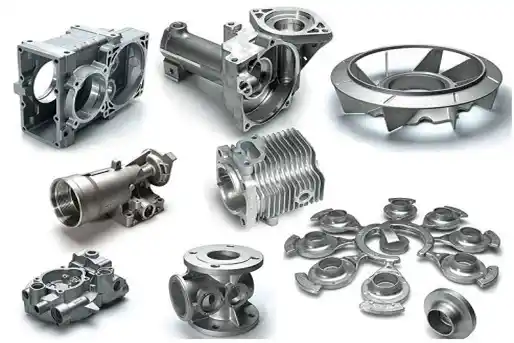
Applications of Automotive Die Casting
Automotive die casting is widely used across nearly every area of modern vehicle manufacturing due to its ability to produce lightweight, high-strength, and dimensionally accurate components. With the growing demand for fuel efficiency, electric vehicles, and integrated vehicle structures, die casting technology continues to expand into more structural and functional automotive applications.
Today, aluminum, magnesium, and zinc die cast components can be found in powertrain systems, chassis structures, body assemblies, and EV platforms, helping manufacturers improve both performance and production efficiency.
Engine & Transmission Components
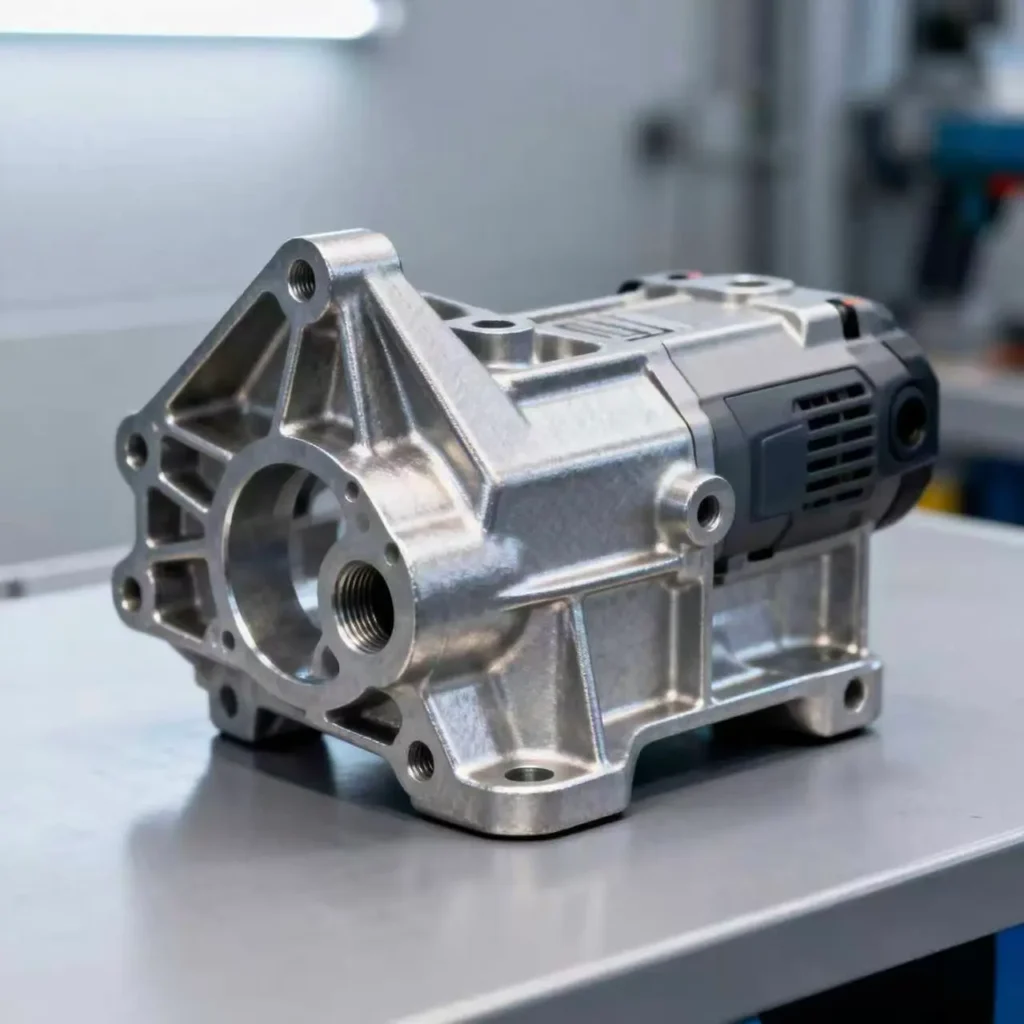
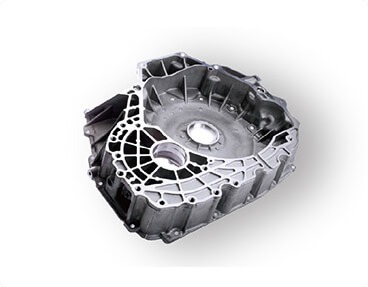
Engine and transmission systems are among the earliest and most common applications of automotive die casting. These components require excellent strength, heat resistance, and dimensional stability while maintaining lightweight performance.
Typical Engine & Transmission Applications
Component Type | Typical Parts |
Engine Components | Engine blocks, cylinder heads |
Transmission Parts | Gear housings, transmission cases |
Powertrain Housings | Clutch housings, oil pans |
Aluminum die casting is commonly used in these applications because of its lightweight properties and excellent thermal conductivity, which help improve engine efficiency and heat dissipation.
Structural & Chassis Parts
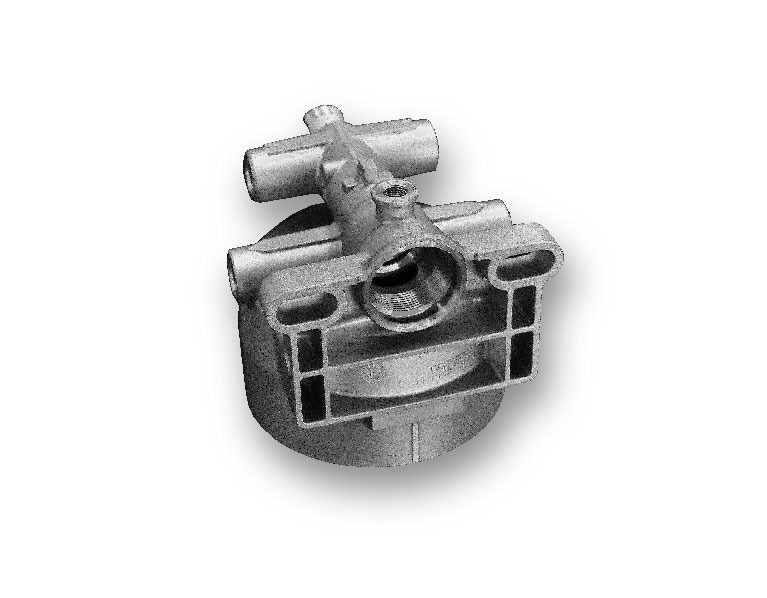
As vehicle lightweighting becomes increasingly important, die casting is now widely used for structural and chassis components. Large integrated castings help reduce vehicle weight while improving structural rigidity and manufacturing efficiency.
Common Structural Applications
- Subframes
- Crossmembers
- Shock tower structures
- Mounting brackets
- Front and rear structural components
The development of giga casting technology is further accelerating the use of large-scale die cast structural parts in electric vehicles.
Benefits for Structural Applications
- ✔ Reduced vehicle weight
- ✔ Improved structural strength
- ✔ Fewer welded assemblies
- ✔ Simplified manufacturing process
Suspension & Brake Systems
Suspension and braking systems require both mechanical strength and precise dimensional control, making them suitable for high-performance die cast components.
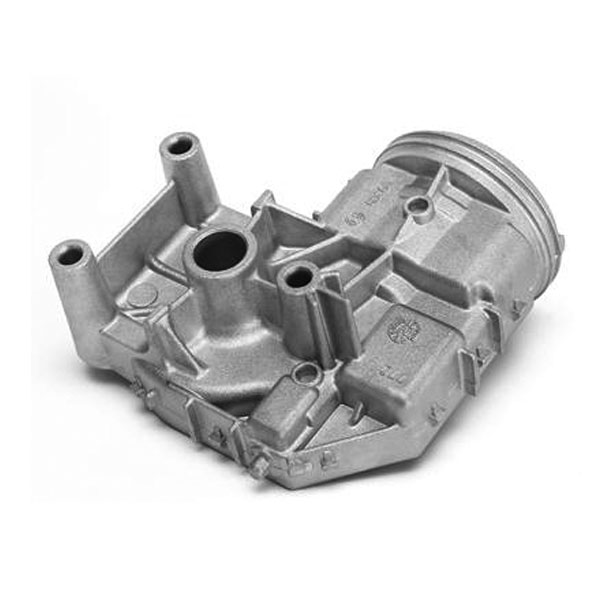
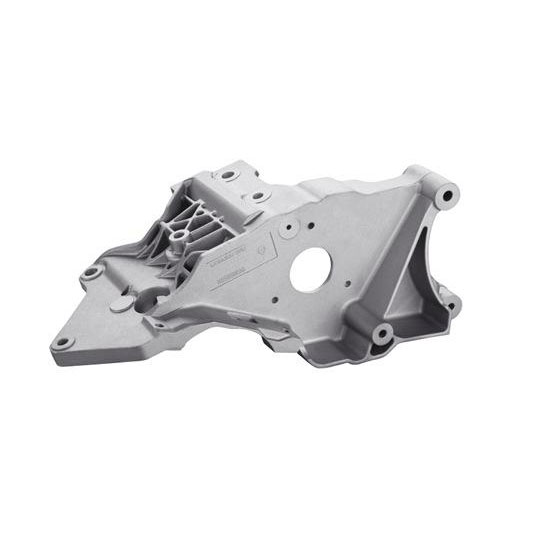
Typical applications include brake calipers, suspension arms, steering housings, and mounting brackets. Aluminum die casting is widely used here because it helps reduce unsprung weight, which directly improves vehicle handling, braking response, and ride comfort.
Body & Interior Components
Body and interior applications focus more on appearance, weight reduction, and design flexibility.
Common parts include door frames, seat structures, dashboard supports, interior trims, sunroof frames, and console structures. In this area, material selection becomes especially important:
- Magnesium alloys → ultra-lightweight structural parts
- Zinc alloys → high-precision, high-surface-quality components
Key characteristics:
✔ Lightweight design
✔ Good vibration damping (magnesium)
✔ Excellent surface finish (zinc)
✔ Strong design flexibility for styling integration
EV & Electronic Components
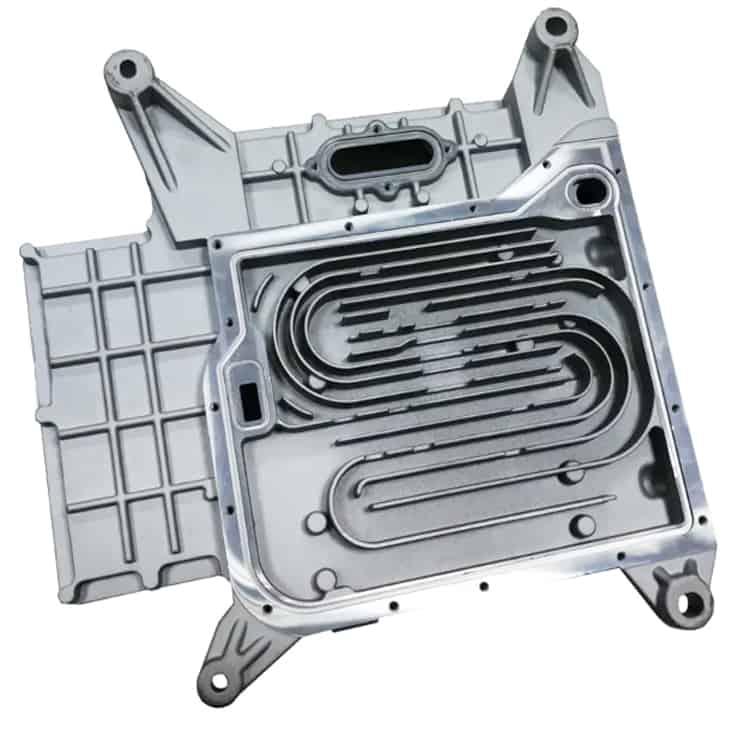
Electric vehicles have significantly expanded the application boundaries of die casting, particularly for structural integration and thermal management.
Instead of multiple assembled parts, EV platforms increasingly use integrated die cast structures for better efficiency.
Typical applications include battery housings, battery trays, motor housings, inverter housings, electronic enclosures, and structural EV castings.
Key advantages:
- ✔ Improved driving range through weight reduction
- ✔ Better thermal management for batteries and motors
- ✔ Fewer assembled components
- ✔ Higher production efficiency for EV platforms
As EV adoption accelerates, die casting is becoming a foundational manufacturing technology for next-generation vehicle architecture.
Future Trends in Automotive Die Casting
As the automotive industry continues to evolve toward electrification, lightweighting, and intelligent manufacturing, automotive die casting technology is also undergoing significant transformation. Manufacturers are increasingly focusing on larger integrated castings, sustainable materials, and automated production systems to improve efficiency, reduce costs, and support next-generation vehicle platforms.
Driven by the rapid growth of electric vehicles and advanced manufacturing technologies, automotive die casting is expected to become even more important in future vehicle production.
Mega Casting / Gigacasting
Mega casting, also known as gigacasting, is one of the most significant trends in modern automotive manufacturing. This technology uses ultra-large die casting machines to produce large structural vehicle components as a single casting instead of assembling multiple stamped or welded parts.
Advantages of Gigacasting
- ✔ Significant reduction in part count
- ✔ Simplified vehicle assembly process
- ✔ Lower manufacturing and labor costs
- ✔ Improved structural rigidity
- ✔ Reduced vehicle weight
Traditional Assembly vs. Gigacasting
Traditional Manufacturing | Gigacasting |
Dozens of welded components | Single integrated casting |
Complex assembly process | Simplified production |
Higher tooling and labor cost | Reduced total manufacturing cost |
Longer production time | Faster production cycles |
Gigacasting technology is becoming increasingly popular in EV manufacturing because it improves production efficiency and supports highly integrated vehicle body structures.
Integration with EV Platforms
The rapid expansion of electric vehicles is creating new opportunities for automotive die casting. EV platforms require lightweight, thermally efficient, and highly integrated structural components to support battery systems and electric drive units.
Key EV Die Casting Trends
- ✔ Larger battery housing castings
- ✔ Integrated front and rear body structures
- ✔ Lightweight motor housings
- ✔ Simplified EV platform assembly
Compared with traditional vehicles, EVs often use more aluminum die cast components to reduce vehicle weight and improve driving range.
Why Die Casting is Important for EV Platforms
EV Requirement | Die Casting Advantage |
Lightweight Design | Reduced vehicle weight |
Thermal Management | Excellent heat dissipation |
Structural Integration | Fewer assembled components |
High Production Volume | Efficient mass manufacturing |
As EV production continues to increase globally, die casting technology will play a key role in future vehicle platform development.
Sustainable & Recyclable Materials
Sustainability has become a major focus in automotive manufacturing, and die casting offers several environmental advantages compared with traditional production methods. Aluminum, magnesium, and zinc alloys are highly recyclable, making them suitable for sustainable vehicle manufacturing.
Sustainability Advantages of Die Casting
- ✔ High material utilization efficiency
- ✔ Reduced manufacturing waste
- ✔ Recyclable metal materials
- ✔ Lower energy consumption in mass production
- ✔ Support for lightweight, energy-efficient vehicles
Many automotive manufacturers are also increasing the use of recycled aluminum alloys to reduce carbon emissions and improve environmental performance throughout the supply chain.
As environmental regulations continue to become stricter worldwide, sustainable die casting solutions will become increasingly important for automotive suppliers and OEMs.
Smart Manufacturing & Automation
Automation and digital manufacturing technologies are transforming automotive die casting production lines. Modern die casting facilities increasingly rely on robotics, intelligent monitoring systems, and data-driven process control to improve production stability and quality consistency.
Smart Manufacturing Technologies
- ✔ Automated robotic part handling
- ✔ Real-time process monitoring
- ✔ AI-assisted quality inspection
- ✔ Predictive maintenance systems
- ✔ Digital mold flow simulation
Benefits of Smart Die Casting Production
Smart Manufacturing Feature | Production Benefit |
Automation | Higher production efficiency |
Real-Time Monitoring | Improved quality control |
Predictive Maintenance | Reduced downtime |
Process Data Analysis | Better production stability |
Smart manufacturing not only improves efficiency, but also helps manufacturers reduce defects, optimize cycle times, and maintain consistent product quality in high-volume automotive production.
As Industry 4.0 technologies continue to develop, intelligent and automated die casting systems are expected to become the standard for future automotive manufacturing.
Conclusion
Automotive die casting has become a core manufacturing technology in the modern automotive industry, enabling the production of lightweight, high-strength, and highly complex components with excellent efficiency and consistency. From traditional powertrain systems to advanced EV platforms, die casting continues to support the industry’s shift toward higher performance, greater integration, and more sustainable production methods.
The key value of automotive die casting lies in its ability to balance cost efficiency, mechanical performance, and large-scale manufacturability. At the same time, effective design optimization—such as part integration, wall thickness control, and DFM implementation—plays a critical role in reducing total manufacturing costs and improving product quality.
As the automotive industry continues to evolve, companies that combine advanced engineering design with optimized die casting solutions will have a stronger competitive advantage in both traditional and electric vehicle markets.
📩 Contact Us
For professional automotive die casting solutions, mold design optimization, and cost-reduction engineering support, please contact us:
Company: IEC Mould Engineering Making Ltd
Email: [email protected]
Tel: +86-0769-85336570
Website: https://castingstool.com / https://www.iec-mould.com