Why Anodizing Die Cast Aluminum Alloys Is More Difficult Than Expected
Anodizing is widely used to improve the corrosion resistance, durability, and appearance of aluminum components. However, when it comes to anodizing die cast aluminum alloys, maintaining stable cosmetic quality is often much more difficult than many manufacturers initially expect.
In real production environments, anodized die cast aluminum parts may develop problems such as:
- uneven surface tone
- visible porosity after anodizing
- inconsistent appearance between batches
- localized pitting or dark areas
- unstable decorative finishing results
These issues are especially common in high-pressure die casting alloys such as ADC12 and A380, where alloy composition and casting structure strongly influence anodizing die cast behavior.
Many die-casting manufacturers first discover these limitations after finishing begins. A die-cast part may appear acceptable after machining or polishing, yet develop visible surface inconsistency once anodizing reveals differences in material structure and surface condition.
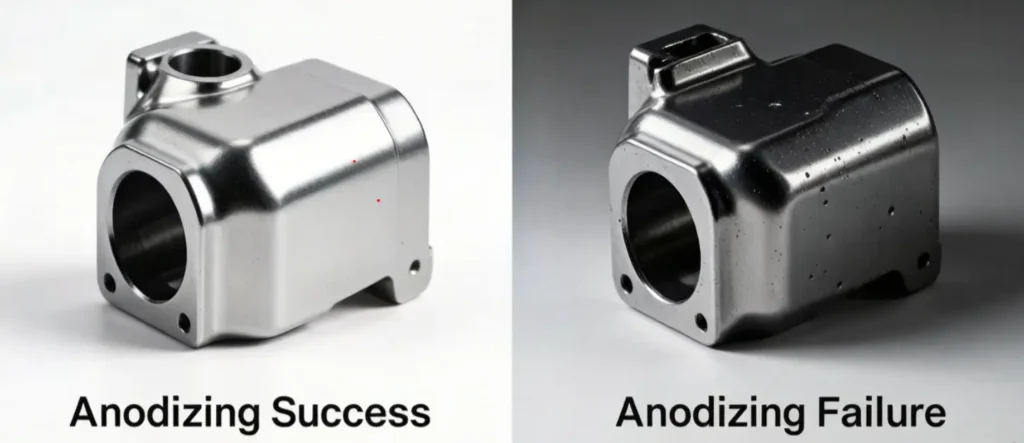
Compared with wrought aluminum materials such as 6061, die cast aluminum typically contains higher silicon content, greater microstructural variation, and trapped gas and subsurface porosity.
As a result, anodizing performance is influenced not only by the anodizing process itself, but also by alloy selection, casting stability, machining condition, and surface preparation quality throughout production.
This becomes particularly important for consumer electronics housings, automotive trim components, lighting products, and visible industrial enclosures, where cosmetic consistency directly affects perceived product quality.
For manufacturers developing these types of components, understanding how different die-cast aluminum alloys behave during anodizing is often the key to reducing the risk of cosmetic rejection and improving long-term production stability.
What Makes an Aluminum Alloy Suitable for Anodizing
Not all materials behave the same during the anodizing die cast aluminum production.
In many projects, two alloys may achieve similar casting performance and dimensional accuracy, yet produce very different surface finishing results after anodizing. One material may maintain stable cosmetic consistency across batches, while another becomes increasingly difficult to control during mass production.
For this reason, alloy selection is not only a casting decision — it is also a surface finishing stability decision.
One of the biggest factors affecting anodizing performance is silicon content. High-silicon die casting alloys are widely used because they improve casting fluidity, dimensional stability, and production efficiency. However, as silicon content increases, maintaining a stable decorative appearance after anodizing generally becomes more difficult.
In production environments, lower-silicon aluminum materials often provide:
- better anodizing consistency
- more uniform color response
- cleaner decorative appearance
This is one reason why wrought aluminum materials such as 6061 are commonly used for products with higher cosmetic requirements, even though die casting remains more efficient for complex geometries and high-volume production.
Material structure also plays an important role in finishing stability. Even when alloy composition remains the same, differences in solidification behavior, surface condition, and machining response can still influence the final anodized appearance.
For appearance-sensitive products, small differences in reflected light consistency or surface texture may become visible after anodizing.
The final anodized appearance is also heavily influenced by surface preparation before finishing begins. Alloys that respond more consistently to machining, polishing, brushing, and pretreatment cleaning are generally easier to control in decorative anodizing applications.
Because of this, selecting materials for anodized die cast aluminum parts usually involves balancing:
- cosmetic appearance requirements
- casting efficiency
- structural performance
- long-term production stability
rather than optimizing for a single material property alone.
Best Aluminum Alloys for Anodizing Die Cast Aluminum Parts
Choosing materials for anodizing die cast aluminum alloys is not simply a casting decision. The alloy also determines how stable the final surface finish will be during anodizing.
Some materials are optimized for fast and efficient die casting, dimensional stability, and large-scale production economics, while others are better suited for decorative anodizing, visible surface quality, and consistent cosmetic appearance.
Because of this, the best aluminum alloy for anodizing die cast parts depends heavily on the actual product requirements rather than a single material property.
Below is a practical comparison of several commonly used aluminum alloys in anodizing applications.
⚠️ ADC12 — High Production Efficiency With Limited Decorative Finishing Capability
ADC12 is one of the most commonly used materials in Asian aluminum die casting production due to its excellent manufacturing efficiency.
It offers:
- strong castability for complex geometries
- stable dimensional control
- efficient high-volume production
- cost advantages for OEM manufacturing
This makes ADC12 highly practical for industrial housings, motor components, internal structural parts, and cost-sensitive production programs. However, ADC12 is generally less suitable for decorative anodizing or premium appearance applications.
In aluminum die casting surface finishing projects, manufacturers often find that ADC12 provides:
 lower cosmetic consistency
less stable dyed appearance
higher visual variation between parts
As a result, ADC12 anodizing is more commonly used for functional applications rather than high-end cosmetic products.
⚙️ A380 — Balanced Structural Performance With Moderate Anodizing Performance
A380 is widely used in North American die casting applications because it balances structural strength and casting performance effectively.
Compared with ADC12, A380 may provide:
- slightly improved surface consistency
- broader engineering application flexibility
- moderate anodizing performance for industrial products
It is commonly used for automotive components, electronic enclosures, industrial structural castings, and medium-to-high complexity parts. However, the A380 still belongs to the high-silicon alloy category, so its decorative anodizing capability remains more limited than that of lower-silicon aluminum materials.
For anodized die cast aluminum used in appearance-sensitive products, achieving stable anodized results still depends heavily on manufacturing consistency and surface preparation quality.
✅ AlSi10Mg — Better Choice for Premium Surface Finishing
Among commonly used casting alloys, AlSi10Mg generally performs better in anodizing applications that require higher cosmetic quality.
Compared with traditional high-silicon die casting materials, it can often achieve:
- cleaner anodized appearance
- improved surface uniformity
- better batch-to-batch consistency
- more stable decorative finishing results
This makes AlSi10Mg more attractive for visible aluminum housings, lightweight structural products, premium industrial components, and higher-end aluminum die casting surface finishing applications.
Although production cost is usually higher, the improved anodizing stability may help reduce cosmetic rejection risk during mass production.
⭐ 6061 Aluminum — The Industry Benchmark for Cosmetic Anodizing
6061 is not a standard pressure die casting alloy, but it is often used as the reference point when evaluating anodizing quality.
Compared with anodized die cast aluminum, 6061 typically delivers:
- brighter decorative finishes
- more uniform color response
- smoother visible surfaces
- highly stable anodizing results
Because of this, many premium consumer products use CNC-machined 6061 when cosmetic appearance is the top priority.
The trade-off is reduced manufacturing efficiency compared with die casting, especially for highly integrated geometries, large production volumes, and complex structural designs.
For many OEM projects, the final material decision becomes a balance between cosmetic expectations and production economics.
📊 Quick Comparison of Common Alloys
Alloy | Decorative Anodizing Capability | Production Efficiency | Typical Applications |
ADC12 | Low | Excellent | Industrial housings |
A380 | Medium-Low | Excellent | Structural components |
AlSi10Mg | Medium-High | Moderate | Premium cast products |
6061 | Excellent | Lower | CNC cosmetic parts |
There is no single best aluminum alloy for anodizing die cast aluminum parts. The right choice depends on how the product balances surface appearance, production cost, structural performance, manufacturing stability, and long-term production consistency within the actual application environment.
Porosity Problems in Anodized Die Cast Aluminum Alloys
For manufacturers producing visible aluminum components, porosity is one of the biggest risks in anodizing die cast aluminum alloys.
In anodizing die cast aluminum production, many parts appear acceptable before surface finishing. However, after anodizing, small internal defects that were previously difficult to detect may suddenly become visible during cosmetic inspection.
This is why porosity is often not discovered during casting production itself, but during final finishing evaluation.
For appearance-sensitive products, porosity can directly affect:
- ⚠️ cosmetic acceptance rate
- ⚠️ batch consistency
- ⚠️ surface appearance stability
- ⚠️ finishing yield during mass production
In anodized die cast aluminum parts, even relatively small subsurface defects may become noticeable once the oxide layer and final surface texture are formed.
⚠️ Why Anodizing Makes Porosity Easier to See
Unlike painted or coated surfaces, anodizing does not fully hide underlying material variation.
Instead, anodizing often increases the visibility of small surface inconsistencies by changing how light reflects across the finished aluminum surface.
As a result, porosity may appear after anodizing as:
- ⚠️ small dark points
- ⚠️ localized texture variation
- ⚠️ uneven reflected light
- ⚠️ visible pitting under certain lighting conditions
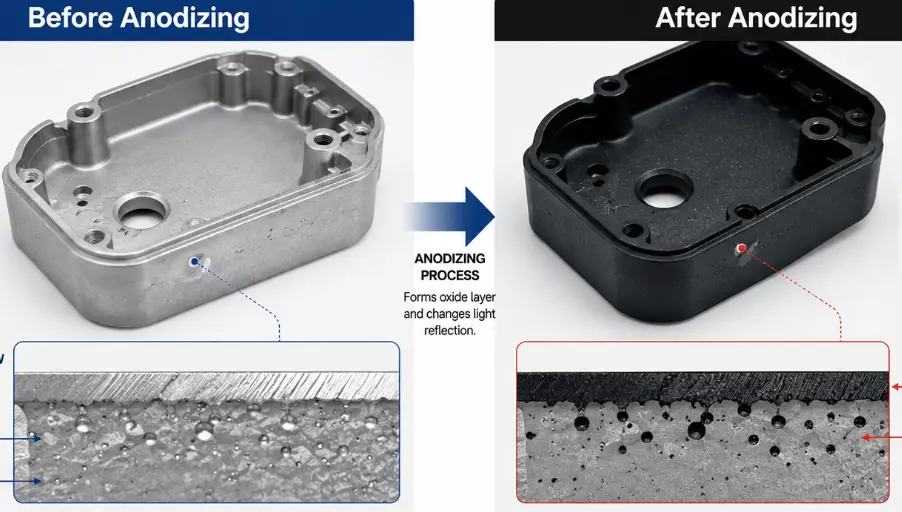
These problems become especially noticeable on:
- matte anodized finishes
- black anodized die cast aluminum parts
- brushed decorative surfaces
- products inspected under direct lighting
For this reason, anodizing die cast aluminum is often more sensitive to internal casting quality than many manufacturers initially expect.
🎯 Appearance-Sensitive Products Face Higher Porosity Risk
Not all anodized aluminum products require the same cosmetic standard.
For internal structural components, minor porosity may have little impact on function. But for exterior-facing products, surface consistency becomes much more critical.
This is particularly true for consumer electronics housings, lighting components, automotive trim parts, and premium industrial enclosures, where customers directly evaluate product quality through visible surface appearance.

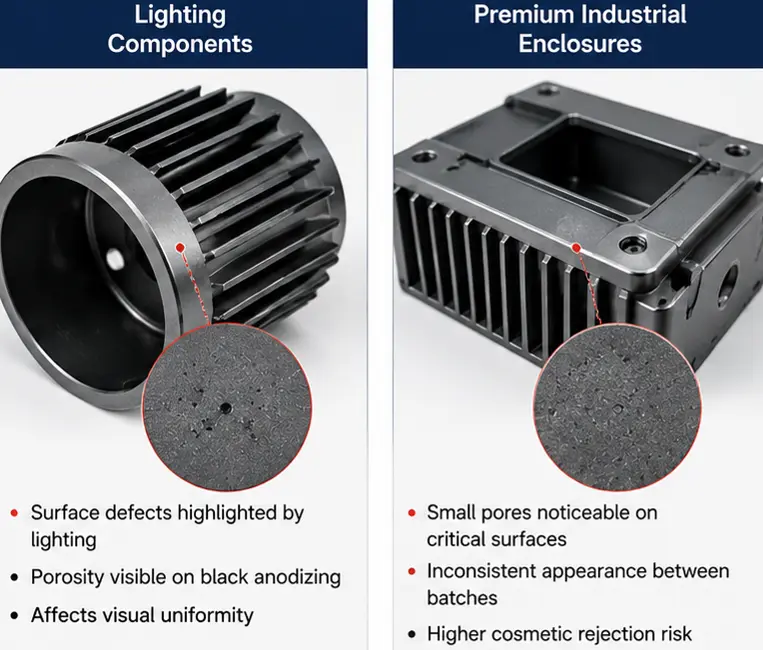
In these applications, anodizing may expose subtle casting inconsistencies that were nearly invisible before finishing.
As production volume increases, even small porosity variations between batches can create unstable inspection results and higher cosmetic rejection rates.
🔍 Some Surface Finishes Are Less Forgiving Than Others
During anodizing die cast aluminum applications, certain finishes make porosity defects easier to detect.
For example:
- matte textures scatter light unevenly around porous areas
- black anodizing increases visible contrast around surface defects
- brushed surfaces may highlight localized inconsistencies after anodizing
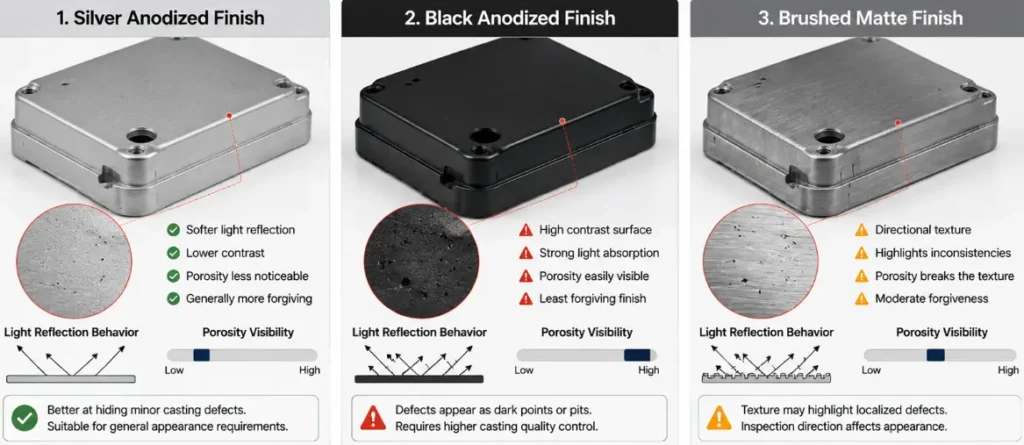
Because of this, the same die-cast aluminum part may perform acceptably with one finish, yet fail cosmetic inspection with another.
For manufacturers developing anodized die cast aluminum alloy parts, finish selection and casting quality often need to be evaluated together rather than separately.
🛠️ Reducing Porosity Risk Requires Stable Upstream Manufacturing
Many porosity-related finishing problems cannot be corrected during anodizing alone.
Once visible defects appear after anodizing, the root cause often originates earlier in production, including:
- casting stability
- mold condition consistency
- thermal balance control
- surface preparation quality
For this reason, manufacturers aiming for stable anodizing performance usually focus on reducing process variation across the entire production chain rather than relying solely on finishing adjustments.
In large-scale aluminum die-casting surface-finishing projects, porosity control is closely linked to long-term cosmetic stability and production yield.
Common Surface Defects in Anodized Die Cast Aluminum Parts
In mass production, even well-cast aluminum components can develop visible surface defects after anodizing.
For manufacturers producing anodized die cast aluminum parts, many of these problems are difficult to identify during early sample evaluation because some defects only become visible after the final oxide layer and decorative finish are completed.
In appearance-sensitive applications, these defects often affect not only cosmetic appearance, but also inspection consistency and long-term production yield.
One of the most common issues is uneven color or tone variation between parts and production batches. After anodizing, some components may develop:
- localized dark areas
- cloudy surface appearance
- inconsistent reflected light
- slight color variation between parts
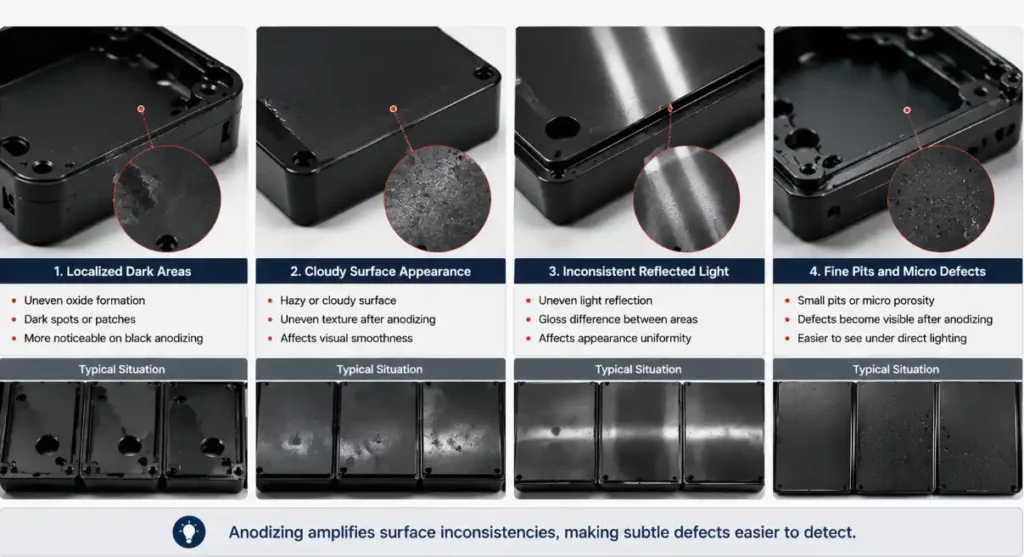
These problems become more noticeable on black anodized finishes, matte surfaces, and large visible exterior panels where lighting reflection consistency is important.
Some anodized die cast aluminum parts may also develop small visible surface imperfections that were difficult to detect before finishing. Under direct lighting, anodizing can make defects such as fine pits, isolated rough areas, or subtle micro-texture variation easier to see.
This is especially critical for consumer electronics housings, lighting products, brushed aluminum surfaces, and premium industrial enclosures, where customers directly evaluate surface quality at close viewing distance.
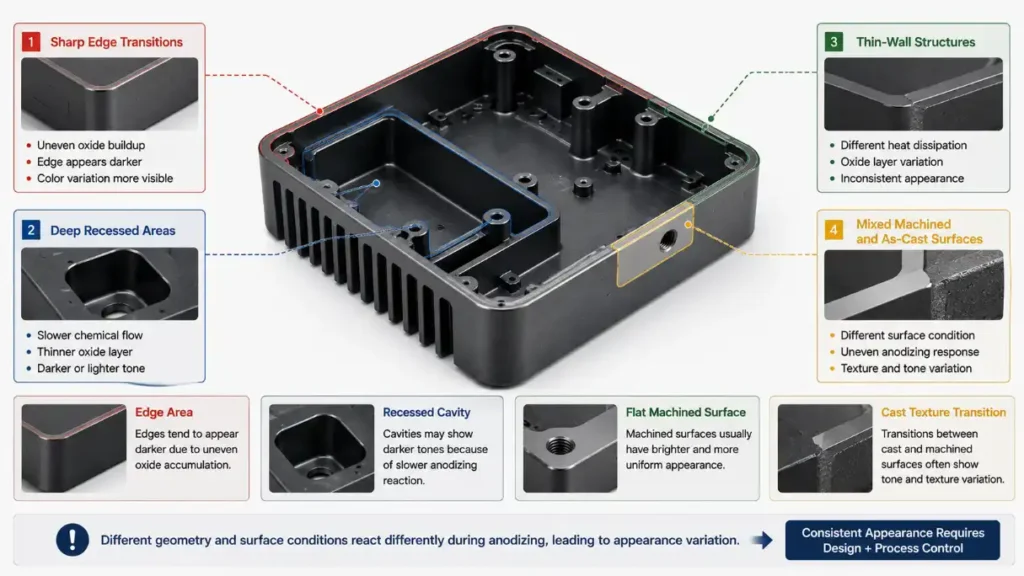
Part geometry can also influence anodizing consistency. Components with:
- sharp edge transitions
- deep recessed areas
- thin-wall structures
- mixed machined and as-cast surfaces
often show greater appearance variation after anodizing because different surface regions may react differently during finishing.
Not all anodized finishes expose defects at the same level. In production environments, matte textures and black anodizing usually reveal surface inconsistency more aggressively than lighter or less reflective finishes.
Because of this, stable anodizing results are often influenced not only by the anodizing process itself, but also by casting quality, part geometry, surface preparation, and finish selection throughout the entire manufacturing process.
How to Improve Stability When Anodizing Die Cast Aluminum
For manufacturers working with anodizing die cast aluminum alloys, the real challenge is usually not producing one acceptable sample part — it is maintaining a stable cosmetic appearance throughout mass production.
In many projects, anodizing problems begin to appear only after production volume increases. Parts that initially passed cosmetic inspection may later develop visible differences in color tone, reflected light consistency, or surface texture between batches.
Because of this, stable anodizing performance depends less on chasing perfect finishing parameters and more on reducing variation throughout the overall manufacturing process.
One of the most important steps is defining a realistic cosmetic standard before tooling and production validation begin. In some projects, appearance expectations are based on wrought aluminum benchmarks even though the actual product is produced by high-pressure die casting.
This often creates instability later in production, especially for:
- black anodized finishes
- matte decorative surfaces
- highly visible exterior housings
where even small surface inconsistencies may become noticeable during inspection.
Stable anodizing results usually require consistent control over:
- incoming part condition
- surface preparation quality
- machining and polishing consistency
- batch handling throughout production
rather than relying only on anodizing chemistry adjustments after defects appear.
Finish selection also has a direct impact on achievable production stability. Some finishes are naturally less forgiving and may amplify minor surface variation that would otherwise remain difficult to detect.
In many OEM programs, improving cosmetic yield is not achieved by eliminating all variation, but by selecting surface finishes that better match the realistic capability of the casting and finishing process.
For anodized die cast aluminum parts, long-term finishing stability is typically achieved when alloy selection, casting consistency, surface preparation, and anodizing requirements are evaluated together as a complete manufacturing system rather than as isolated production steps.
Work With Suppliers That Understand Both Casting and Surface Finishing
For anodized die cast aluminum parts, cosmetic quality is rarely determined by anodizing alone.
In many production environments, surface finishing problems actually originate much earlier in the manufacturing process. Variations in casting stability, trimming condition, machining consistency, or surface preparation may all influence how the final anodized surface appears after finishing.
This is why some die casting suppliers are able to produce dimensionally acceptable die castings, yet still struggle to maintain stable cosmetic results during anodizing production.
For appearance-sensitive products, especially those using:
- black anodized finishes
- matte decorative surfaces
- brushed aluminum textures
- visible exterior housings
small inconsistencies that appear insignificant before finishing may become much more visible after anodizing.
Manufacturers that achieve more stable anodizing results usually pay close attention not only to alloy selection and anodizing parameters, but also to:
- casting process consistency
- surface condition control
- polishing stability
- batch-to-batch variation management
Because anodizing tends to reveal existing surface variation rather than hide it, suppliers that understand both die casting and surface finishing are often better positioned to maintain long-term cosmetic consistency in mass production.
FAQ About Anodizing Die Cast Aluminum Alloys
Can ADC12 Be Used in Anodizing Die Cast Aluminum Applications?
Yes, ADC12 can be anodized, but it is usually less suitable for decorative anodizing. Its high silicon content often causes darker color, uneven appearance, and lower cosmetic consistency compared with wrought aluminum such as 6061.
Why Does Anodizing Die Cast Aluminum Sometimes Produce Dark Surfaces?
High-silicon die casting alloys such as ADC12 and A380 often produce darker anodized surfaces because silicon affects uniform oxide layer formation. This is a common limitation in anodizing die cast aluminum alloys.
Is A380 Better Than ADC12 for Anodizing?
A380 may provide slightly more stable anodized appearance in some applications, but it is still a high-silicon die casting alloy. For high-end decorative finishes, both A380 and ADC12 have cosmetic limitations compared with lower-silicon aluminum materials.
Why Do Surface Defects Become More Visible After Anodizing?
Anodizing changes how light reflects across the aluminum surface, which can make small defects easier to see. Porosity, polishing marks, and texture variation often become more noticeable after anodizing, especially on black or matte finishes.
Can Black Finishes Hide Defects When Anodizing Die Cast Aluminum?
Usually not. Black anodizing often increases visible contrast around pits, texture inconsistency, and small surface defects. This is why black anodized die cast aluminum parts typically require tighter cosmetic control.
Is 6061 Better Than Die Cast Aluminum for Decorative Anodizing?
For premium cosmetic appearance, anodized 6061 generally produces brighter and more uniform finishes than anodized die cast aluminum alloys. However, die casting still offers major advantages in production efficiency, tooling economy, and complex part manufacturing.
Conclusion
Successful anodizing die cast aluminum parts depends not only on the anodizing process itself, but also on alloy selection, casting consistency, and surface preparation stability throughout production.
For appearance-sensitive applications, understanding these manufacturing limitations early can help reduce cosmetic risk and improve long-term production consistency.
✨ Planning an Anodized Die Cast Aluminum Project?
If your project involves anodizing die cast aluminum parts that require both casting efficiency and stable cosmetic appearance, evaluating cosmetic risk early in development can help reduce production problems later.
For appearance-sensitive aluminum components, factors such as alloy selection, porosity control, surface preparation, and finishing consistency may all influence long-term anodizing stability during mass production.
Before tooling begins, many OEM teams typically prepare:
- 2D drawings or 3D CAD files
- target alloy requirements
- surface finish expectations
- estimated production volume
- cosmetic inspection standards
With this information, engineering teams can usually evaluate potential finishing risks earlier and recommend more stable manufacturing approaches for anodized die cast aluminum parts.