
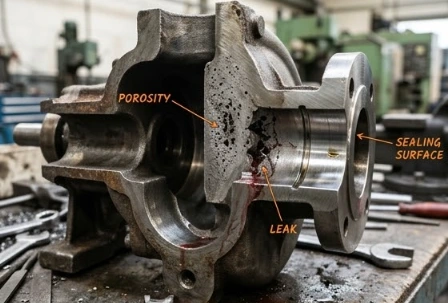
In practical production, most pump casting leakage issues are not caused by process instability, but by design decisions made long before tooling begins.
From real project experience, over 70% of leakage failures in pump housing casting can be traced back to three root causes:
- Solidification-related defects – such as shrinkage porosity forming internal leakage paths
- Sealing surface failure – caused by insufficient machining allowance or deformation
- Structural stress issues – including micro-cracks under pressure or thermal cycling
Unlike simple components, pump casting typically involves complex internal flow channels, multiple sealing interfaces, and pressure-bearing zones. These factors significantly increase the sensitivity to internal defects and dimensional deviations.
👉 Key engineering insight:
Leakage is not a “quality inspection problem”—it is fundamentally a design problem. Once tooling is completed, solving leakage issues often requires costly modifications or even redesign.
Why Pump Casting Leakage Is Difficult to Fix After Tooling
In pump casting projects, leakage problems are particularly difficult to correct after tooling because they are often embedded in the geometry itself, not just in the process.
Once the die is manufactured:
- Wall thickness distribution is fixed
- Internal flow channels cannot be modified
- Gating and venting options become limited
As a result, solving pump casting leakage after tooling often requires:
- Tool modification (limited effectiveness)
- Secondary sealing solutions (increased cost)
- Or complete redesign (highest cost)
👉 Engineering takeaway:
Leak-proof performance must be designed—not inspected.
Uneven Wall Thickness → Shrinkage Porosity Network
1. Root Cause
Non-uniform wall thickness leads to uneven cooling rates during solidification.
2. Failure Mechanism
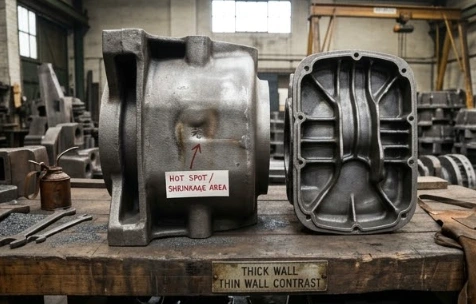
Thicker sections cool slower and continue to shrink after the surrounding material has solidified, forming shrinkage porosity. In many pump casting applications, these defects are not isolated—they form interconnected networks that create leakage paths.
3. Engineering Impact
- Leakage under pressure testing
- Reduced mechanical strength
- High rejection rate in product
4. Design Solution
- Maintain wall thickness variation within ±20%
- Avoid local hot spots exceeding 1.5× nominal thickness
- Use smooth transitions with fillets instead of sharp steps
🔧 Advanced Design Insight
In die casting pump parts, shrinkage defects often occur at junctions where thick ribs connect to thin walls. These areas act as thermal accumulation zones and are difficult to feed during solidification. Industry guidelines from organizations such as North American Die Casting Association highlight the importance of controlling solidification behavior in die casting design.
📌 Engineering Recommendation
- Design for directional solidification toward gates
- Avoid closed thick sections without feeding paths
- Use simulation tools to identify hot spots early
Poor Flow Channel Design → Air Entrapment & Turbulence
1. Root Cause
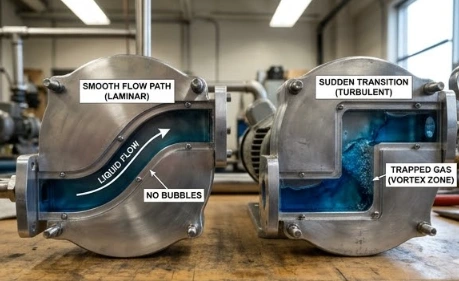
Abrupt geometry changes inside the flow channels disrupt molten metal flow.
2. Failure Mechanism
Turbulent flow traps gas within the molten metal, creating gas porosity. These defects are a major source of pump casting leakage, especially in internal channels that cannot be machined.
3. Engineering Impact
- Micro leakage not visible externally
- Inconsistent performance across batches
- Reduced reliability in fluid systems
4. Design Solution
- Avoid sudden cross-section changes (>30%)
- Maintain curvature radius ≥ 2× wall thickness
- Ensure smooth and continuous flow paths
🔧 Advanced Insight
In complex pump housing casting, flow behavior is strongly influenced by geometry. Even small design changes can significantly affect turbulence and air entrapment.
📌 Recommendation
- Use flow simulation (Mold Flow or CFD)
- Avoid dead zones where metal flow stagnates
- Balance flow paths in symmetrical designs
Improper Sealing Surface Design → Machining & Distortion Failure
1. Root Cause
Insufficient machining allowance or poor structural support around sealing areas.
2. Failure Mechanism
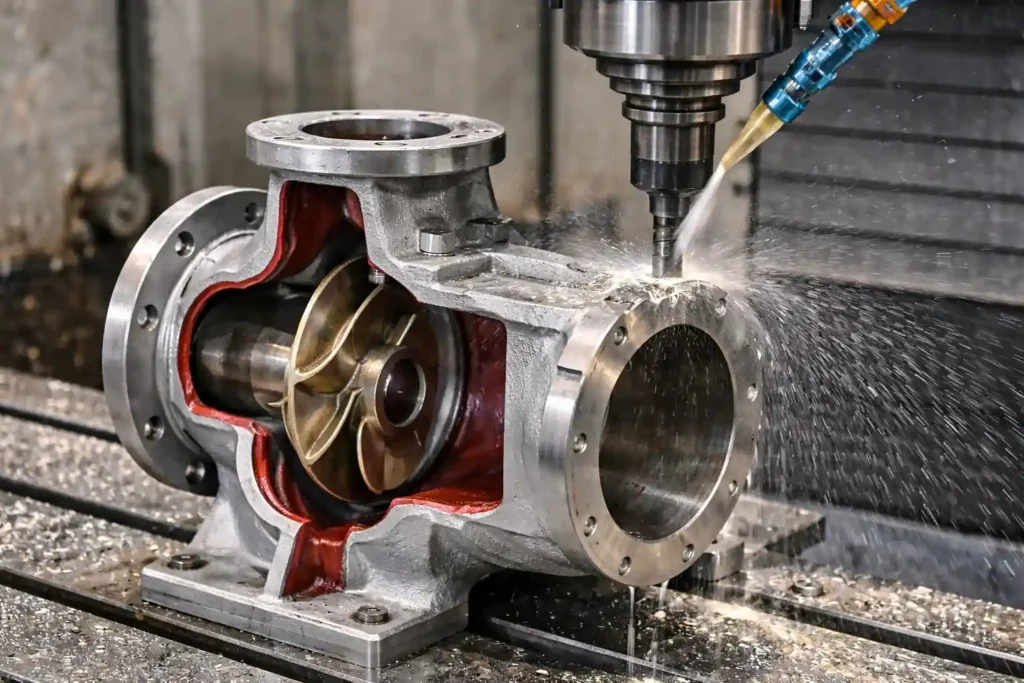
Sealing surfaces cannot achieve required flatness or are distorted after machining, leading to leakage even when casting quality appears acceptable.
3. Engineering Impact
- Leakage during assembly or operation
- High rework cost
- Reduced product reliability
4. Design Solution
- Machining allowance: 0.3–0.8 mm
- Flatness: typically ≤ 0.05 mm
- Clearly define sealing type (O-ring or metal contact)
🔧 Advanced Insight
In many pump casting projects, sealing failure is caused by residual stress rather than machining accuracy. Uneven cooling can lead to deformation after machining.
📌 Recommendation
- Avoid placing sealing surfaces near thick-thin transitions
- Ensure structural rigidity around sealing zones
- Consider stress-relief processes if necessary
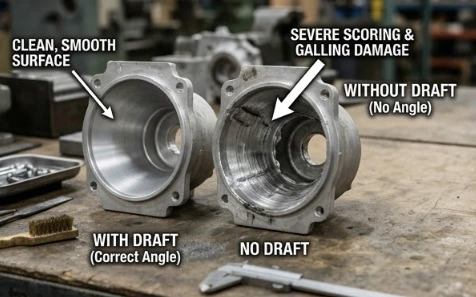
Insufficient Draft Angle → Surface Damage & Leakage Paths
1. Root Cause
Lack of proper draft angle in casting design.
2. Failure Mechanism
Parts stick to the die and experience surface tearing during ejection. These micro defects can develop into leakage paths under pressure.
3. Engineering Impact
- Surface quality issues
- Increased scrap rate
- Reduced sealing performance
4. Design Solution
- External surfaces: ≥ 1° draft
- Internal cavities: ≥ 2° draft
- Increase draft for deep or complex features
🔧 Advanced Insight
In high-volume pump casting manufacturing, insufficient draft not only affects quality but also shortens die life due to increased ejection force.
Over-Complex Internal Geometry → Unfillable & Uninspectable Design
1. Root Cause
Design exceeds the limits of casting and inspection processes.
2. Failure Mechanism
Certain internal areas cannot be fully filled or effectively inspected, resulting in hidden defects.
3. Engineering Impact
- Undetected porosity
- Leakage during field operation
- Difficulty in quality validation
4.Design Solution
- Minimum core diameter: ≥ 3 mm
- Depth-to-width ratio: < 4:1
- Simplify internal flow structures
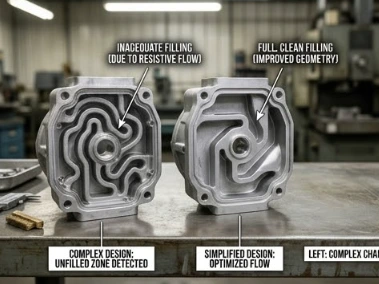
🔧 Advanced Insight
Even advanced inspection methods like X-ray cannot fully evaluate defect connectivity, which is critical in pump casting leakage.
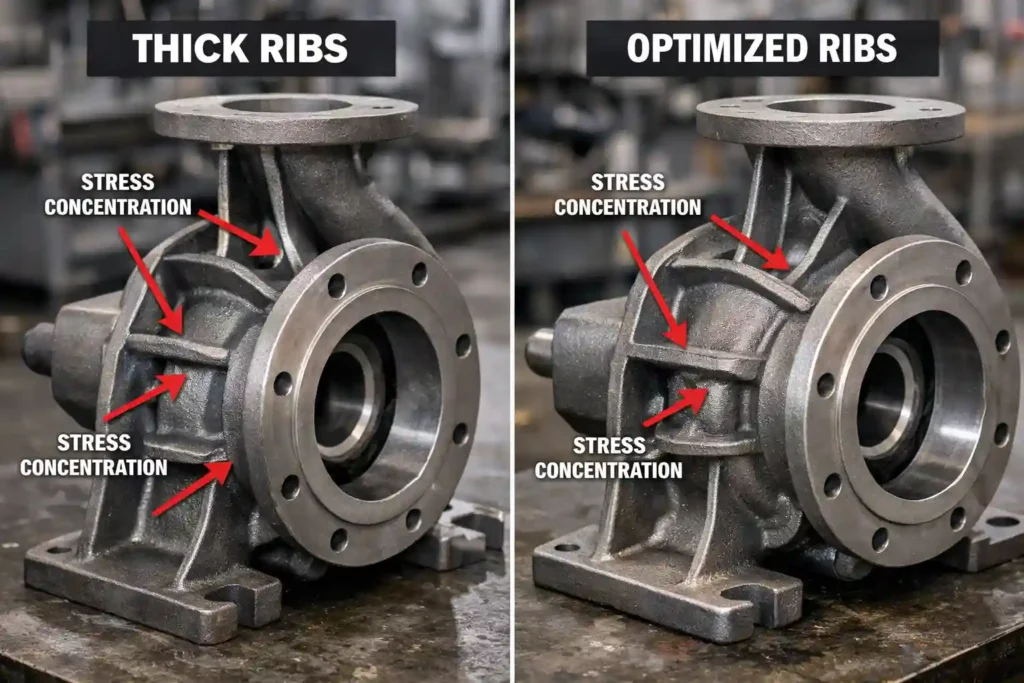
Improper Rib Design → Stress Concentration + Shrinkage
1. Root Cause
Ribs designed too thick or without proper transitions.
2. Failure Mechanism
Thick ribs create localized shrinkage, while sharp corners cause stress concentration. Combined, they lead to cracks and leakage.
3. Engineering Impact
- Structural failure under pressure
- Crack propagation over time
- Reduced fatigue life
4.Design Solution
- Rib thickness: 0.5–0.6× wall thickness
- Fillet radius: ≥ 0.25× thickness
- Avoid abrupt geometry changes
🔧 Advanced Insight
In pressure-bearing pump casting, rib design must balance structural strength and casting quality—overdesign can be as harmful as underdesign.
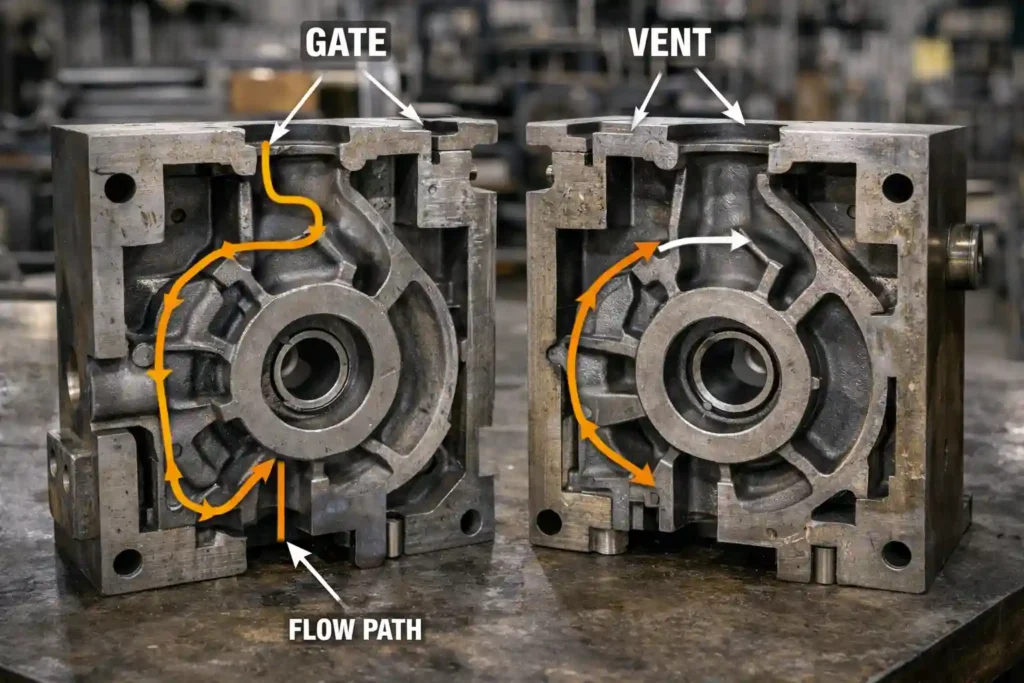
No Gating & Venting Consideration → Gas Porosity
1. Root Cause
Design is created without considering the die casting filling system.
2. Failure Mechanism
Improper gate location and lack of venting trap air inside the casting, forming porosity that leads to leakage.
3. Engineering Impact
- High porosity rate
- Inconsistent quality
- Increased tooling modification cost
4. Design Solution
- Place gates to ensure directional solidification
- Add vents at last-fill areas
- Avoid long flow lengths (>150 mm without venting)
🔧 Advanced Design Insight
Gate design directly determines porosity distribution in pump casting.
Poor design often leads to defects concentrated near sealing surfaces—the most critical areas.
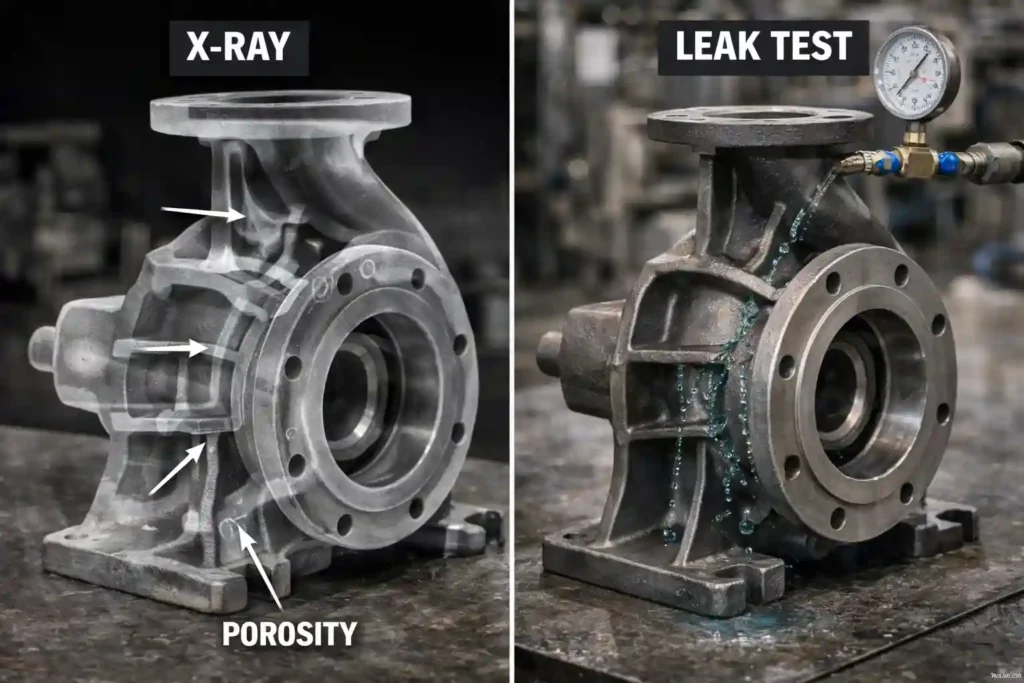
Failure Case: Why a Pump Casting Passes X-Ray but Still Leaks
1. Scenario
A pump housing casting passes X-ray inspection but fails hydrostatic testing.
2. Root Cause
Porosity forms connected micro-channels that allow fluid to pass under pressure.
3. Engineering Insight
X-ray evaluates defect size and distribution—but not connectivity.
4. Solution
- Combine X-ray with pressure testing
- Optimize design to eliminate connected defects
Critical Design Rules for Leak-Proof Pump Casting
| Design Feature | Recommended Value | Risk if Ignored |
|---|---|---|
| Wall thickness | Uniform (±20%) | Shrinkage porosity |
| Draft angle | 1°–3° | Surface damage |
| Rib thickness | ≤0.6T | Porosity & cracks |
| Machining allowance | 0.3–0.8 mm | Seal failure |
This table summarizes the key engineering rules for achieving reliable pump casting solutions.
Pump Casting vs Valve Casting: Why Pumps Are More Prone to Leakage
At first glance, both pump and valve components are pressure-containing cast parts. However, in real manufacturing, pump casting shows a significantly higher leakage risk than valve casting. This difference is not accidental—it is driven by fundamental differences in geometry, flow behavior, and functional requirements.
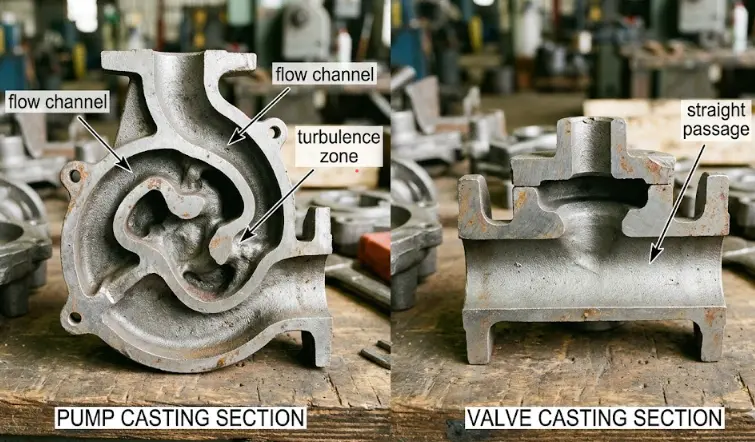
1. Internal Geometry Complexity Drives Defect Sensitivity
The most critical difference lies in internal structure.
Pump casting typically includes:
- Curved flow channels
- Variable cross-sections
- Impeller interaction zones
Valve casting usually features:
- Straight or simple passages
- More uniform wall sections
📌Engineering Impact
Complex internal geometry in pump housing casting leads to:
- Unstable metal flow during filling
- Increased turbulence and air entrapment
- Higher probability of internal porosity
In contrast, simpler geometry in valve casting allows for more predictable filling and solidification.
👉 Conclusion:
The more complex the internal flow path, the harder it is to control casting defects—and the higher the leakage risk.
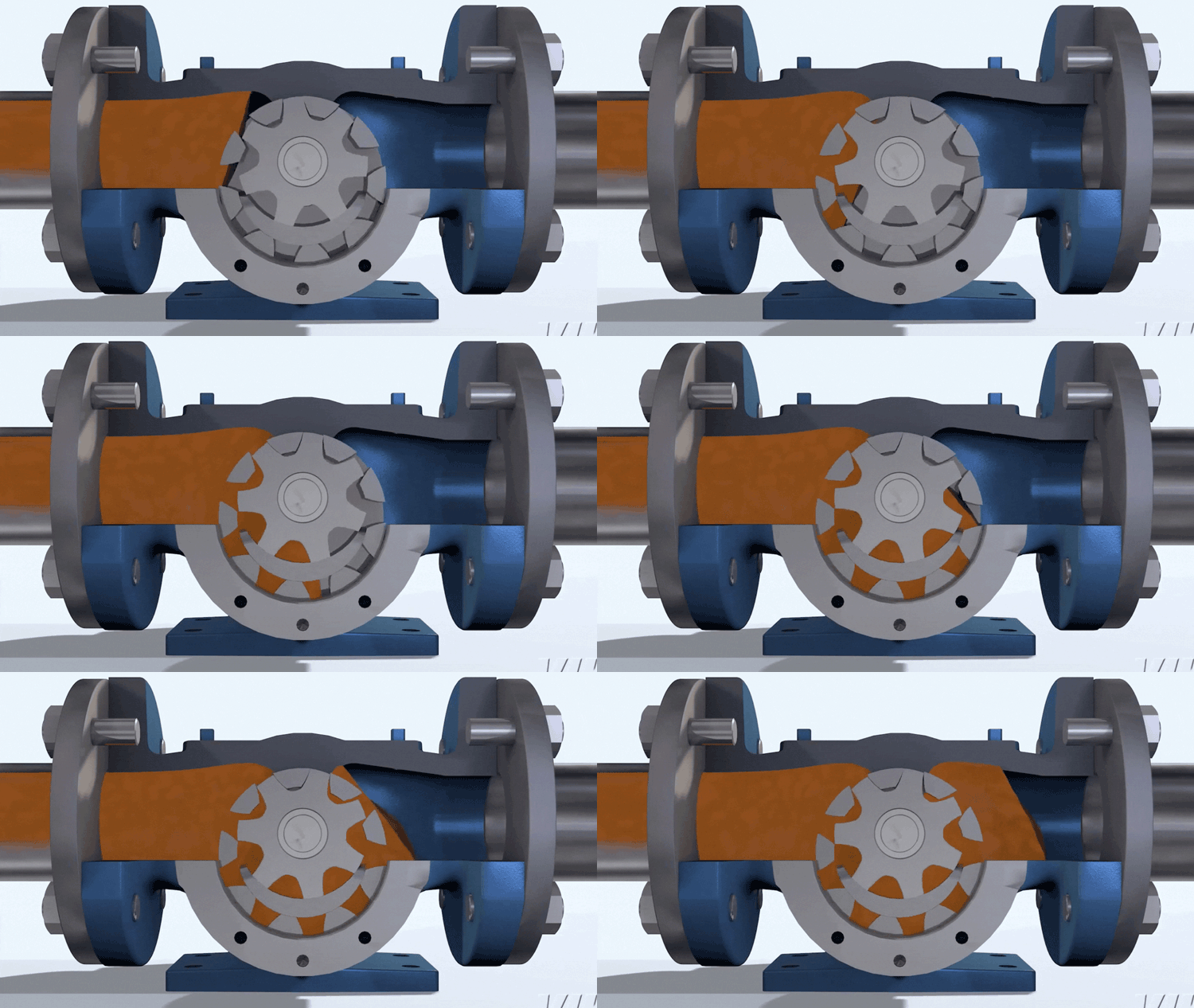
2. Flow Dynamics: Continuous Flow vs Intermittent Control
The functional difference between pumps and valves directly affects leakage sensitivity.
Pump casting operates under:
- Continuous fluid flow
- Dynamic pressure fluctuations
- High flow velocity zones
Valve casting typically operates under:
- Intermittent flow
- Static sealing conditions (when closed)
Engineering Impact
In pump casting, continuous flow creates:
- Erosion of weak internal surfaces
- Pressure-driven fluid penetration into micro defects
- Progressive leakage over time
Even small porosity that is initially harmless can evolve into leakage under cyclic flow conditions.
👉 Key Insight:
Pump components are exposed to both structural and fluid dynamic stress, while valves are primarily exposed to static pressure.
3. Pressure Distribution and Leakage Path Activation
Another critical difference is how pressure is distributed.
In pump casting:
- Pressure varies along the flow path
- Localized high-pressure zones exist
- Internal defects are more likely to be “activated”
In valve casting:
- Pressure is often more uniform
- Leakage paths are easier to isolate
Engineering Impact
In pump systems, pressure gradients can drive fluid through:
- Connected porosity networks
- Micro-cracks at stress concentration zones
- Imperfect sealing interfaces
This makes pump casting leakage more sensitive to even small internal defects.
4. Sealing Strategy: Distributed vs Localized Sealing
Sealing requirements differ significantly.
Pump casting:
- Multiple sealing interfaces
- Complex geometry around sealing zones
- Interaction between flow and sealing
Valve casting:
- Clearly defined sealing surfaces
- Easier machining and control
Engineering Impact
In pump housing casting, sealing surfaces are often located near:
- Flow channel transitions
- Structural ribs
- High thermal gradient areas
These conditions increase the risk of:
- Deformation
- Poor flatness
- Leakage initiation
5. Defect Tolerance: Pumps Are Less Forgiving
Perhaps the most important difference is defect tolerance.
Valve casting can tolerate:
- Small isolated porosity
- Minor surface defects
Pump casting typically cannot tolerate:
- Connected porosity
- Defects near flow channels
- Micro leakage paths
Engineering Insight
In pump casting, defects are not just structural issues—they directly interact with fluid flow.
👉 A defect that is harmless in a valve may become a leakage channel in a pump.
Summary Comparison
| Factor | Pump Casting | Valve Casting |
|---|---|---|
| Internal geometry | Complex | Simple |
| Flow condition | Continuous | Intermittent |
| Pressure behavior | Dynamic | Static |
| Sealing difficulty | High | Moderate |
| Defect tolerance | Low | Higher |
Practical Design Implication
For engineers working on pump casting design, this comparison leads to a clear conclusion:
- Design must prioritize leakage prevention, not just manufacturability
- Internal defects must be minimized—not just controlled
- Collaboration with an experienced pump casting manufacturer is critical at the design stage
👉 In short:
Pump casting requires a “zero-leakage mindset,” while valve casting often allows a “controlled defect mindset.”
How to Validate Leak-Proof Pump Castings
A robust validation process is essential for any custom pump casting project:
- X-ray inspection – detect internal porosity
- Air leak test – initial leakage screening
- Hydrostatic pressure test – simulate working conditions
- Helium leak test (if required) – high-precision detection
Reliable pump casting suppliers integrate these methods into their quality control systems.
When to Choose Die Casting for Pump Parts (And When Not To)
1. Suitable for:
- High-volume production
- Medium pressure applications
- Complex geometries
2. Not suitable for:
- Extremely high-pressure systems
- Thick-wall structures
- Zero-porosity requirements
Choosing the right process is critical for successful pump casting projects.
From Design to Production: How IEC Mould Prevents Leakage
At IEC Mould, leakage prevention starts before tooling:
- DFM analysis for pump casting design optimization
- Mold flow simulation to predict porosity risks
- Tooling design aligned with gating and venting strategy
- Precision CNC machining for sealing surfaces
- Leak testing based on customer requirements
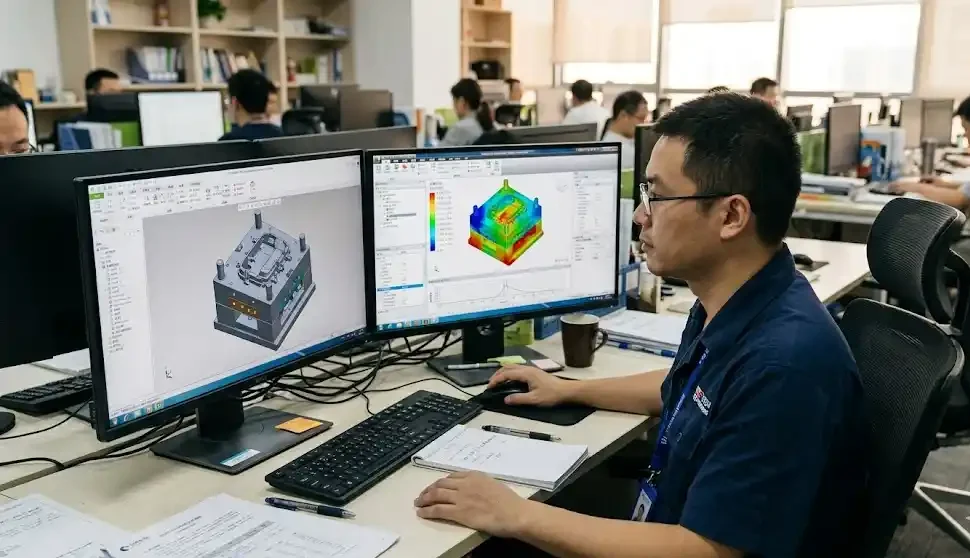
This integrated approach helps reduce risk in die casting pump parts and ensures stable production quality.
Avoid Costly Pump Casting Failures Before Tooling
In many cases, leakage problems are discovered only after tooling is completed—when modification costs can be 5–10× higher.
At IEC Mould, we help customers identify pump casting risks early, reducing both technical and financial uncertainty.
🔧What We Can Do
- Optimize your pump casting design for leak-proof performance
- Reduce porosity and sealing risks
- Support full production from casting to machining
📧What You Should Provide
- 3D drawings (STEP / IGES)
- Material requirements
- Annual volume
- Leakage or pressure specifications
👉 If you are developing a new pump housing casting, it is always better to validate the design before tooling starts.
FAQ
What is the most common cause of pump casting leakage?
Shrinkage porosity caused by uneven wall thickness is one of the most common causes.
Can pump casting be completely leak-proof?
With proper design and process control, leakage risk can be significantly reduced, but zero porosity is difficult to guarantee.
How much machining allowance is needed for sealing surfaces?
Typically between 0.3–0.8 mm depending on size and tolerance requirements.
Is die casting suitable for pump parts?
Yes, especially for high-volume die casting pump parts, but design must consider casting limitations.
How do you test leakage in pump castings?
Common methods include air leak testing, hydrostatic testing, and helium leak detection.