
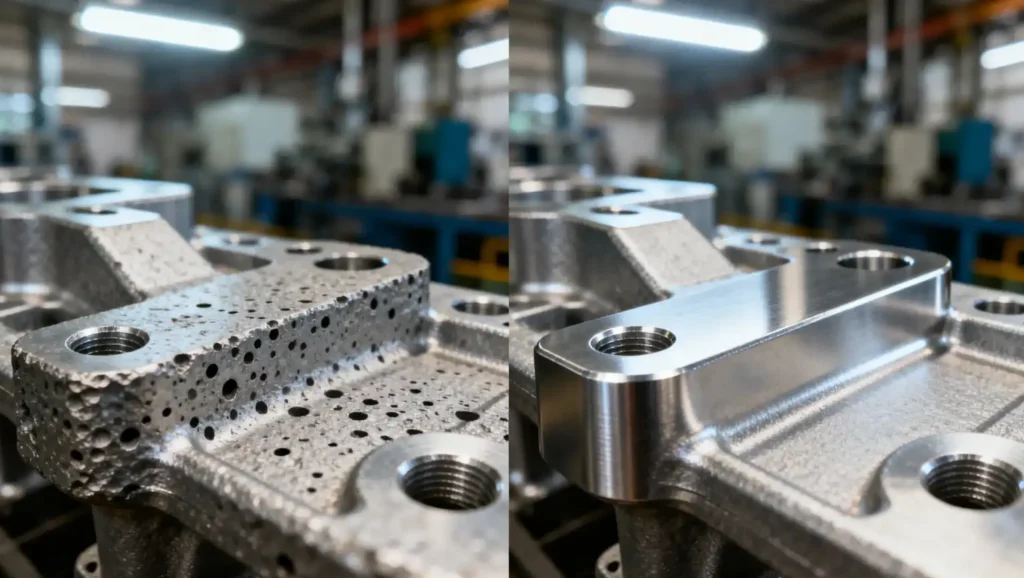
Die casting production often looks stable—until it isn’t.
Unexpected porosity, inconsistent cycle times, premature die failure, and rising scrap rates are common challenges that can quickly turn a profitable production line into a cost center. In many cases, these issues are not caused by a single factor, but by hidden instability across thermal control, process parameters, tooling, and material consistency.
This article breaks down the real reasons behind unstable die casting production and provides 7 proven engineering practices to help you achieve consistent quality, longer tool life, and predictable production performance.
What Is Stable Die Casting Production?
Stable die casting production refers to a manufacturing state where quality, process, and output remain consistently predictable over time—not just for a few cycles, but across thousands or even millions of shots.
In practical terms, stability is not about running fast. It’s about running consistently with minimal variation.
🔍 A Practical Definition
A die casting process can be considered stable when it achieves:
- ✅ Consistent part quality (dimension, surface finish, internal integrity)
- ✅ Controlled and low defect rate
- ✅ Repeatable cycle time
- ✅ Predictable tool life
- ✅ Stable and standardized process parameters
👉 In other words, you can reliably predict output, cost, and quality before production begins.
⚙️ Stable vs Unstable Production
| Factor | Stable Production ✅ | Unstable Production ❌ |
|---|---|---|
| Part Quality | Consistent, within tolerance | Fluctuating, frequent deviations |
| Defect Rate | Low and predictable | Random spikes |
| Cycle Time | Repeatable | Inconsistent |
| Tool Life | Long and predictable | Premature failure |
| Production Output | Reliable | Uncertain |
| Cost Control | Accurate and stable | Increasing and unpredictable |
📌 Key Takeaway
Stable die casting production is not achieved by chance—it is the result of controlled, repeatable manufacturing conditions throughout the entire process.
Why Die Casting Production Becomes Unstable
Stable die casting production depends on one critical condition: process consistency.
Once that consistency is disrupted, even slightly, the entire production system can begin to drift—leading to fluctuating quality, unpredictable defects, and increasing production risk.
In most cases, instability does not come from a single failure. It develops gradually, as small variations across the process accumulate and begin to interact.
🔍Instability Starts with Variation
At its core, die casting instability is caused by uncontrolled variation.
These variations may not be obvious at first. A slight temperature shift, a minor parameter change, or gradual tool wear can seem insignificant—but over time, they affect:
- Metal flow behavior
- Solidification consistency
- Internal stress distribution
👉 Once variation enters the process, repeatability is lost.
⚙️ Where Does This Variation Come From?
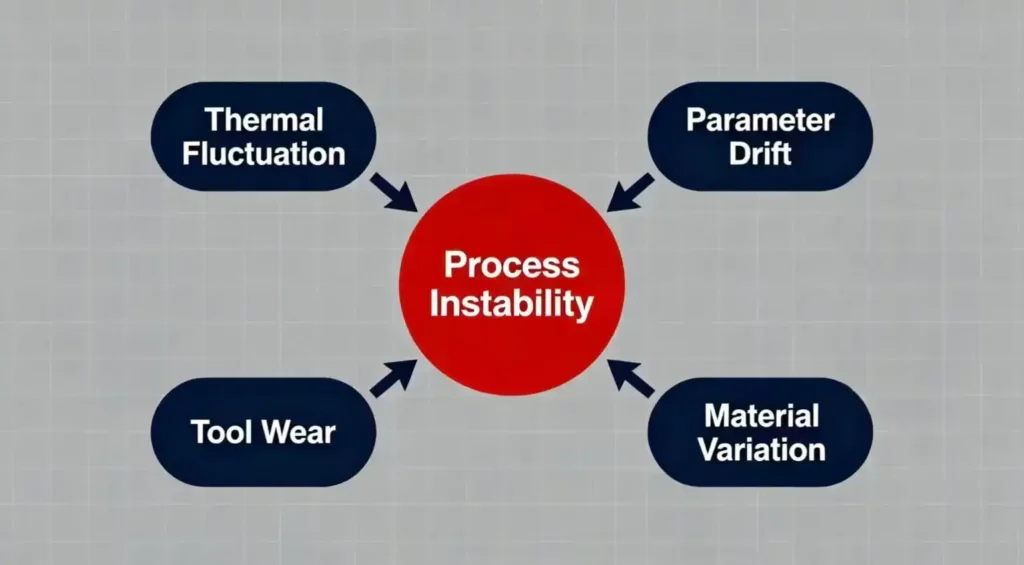
In real production environments, instability typically originates from four key areas.
🌡️1. Thermal Conditions
Die casting is highly temperature-sensitive.
When thermal conditions fluctuate or become unbalanced, the process becomes unpredictable.
👉 Result:
Inconsistent filling and solidification behavior
⚙️2. Process Control
Stable production requires parameters to remain consistent from shot to shot.
When process settings drift or rely too heavily on manual adjustment:
👉 Result:
Loss of repeatability and increasing defect variation
🧱3. Tooling Condition
The die is not static—it degrades over time.
Without proper control, wear, micro-cracks, and surface changes gradually alter how the process behaves.
👉 Result:
Production performance slowly becomes unstable
🔩4. Material Consistency
Even small variations in alloy composition or melt condition can influence how metal flows and solidifies.
👉 Result:
Batch-to-batch inconsistency in casting quality
🧠 Key Insight: Instability Is a Chain Reaction
One of the most overlooked realities in die casting: Instability is not isolated—it is interconnected.
7 Engineering Practices to Achieve Stable Die Casting Production
Once instability appears in die casting, many teams respond in the same way—by adjusting parameters, slowing production, or relying on operator experience.
But these are temporary fixes.
👉 Stable production is not achieved by reacting faster.
It is achieved by removing the sources of variation at the system level.
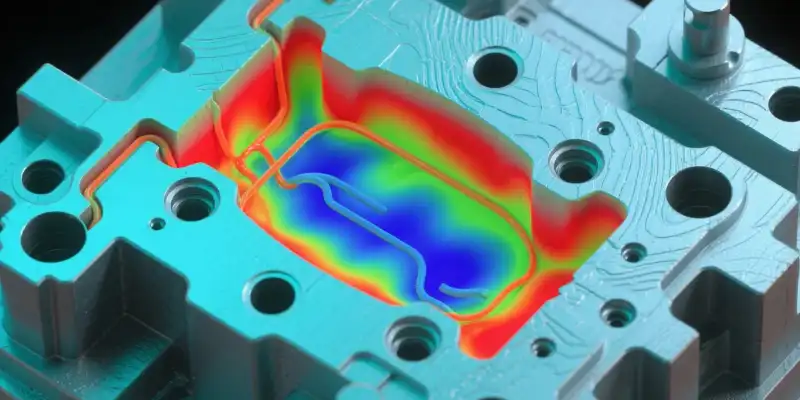
🌡️ 1. Control Die Temperature—Not Just Cooling
If your defect rate changes from shift to shift, temperature is often the hidden cause. In many factories, cooling is present, but thermal balance is not.
What actually matters is:
- Whether the temperature is evenly distributed
- Whether it remains stable over time
When thermal conditions are controlled:
- Metal flows more predictably
- Solidification becomes consistent
- Tool stress is significantly reduced
👉 This is often the first breakthrough in stabilizing production.
⚙️ 2. Lock Process Parameters Instead of Constantly Adjusting
Frequent parameter adjustments may feel like “fine-tuning,” But in reality, they introduce instability.
Stable die casting production requires:
- Defined parameter windows
- Controlled injection profiles
- Minimal operator intervention
When parameters are standardized:
- Each shot behaves the same
- Defects become predictable (and reducible)
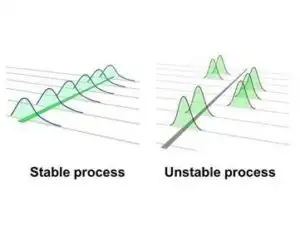
👉 If your team is constantly adjusting settings, the process is not under control.
🧱 3. Build Stability into the Tooling
Many stability issues are not “process problems”—they are tooling limitations.
For example:
- Poor heat dissipation leads to thermal imbalance
- Weak gating design causes inconsistent filling
- Inadequate tool steel accelerates wear
Optimized tooling design and material selection:
- Reduce variation at the source
- Improve long-term repeatability
👉 Stable production starts with a stable mold.
🛡️ 4. Reduce Surface-Related Instability
Sticking, surface defects, and inconsistent release are often overlooked—but they directly disrupt production rhythm.
By improving the die surface condition:
- Ejection becomes consistent
- Cycle interruptions are reduced
- Surface quality stabilizes
👉 Small surface improvements can significantly improve overall stability.
🔩 5. Keep Material Behavior Consistent
Even with a perfect setup, unstable material will break consistency.
In practice, this shows up as:
- Same parameters, different results
- Batch-to-batch variation
Controlling melt condition and alloy consistency ensures predictable flow behavior and consistent internal structure.
🛠️ 6. Prevent Problems Before They Appear
Instability often builds silently. A die may look “fine” externally, while internally, micro-cracks are forming, and cooling efficiency is dropping.
Without preventive maintenance:
- Small deviations accumulate
- Stability gradually disappears
👉 The goal is not to fix problems—it’s to stop them from appearing.
📊 7. Replace Guesswork with Data
When die casting production relies on experience alone, stability is difficult to maintain. Leading manufacturers now use temperature monitoring, pressure tracking, and cycle consistency data. This allows them to detect variation early, identify root causes faster, and maintain consistent production conditions.
👉 Data turns unstable processes into controllable systems.
🧠 What This Means in Practice
If your die casting production feels unpredictable, the issue is not a single parameter or machine setting.
👉 It is a system-level lack of control.
The companies that achieve stable die casting production do not rely on trial-and-error. They build processes where variation is minimized, conditions are controlled, and results are repeatable.
📌 A Practical Perspective
In many real-world cases, improving just 2–3 of the areas above can reduce defect rates significantly, extend tool life, and stabilize daily production output.
Key Metrics to Measure Production Stability
Stable die casting production is not based on feeling—it is measured.
Many production teams believe their process is “mostly stable,” but without clear metrics, instability often goes unnoticed until defects increase or costs rise.
👉 To truly control stability, you need to track a small set of high-impact, decision-making metrics.
🔍 The 5 Metrics That Actually Matter
Instead of tracking everything, focus on the indicators that directly reflect process consistency and variation:
📊 1. Defect Rate (Scrap Rate)
What it tells you: How consistent is your quality output?
- A stable process maintains a low and predictable defect rate
- Sudden spikes usually indicate process variation
👉 If your defect rate fluctuates week to week, your production is not stable—even if the average looks acceptable.
⏱️ 2. Cycle Time Consistency
What it tells you: Whether your process is repeatable.
- Stable production = nearly identical cycle time per shot
- Variation often signals thermal imbalance, ejection issues, and process interruptions.
👉 It’s not the speed that matters—it’s the consistency of speed.
🔧 3. Tool Life (Shots per Die)
What it tells you: How controlled are your overall process conditions?
- Stable processes produce a predictable tool lifespan
- Early failure usually indicates excessive thermal stress and a material or design mismatch.
👉 Tool life is a long-term indicator of stability—not just tooling quality.
📉 4. Process Capability (Cp / Cpk)
What it tells you: How well your process stays within tolerance.
- High Cpk = consistent, centered production
- Low Cpk = variation and risk of defects
👉 This is one of the most important metrics for automotive, precision components, and high-volume production.
🔁 5. Batch-to-Batch Consistency
What it tells you: Whether your process is stable over time, not just within a single run.
Signs of poor consistency:
- Same parameters, different results
- Quality variation between shifts or days
👉 This often points to material inconsistency, temperature drift, and lack of standardized control.
⚙️ Quick Stability Benchmark (Practical Reference)
| Metric | Stable Production ✅ | Warning Sign ⚠️ |
|---|---|---|
| Defect Rate | Low & consistent | Fluctuating or trending up |
| Cycle Time | Repeatable | Frequent variation |
| Tool Life | Predictable | Early or inconsistent failure |
| Cpk | ≥ 1.33 (or higher) | < 1.0 |
| Batch Consistency | Uniform across runs | Differences between batches |
🧠 Key Insight
You cannot stabilize what you do not measure. Many instability issues are not caused by lack of effort—but by lack of visibility.
When these metrics are tracked consistently:
- Variation becomes visible
- Root causes become traceable
- Improvements become measurable
📌 What This Means for Your Production
If you are currently facing unexplained defects, inconsistent output, and rising production costs.
👉 Start by measuring—not guessing.
Even implementing 2–3 of these metrics can quickly reveal where instability is coming from.
Common Mistakes That Destroy Die Casting Production Stability
In die casting, instability rarely comes from a lack of effort.
More often, it comes from well-intentioned actions that unintentionally introduce variation into the process.
These mistakes are common—even in experienced production teams—and they tend to follow the same pattern:
Trying to fix symptoms instead of controlling the system.
⚠️ Mistake 1: Prioritizing Speed Over Process Consistency
In pursuit of higher output, production is often pushed beyond stable limits.
Cooling time is reduced, cycle time is compressed, and the process window becomes narrower.
👉 The result is predictable:
- Increased defect rates
- Higher scrap and rework
- Greater stress on tooling
Faster production without stability does not reduce cost—it increases it.
⚠️ Mistake 2: Using Parameter Adjustment as a “Solution.”
When defects appear, operators often respond by adjusting machine settings.
While this may provide short-term relief, it introduces a deeper issue:
👉 The process becomes dependent on constant correction instead of control.
Over time:
- Parameter windows drift
- Repeatability disappears
- Root causes remain hidden
Frequent parameter adjustment is not optimization—it is a sign of instability.
⚠️ Mistake 3: Assuming the Die Will Perform Consistently Over Time
Many teams treat tooling as a fixed condition.
In reality, the die is continuously changing due to:
- Thermal cycling
- Surface wear
- Micro-crack development
Without active control:
- Process behavior gradually shifts
- Previously stable conditions no longer apply
A die that is not managed will eventually become a source of variation.
⚠️ Mistake 4: Ignoring Early-Stage Process Variation
Instability does not appear suddenly—it develops gradually.
Early indicators are often subtle:
- Slight increases in defect frequency
- Minor cycle time fluctuations
- Small changes in surface quality
Because these signals seem manageable, they are often overlooked.
👉 By the time action is taken, instability has already spread.
Small variations are easy to fix—once they grow, they become expensive problems.
⚠️ Mistake 5: Relying on Experience Instead of Measurable Control
Operator experience is valuable—but it is not a substitute for process control.
Without data:
- Decisions become subjective
- Variation cannot be quantified
- Improvements cannot be standardized
👉 This leads to inconsistency between shifts, operators, and production runs.
Stable die casting production requires visibility—not guesswork.
⚠️ Mistake 6: Fixing Problems in Isolation
A common approach to troubleshooting is to address issues one at a time.
However, die casting is a highly interconnected process:
- Thermal conditions affect flow
- Flow affects defects
- Defects affect tooling stress
When only one element is adjusted:
- Short-term improvement may occur
- New problems often appear elsewhere
Local fixes do not create global stability. System control does.
🧠 Key Insight
Across all these mistakes, one pattern becomes clear:
Instability is not caused by a single wrong action—but by a lack of system-level control.
📌 What This Means for Your Production
If your production repeatedly encounters:
- Fluctuating defect rates
- Inconsistent output
- Unpredictable tooling performance
👉 The issue is unlikely to be a single parameter or machine setting.
It is more often a sign that the process is being managed reactively instead of controlled systematically.
🎯 Final Takeaway
Stable die casting production is not achieved by fixing problems faster—it is achieved by preventing variation from entering the process.
Case Study: How Stable Die Casting Production Reduced Cost by 30%
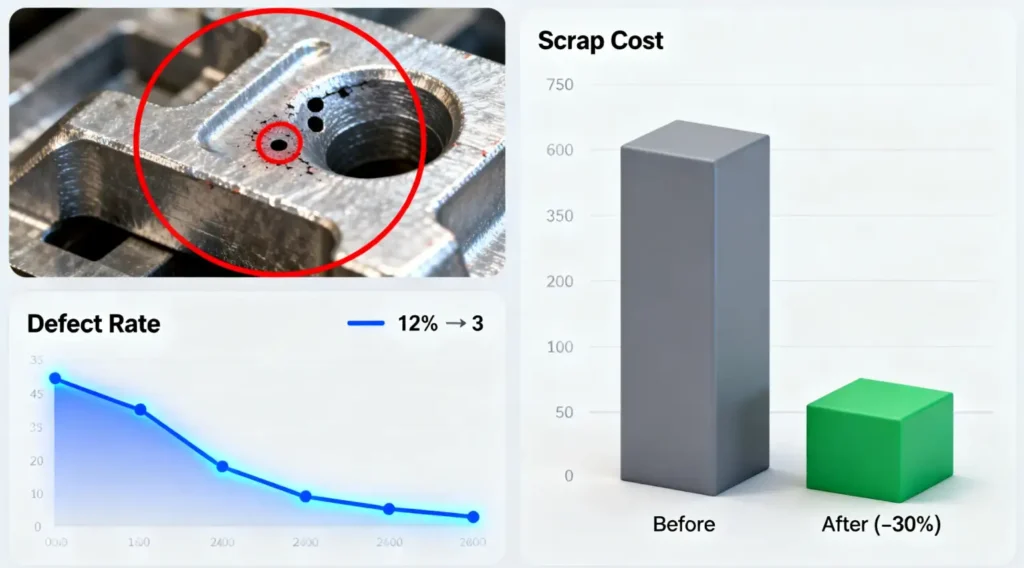
For many manufacturers, “stability” sounds like a theoretical goal—until it directly impacts cost, delivery, and customer satisfaction.
The following case shows how addressing process instability at the system level can deliver measurable, real-world results.
🏭 Project Background
A mid-to-high volume aluminum die casting project for an industrial component was facing ongoing production challenges:
- Defect rate fluctuating between 8%–12%
- Frequent porosity issues affecting internal quality
- Cycle time inconsistent across shifts
- Tooling showing early signs of thermal fatigue
Despite repeated parameter adjustments, the problems persisted.
The process was being managed—but not controlled.
🔍 Root Cause Analysis
Instead of continuing trial-and-error adjustments, a structured review of the production system was conducted.
Key findings:
- Thermal imbalance across the die led to inconsistent solidification
- Process parameters varied between operators and shifts
- Tool surface degradation increased sticking and cycle interruptions
- Lack of monitoring made early-stage variation invisible
👉 None of these issues alone caused failure—but together, they created instability.
⚙️ Actions Implemented
Rather than applying isolated fixes, the team focused on system-level stabilization:
- Improved die temperature control to maintain thermal balance
- Standardize critical process parameters across all shifts
- Applied surface treatment to reduce sticking and wear
- Introduced basic monitoring for temperature and cycle consistency
The goal was not to optimize speed—but to restore repeatability.
📊 Results Achieved
Within a controlled production period, the following improvements were observed:
| Metric | Before ❌ | After ✅ |
|---|---|---|
| Defect Rate | 8% – 12% | 3% – 5% |
| Cycle Time Stability | Inconsistent | Repeatable |
| Tool Life | Early degradation | Significantly extended |
| Scrap Cost | High and variable | Reduced by ~30% |
🧠 Key Insight
What made the difference was not a single adjustment—but a shift in approach:
From reactive troubleshooting to proactive process control.
📌 What This Means for You
If your current die casting production shows recurring defects, inconsistent output, and rising tooling or scrap costs
👉 The issue is likely not isolated—it is systemic.
And more importantly:
Stability improvements do not require a complete overhaul.
Even targeted changes in the right areas can deliver significant cost reduction.
🎯 Practical Takeaway
Most unstable die casting production lines already have the necessary equipment and capability.
What they lack is process consistency, parameter control, and system-level visibility.
How to Choose a Reliable Die Casting Production Partner
Even with optimized processes, production stability ultimately depends on your die casting partner.
A supplier may have advanced equipment and strong capacity—but if their process is not controlled, stability cannot be guaranteed.
🔍 What to Look for in a Stable Production Partner
Instead of focusing only on price or capacity, evaluate whether the supplier can consistently control variation.
⚙️ 1. Tooling Engineering Capability
A reliable partner should be able to design tooling that supports:
- balanced flow
- thermal stability
- long tool life
👉 Stability starts at the mold design stage.
🌡️ 2. Process Control, Not Just Operation
Ask whether their production is:
- standardized
- documented
- repeatable across shifts
👉 If results depend on operator experience, stability is at risk.
📊 3. Data Visibility
Look for the ability to:
- monitor key process variables
- trace defects
- maintain consistency over time
👉 Without data, there is no real control.
🛠️ 4. Maintenance Discipline
Stable suppliers proactively manage:
- tooling wear
- cooling systems
- process drift
👉 This prevents gradual loss of stability.
🧠 Key Insight
A reliable die casting partner is not defined by capacity—but by their ability to maintain stable, repeatable production.
Next Step – Improve Your Die Casting Production Stability
If you have read this guide, you can already identify that die casting stability is not controlled by a single factor, but by the overall consistency of your process, tooling, and material system.
For many manufacturers, the next challenge is not understanding the problem—but deciding where to start improving first.
🔍 Start With a Simple Technical Check
Before making large process changes, it is often more effective to first evaluate:
- Where variation is coming from in your process
- Whether tooling design is supporting stable production
- Whether key parameters are truly standardized
- Whether defects are repeatable or random
👉 In most cases, the biggest gains come from identifying the top 1–2 instability sources, not changing everything at once.
⚙️ What Typically Delivers the Fastest Stability Improvement
Based on real die casting projects, improvements are usually achieved by focusing on:
- Thermal balance of the die system
- Consistency of injection and holding parameters
- Tool condition and maintenance status
- Material stability and melt control
👉 Even small improvements in these areas can significantly reduce variation.
📌 Final Takeaway
If your current die casting production shows signs of instability, such as fluctuating defect rates or inconsistent cycle times, the most effective next step is not trial-and-error adjustments but a structured evaluation of your process system.