High-pressure die casting is a manufacturing process in which molten metal is injected into a steel mold at high pressure and speed to produce precise metal parts.
The high pressure die casting process typically includes die preparation, molten metal injection, solidification under pressure, die opening, and part ejection. Each step plays a critical role in determining product quality, cycle time, and production cost.
In this guide, we break down how the high pressure die casting process works step by step, with practical insights into machines, parameters, and real-world manufacturing considerations.
What Is High Pressure Die Casting?
High pressure die casting (HPDC) is a high-efficiency manufacturing method used to produce metal parts in large volumes with excellent dimensional accuracy and surface finish. It works by forcing molten metal—typically aluminum, zinc, or magnesium—into a hardened steel mold under high pressure.
🔧 What makes this process unique is the combination of:
- High injection speed
- High pressure (typically 40–150 MPa)
- Reusable steel dies
Unlike sand casting or gravity casting, the high pressure die casting process allows manufacturers to produce complex geometries, thin walls, and tight tolerances in a matter of seconds.
⚙️ Why It’s Widely Used
High-pressure die casting is commonly used in industries where consistency and productivity matter:
- 🚗 Automotive (engine housings, brackets, EV components)
- 🔌 Electronics (heat sinks, enclosures)
- 🏭 Industrial equipment
Because the molds are reusable and the cycle time is short, HPDC is especially suitable for high-volume production.
📌 Key Takeaway
The high pressure die casting process is best suited for producing complex, high-precision metal parts in large volumes with consistent quality.
High Pressure Die Casting Process Overview
The high pressure die casting process is a fast, high-precision manufacturing method used to produce metal parts in large volumes. It involves a controlled sequence of steps designed to ensure consistent quality and dimensional accuracy.
🔄 The Core Steps of the High Pressure Die Casting Process
| Step | Process Stage | What Happens |
|---|---|---|
| 1 | Die Preparation | The mold is cleaned, lubricated, and preheated |
| 2 | Metal Injection | Molten metal is injected at high speed and pressure |
| 3 | Solidification | Metal cools and solidifies under pressure |
| 4 | Die Opening | The mold halves separate |
| 5 | Part Ejection | Ejector pins push out the casting |
| 6 | Trimming & Finishing | Excess material is removed and surfaces refined |
⚙️ Key Points
- The process is high-speed, with typical cycles ranging from 20 to 60 seconds
- Suitable for aluminum, zinc, and magnesium alloys
- Ideal for complex shapes, thin walls, and high-volume production
📌 Key Takeaway
The high-pressure die casting process consists of six main steps—from die preparation to finishing—completed in seconds, making it ideal for high-volume, precision manufacturing.
Step-by-Step High Pressure Die Casting Process
The high-pressure die casting process may look simple on the surface, but in reality, each step must be precisely controlled to ensure consistent quality. Below is a detailed breakdown of how the process works in a real production environment.
🔹 Step 1 – Die Preparation
Before any metal is injected, the die (mold) must be properly prepared. This step is often underestimated, but it has a direct impact on part quality and tool life.
🔧 What happens in this stage:
- The die cavity is cleaned to remove residue from the previous cycle
- A lubricant is sprayed onto the mold surface
- The die is brought to a controlled operating temperature
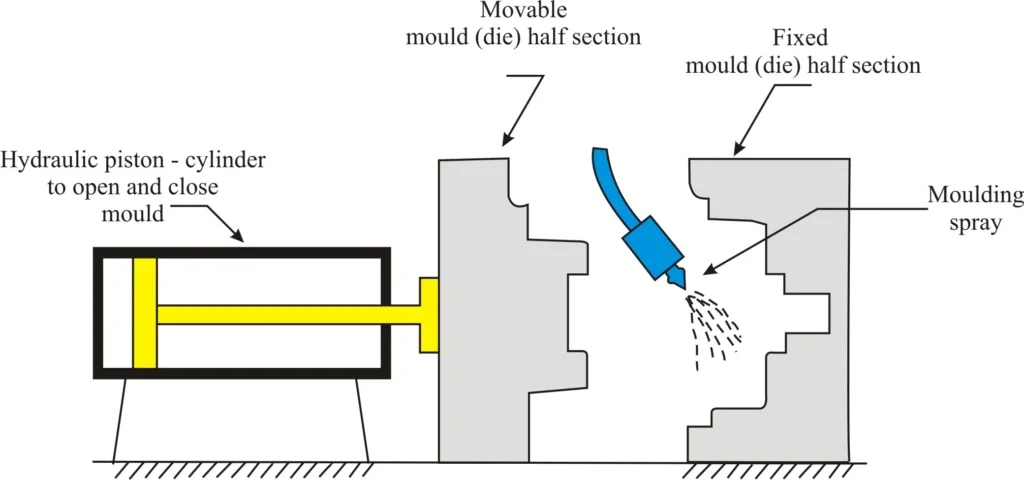
🌡️ Why temperature matters:
If the die is too cold, molten metal may solidify too quickly, leading to defects such as incomplete filling. If it’s too hot, it can increase cycle time and reduce tool life.
👉 In a stable high pressure die casting process, die temperature is carefully maintained within a narrow range.
🔹 Step 2 – Molten Metal Injection
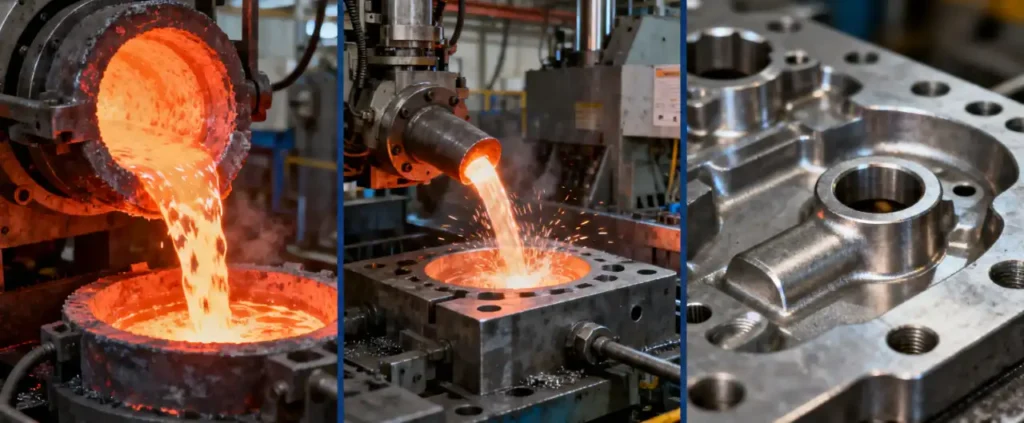
This is the most critical stage of the entire high pressure die casting process. Molten metal is injected into the die cavity at extremely high speed and pressure.
⚙️ Key actions:
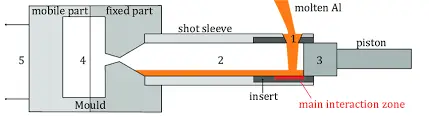
- Molten aluminum (or zinc) is poured into the shot sleeve
- A plunger pushes the metal into the die
- The cavity is filled in milliseconds
🔍 Inside the Shot Sleeve: The Main Interaction Zone
As illustrated in the cross-section diagram beside, the journey begins as the molten Al is transferred into the shot sleeve. The piston then advances at a controlled velocity, driving the metal past the insert and into the main interaction zone—the narrow gateway where the metal accelerates to over 40 meters per second before dispersing into the mould cavity.
📊 Typical Process Parameters
| Parameter | Typical Range |
|---|---|
| Injection Pressure | 40–150 MPa |
| Injection Speed | Very high (fast fill) |
| Metal Temperature (Aluminum) | 650–700°C |
🎯 Why this step is critical:
- Too slow → cold shut / misrun
- Too fast → turbulence → gas porosity
- Unstable pressure → internal defects
👉 Experienced engineers optimize injection speed in stages (slow → fast) to balance flow and air evacuation.
🔹 Step 3 – Solidification Under Pressure
Once the cavity is filled, the metal begins to cool and solidify—but pressure is still applied during this stage.
❄️ What happens:
- Heat is rapidly transferred to the steel die
- The metal solidifies from the surface inward
- Pressure is maintained to compensate for shrinkage
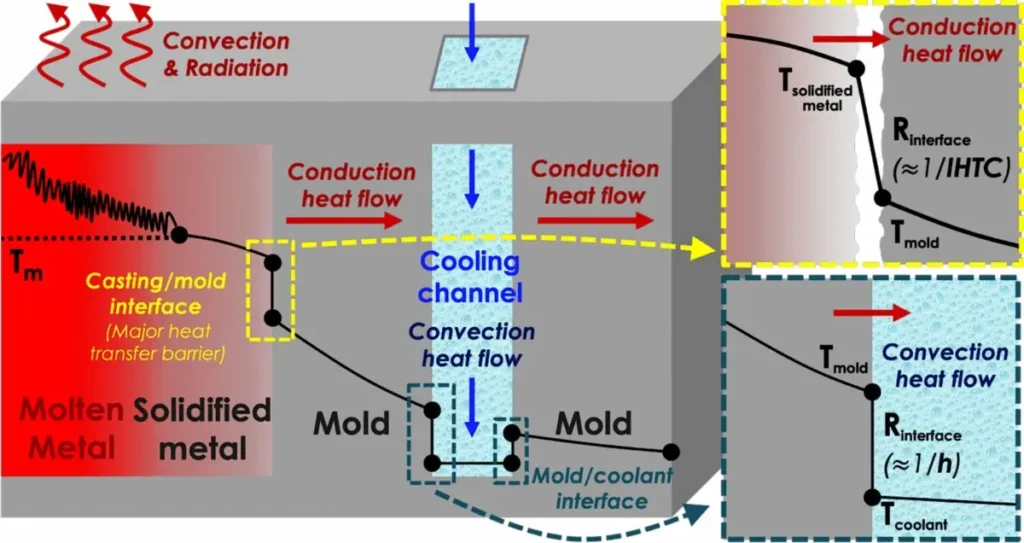
🔍 Why pressure during solidification is important:
Without sufficient pressure, shrinkage cavities can form inside the part. Maintaining pressure ensures:
- Better density
- Reduced porosity
- Improved mechanical strength
👉 This is a defining feature of the high pressure die casting process compared to other casting methods.
🔹 Step 4 – Die Opening
After the metal has fully solidified, the die opens to release the casting.
⚙️ Key points:
- The two halves of the die separate automatically
- Cycle timing must be precise
- Early opening → deformation risk
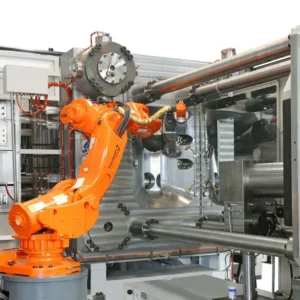
In modern factories, this step is fully automated and synchronized with the machine cycle.
🔹 Step 5 – Part Ejection
Once the die is open, ejector pins push the casting out of the mold cavity.
🔧 What to control:
- Ejection force
- Pin position
- Part cooling level
⚠️ Potential issues:
- Uneven force → part deformation
- High temperature → surface damage
👉 Proper ejection design is essential to maintain part integrity in the high pressure die casting process.
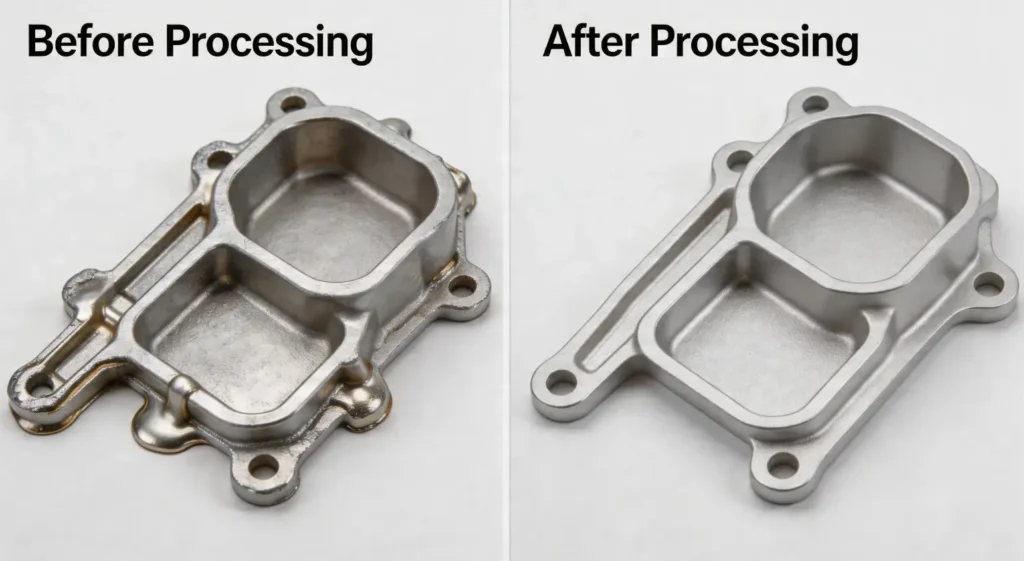
🔹 Step 6 – Trimming & Finishing
After ejection, the part still contains excess material such as runners, gates, and flash.
✂️ Post-processing includes:
- Trimming (removing excess metal)
- Shot blasting (surface cleaning)
- CNC machining (if needed)
- Surface treatments (coating, plating)
🎯 Why this step matters:
Even though the high pressure die casting process produces near-net-shape parts, finishing ensures:
- Final dimensional accuracy
- Improved surface quality
- Functional performance
📌 Key Takeaway
The high pressure die casting process involves six critical steps—die preparation, injection, solidification, opening, ejection, and finishing—each of which must be precisely controlled to ensure high-quality, defect-free parts.
Types of High Pressure Die Casting Machines
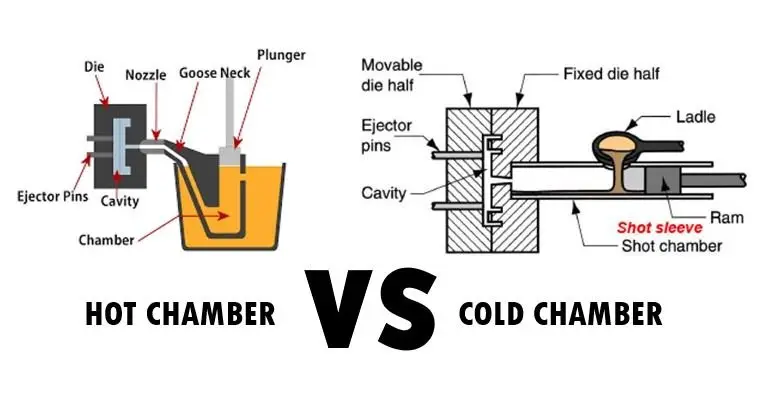
Different materials and applications require different types of machines. In the high pressure die casting process, two main machine types are used: hot chamber and cold chamber systems.
Understanding their differences is essential for selecting the right process, controlling quality, and optimizing cost.
⚙️ Overview of Machine Types
| Machine Type | Best For | Key Feature |
|---|---|---|
| Hot Chamber | Zinc, Magnesium | Faster cycle, integrated melting system |
| Cold Chamber | Aluminum | Handles high-temperature alloys |
🔹 Hot Chamber Die Casting Machine
Hot chamber machines are typically used for low-melting-point metals such as zinc and magnesium.
🔧 How it works:
- The injection system is immersed in molten metal
- Metal is drawn directly into the chamber
- Injection happens without transferring metal externally
✅ Advantages:
- ⚡ Faster cycle time
- 🔁 Higher production efficiency
- 🔧 Less oxidation during transfer
⚠️ Limitations:
- Not suitable for aluminum (temperature too high)
- Equipment exposure to molten metal increases wear
📌 Best Use Cases:
- Small precision parts
- High-volume zinc components
- Consumer electronics and hardware
🔹 Cold Chamber Die Casting Machine
Cold chamber machines are mainly used for aluminum alloys, which have higher melting temperatures.
🔧 How it works:
- Molten metal is poured into a shot sleeve
- A plunger injects it into the die cavity
- The system is not continuously exposed to molten metal
✅ Advantages:
- Suitable for high-temperature alloys (e.g., aluminum)
- Better control for structural parts
- Widely used in automotive manufacturing
⚠️ Limitations:
- ⏱️ Slightly longer cycle time
- 🔄 Additional step for metal transfer
📌 Best Use Cases:
- Automotive parts (engine housings, brackets)
- EV components
- Medium to large structural castings
🔍 Key Differences in the High Pressure Die Casting Process
| Feature | Hot Chamber | Cold Chamber |
|---|---|---|
| Metal Type | Zinc, Magnesium | Aluminum |
| Injection Method | Direct (immersed system) | External pouring + injection |
| Cycle Time | Faster | Slower |
| Equipment Wear | Higher (metal exposure) | Lower |
🎯 Practical Insight from IEC MOULD
In real-world manufacturing, the choice between hot and cold chamber systems is not just about material—it also affects:
- Production speed
- Tooling design
- Cost per part
👉 For example, aluminum parts used in automotive applications almost always rely on cold chamber machines within the high pressure die casting process.
📌 Key Takeaway
The high pressure die casting process uses two main machine types: hot-chamber machines for zinc and magnesium, and cold-chamber machines for aluminum, each optimized for different materials and production requirements.
Key Advantages of High Pressure Die Casting
The reason the high pressure die casting process is widely used across industries is simple: it combines speed, precision, and scalability in a way few manufacturing methods can match.
Below are the key advantages that make it the preferred choice for many OEM projects.
🔹 High Production Efficiency
One of the biggest strengths of the high pressure die casting process is its ability to produce large quantities of parts in a short time.
- ⏱️ Cycle time as low as 20–60 seconds
- 🔁 Fully automated production lines
- 📦 Ideal for mass production
👉 This makes it highly cost-effective when producing thousands or millions of parts.
🔹 Excellent Dimensional Accuracy
HPDC is known for producing parts with tight tolerances and repeatable quality.
- 📏 Minimal dimensional variation
- 🔧 Reduced need for secondary machining
- 🔁 High consistency between batches
👉 For industries like automotive and electronics, this level of precision is critical.
🔹 Complex Shapes and Thin Walls
The high-speed injection allows molten metal to fill intricate mold cavities before solidifying.
- 🧩 Complex geometries
- 📉 Thin wall thickness (especially for zinc)
- 🔍 Fine details and sharp edges
👉 This design flexibility is a major advantage of the high pressure die casting process compared to traditional casting methods.
🔹 Superior Surface Finish
Parts produced through HPDC typically have smooth surfaces and clean edges.
- ✨ Good as-cast surface quality
- 🎨 Suitable for plating, painting, or coating
- 🔧 Reduced finishing work
👉 In some cases, parts can be used directly without additional processing.
🔹 Material Efficiency
Because the process is highly controlled, material waste is minimized.
- ♻️ Recyclable scrap (runners and flash)
- 📉 Lower material loss
- 💰 Improved cost efficiency
🔹 Strong Mechanical Properties (With Proper Control)
When parameters are optimized, the high pressure die casting process can produce parts with good strength and durability.
- 🏋️ High strength-to-weight ratio (especially aluminum)
- 🔩 Good structural integrity
- 📈 Consistent performance
👉 However, this depends heavily on controlling pressure, temperature, and cooling conditions.
🔹 Scalable for OEM Production
For companies looking for high-pressure die casting services, scalability is a major advantage:
- 📈 Easy to scale from prototype to mass production
- 🤖 Compatible with automated manufacturing
- 🏭 Suitable for global supply chains
📌 Key Takeaway
The high-pressure die casting process offers high efficiency, excellent precision, complex geometry capability, and scalability, making it ideal for large-volume production of high-quality metal parts.
Common Challenges in High Pressure Die Casting Process
While the high pressure die casting process offers excellent speed and precision, it is not without challenges. Understanding common defects and process limitations helps manufacturers produce higher-quality parts and reduces costly rework.
🔹 Porosity
Porosity occurs when air or gas gets trapped inside the metal during injection or solidification.
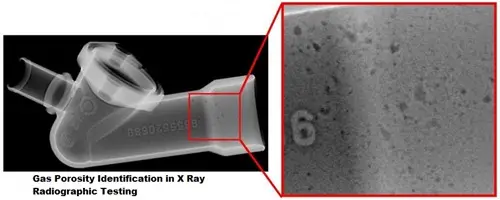
- 💨 Causes:
- Entrapped air in the mold
- Inadequate venting
- Turbulent metal flow
- 🏭 Impact: Weakens mechanical strength, may lead to leaks in functional components
- ✅ Prevention:
- Optimize injection speed
- Proper venting and die design
- Maintain correct metal temperature

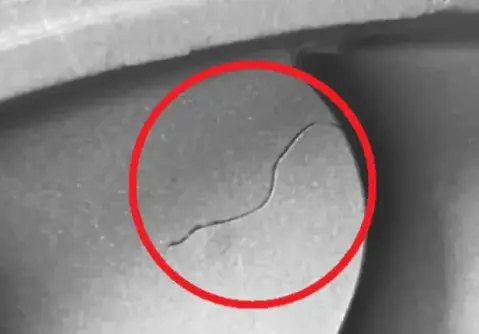
🔹 Cold Shut
A cold shut occurs when two streams of molten metal meet and fail to fuse properly.
- ❄️ Causes:
- Low die temperature
- Slow injection speed
- Complex mold geometry
- ⚠️ Impact: Surface cracks, potential structural weakness
- 🔧 Prevention:
- Preheat dies appropriately
- Adjust injection timing
- Modify gate design
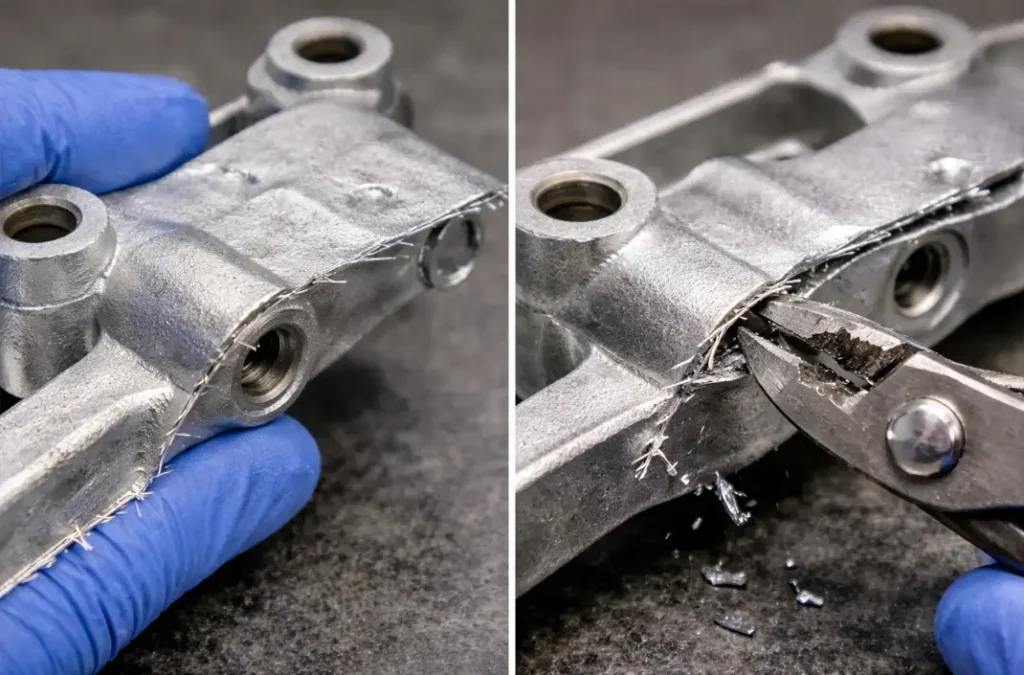
🔹 Flash
Flash is excess metal that seeps out between die halves.
- 💡 Causes:
- High injection pressure
- Worn or damaged molds
- 🔨 Impact: Requires additional trimming and finishing
- ✅ Prevention:
- Regular mold maintenance
- Correct clamping force
🔹 Warping or Distortion
Parts may deform after ejection due to uneven cooling or residual stress.
- 🌡️ Causes:
- Non-uniform die cooling
- Rapid ejection of hot parts
- ⚠️ Impact: Dimensional inaccuracies
- 🔧 Prevention:
- Balanced cooling system
- Controlled ejection timing
🔹 Material-Specific Challenges
- Aluminum: A higher melting point requires cold-chamber machines; improper handling can cause oxide inclusions
- Zinc: Lower melting point allows faster cycles but requires precise temperature control to avoid shrinkage
🔍 Practical Insight from IEC MOULD
Experienced manufacturers treat the high pressure die casting process as a system where pressure, temperature, die design, and metal flow must all be carefully monitored. Minor variations can lead to significant defects, which is why choosing a skilled die casting partner is critical.
📌 Key Takeaway
Common challenges in the high pressure die casting process include porosity, cold shut, flash, and warping. Proper die design, temperature control, and process optimization are essential for defect-free, high-quality castings.
When to Use High Pressure Die Casting
The high pressure die casting process is not suitable for every metal part or production scenario. Choosing the right manufacturing method depends on factors such as part complexity, production volume, material, and required mechanical properties.
🔹 High-Volume Production
HPDC is ideal for large-scale production runs where speed and repeatability are critical:
- ⏱️ Short cycle times (20–60 seconds per part)
- 🔁 Consistent quality across thousands or millions of parts
- 💰 Cost-effective when producing high quantities
If your project involves mass production of aluminum or zinc components, HPDC is often the most economical choice.
🔹 Complex Geometries
The process can produce intricate shapes and thin walls that would be difficult or impossible with other casting methods:
- 🧩 Fine details, sharp edges, and undercuts
- 📉 Wall thickness as low as 0.8 mm (for zinc)
- ⚙️ Suitable for functional and decorative components
For designs that require precision and detail, the high pressure die casting process offers superior results.
🔹 Structural and Functional Parts
HPDC can produce parts with high strength and dimensional accuracy, making it suitable for load-bearing or critical components:
- 🚗 Automotive brackets, engine housings, and EV motor components
- 🔩 Industrial equipment requiring durability
- 🏗️ Structural assemblies in electronics or machinery
Aluminum die castings are often chosen for their high strength-to-weight ratio, while zinc excels in precision and complex small parts.
🔹 Cost-Sensitive and Efficient Manufacturing
Although initial tooling costs are higher than other methods, HPDC is highly efficient over the long term:
- 📈 Reduces labor costs due to automation
- ♻️ Minimizes material waste through controlled injection
- 🔧 Reduces need for secondary machining
Companies looking for high pressure die casting services often select HPDC to balance cost, quality, and volume efficiency.
📌 Key Takeaway
The high pressure die casting process is best used for high-volume, complex, or structural parts where precision, repeatability, and cost efficiency are critical. Aluminum and zinc are the most common materials for these applications.
Frequently Asked Questions About High Pressure Die Casting
Q1: How long does high pressure die casting take?
- ⏱️ Cycle time: Typically 20–60 seconds per part, depending on size, material, and machine type.
- ⚙️ Automation and optimized die design can further reduce cycle time.
- 🏭 Ideal for high-volume production because each cycle is rapid and consistent.
Q2: What metals are commonly used in HPDC?
- Aluminum: High strength-to-weight ratio, widely used in automotive and aerospace parts.
- Zinc: Excellent for small, precise, and decorative components.
- Magnesium: Lightweight, often used for electronics or automotive parts.
The choice of metal affects the type of machine used (hot chamber vs cold chamber) and process parameters.
Q3: Why is high pressure used in die casting?
- High pressure forces molten metal into the die quickly, ensuring complete filling of complex cavities.
- It reduces porosity and shrinkage defects by maintaining metal density during solidification.
- High pressure enables thin walls and intricate geometries that other casting methods cannot achieve.
Q4: What is the difference between HPDC and low-pressure die casting?
| Feature | High Pressure Die Casting | Low Pressure Die Casting |
|---|---|---|
| Injection Method | High-speed, high-pressure plunger | Low-pressure metal fill from bottom |
| Cycle Time | Very fast (20–60s) | Slower (minutes per part) |
| Part Precision | High | Medium |
| Typical Metals | Aluminum, Zinc, Magnesium | Aluminum, Copper alloys |
| Applications | Automotive, Electronics, Industrial parts | Aerospace, Structural parts |
HPDC is preferred for mass production and complex shapes, while low-pressure die casting is often used for specialized structural components.
Q5: Can HPDC produce near-net-shape parts?
- ✅ Yes, parts are typically near-net-shape, reducing the need for extensive machining.
- Additional trimming, CNC machining, or surface finishing may be applied for precise tolerances.
- This efficiency is one reason high pressure die casting services are cost-effective for large production runs.
Get Expert Support for Your High Pressure Die Casting Projects
If you are producing aluminum, zinc, or magnesium castings and want to reduce defects like porosity, cold shuts, or flash, getting the right pressure settings from the start can save weeks of trial and error.
✨ Ready to Turn This Guide into Defect-Free Castings?
You can start by sharing your project details with our team. The more we know, the faster we can provide actionable recommendations.
👉 Typical information to prepare:
- 2D drawings or 3D CAD files (STEP / IGS / STL)
- Alloy type and performance requirements (e.g., pressure tightness, heat treatment)
- Estimated annual volume
With this information, our technical team can quickly evaluate pressure-related risks and offer solutions tailored to your project.