
Two dies producing similar components can have dramatically different die-casting tool lives due to variations in design strategy, material selection, cooling performance, and maintenance practices. In many cases, these differences are not visible at the quoting stage—but they significantly impact long-term production outcomes.
This is why understanding the die casting tooling lifecycle is critical. It provides a structured way to evaluate how a mold performs over time—and where hidden risks and costs actually come from.
What Is Die Casting Tooling Lifecycle?
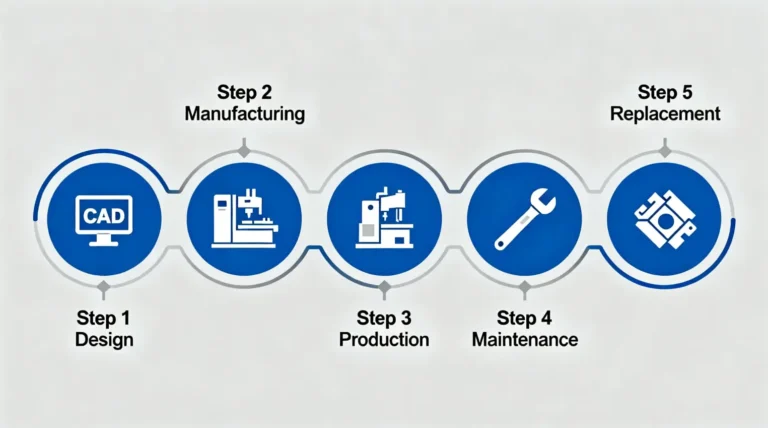
The die casting tooling lifecycle refers to the complete lifespan of a die, from initial design and manufacturing to production use, maintenance, and eventual retirement.
Rather than being a one-time investment, a die functions as a dynamic system that evolves under repeated thermal and mechanical stress. Each stage of its lifecycle influences tool durability, casting consistency, and overall cost efficiency.
A well-designed and properly maintained tool can deliver stable performance over hundreds of thousands of cycles, while a poorly optimized one may fail prematurely, leading to defects, delays, and unexpected replacement costs.
The 5 Key Stages of Die Casting Tooling Lifecycle
Understanding the die casting tooling lifecycle is not just about knowing the stages—it’s about seeing how each phase connects and where performance is gained or lost.
↓ ↓ ↓ ↓ ↓
Performance → Execution → Wear & Fatigue → Life Extension → Risk Control
👉 Key Insight:
Most tooling failures originate in the design and production stages, even if they only become visible later.
🔍 Quick Comparison of Each Stage
| Stage | What Happens | Main Impact | Risk Level |
|---|---|---|---|
| Design | The tool is engineered | Determines tool life | 🔴 High |
| Manufacturing | The tool is built | Defines execution quality | 🟠 Medium |
| Production | The tool is used | Drives wear and fatigue | 🔴 High |
| Maintenance | The tool is serviced | Extends usable life | 🟠 Medium |
| End-of-Life | The tool is retired | Controls cost & risk | 🟡 Low |
1️⃣ Tool Design Phase: Where Tool Life Is Decided
The design phase determines up to 70–80% of the tool’s lifecycle performance.
Key decisions include:
- Cooling channel layout
- Gating and runner design
- Material selection
- Structural configuration
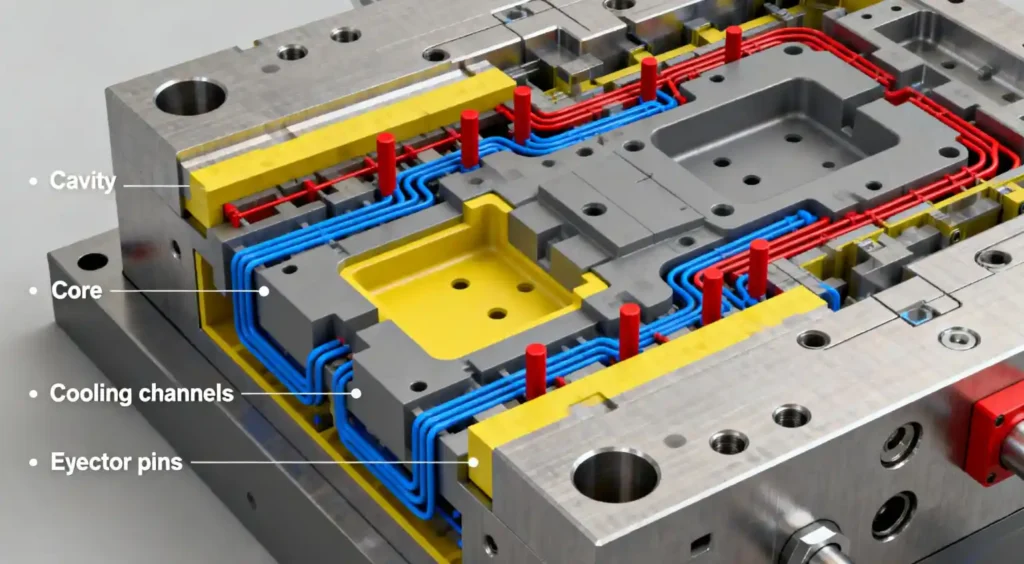
Poor design leads to uneven thermal distribution and increased thermal fatigue. even early cracking and wear.
👉 A well-optimized design directly improves die casting tool life and reduces long-term cost.
2️⃣ Tool Manufacturing Phase: Translating Design into Performance
This stage ensures that the design is executed accurately.
Critical factors include precision machining, heat treatment quality, and surface finishing.
Common risks:
- ❌ Improper heat treatment → internal stress
- ❌ Poor finishing → increased friction and wear
👉 Even a perfect design can fail if manufacturing quality is not controlled.
3️⃣ Production Phase: Where Wear and Fatigue Begin
During production, the die experiences:
- High-pressure injection
- Rapid heating and cooling
- Continuous thermal cycling
Molten metal flows through the gate at 30–80 m/s (up to ~120 m/s in optimized systems), creating intense thermal and mechanical stress.
⚠️ This refers to metal flow speed, not plunger speed.
Key degradation mechanisms: thermal fatigue, erosion, and mechanical wear
👉 This stage determines how quickly the tool moves toward failure.
4️⃣ Maintenance & Repair Phase: The Key to Extending Tool Life
Maintenance is the most controllable stage in the lifecycle.
Effective practices include:
- Regular inspection
- Surface polishing
- Early crack repair
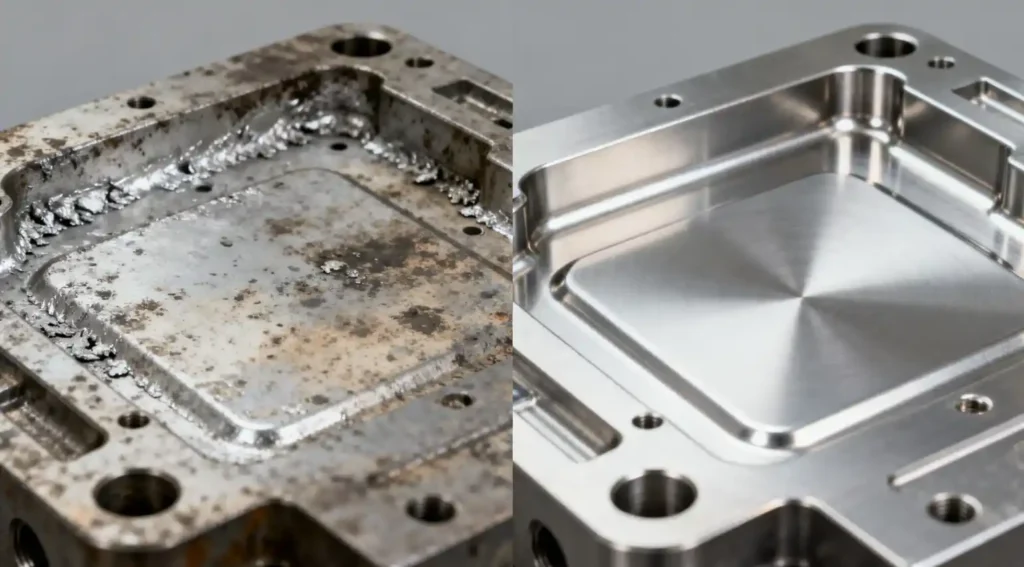
Without maintenance:
- ❌ Minor damage escalates quickly
- ❌ Unexpected downtime increases
👉 Preventive maintenance can significantly extend die casting tooling lifecycle and stabilize production.
5️⃣ End-of-Life & Replacement: Knowing When to Stop
A tool reaches end-of-life when racking becomes severe, dimensional accuracy declines, or repair cost exceeds value.
Risks of delayed replacement:
- ❌ Increased defect rate
- ❌ Production instability
- ❌ Higher total cost
👉 Lifecycle-aware planning helps avoid sudden failures and ensures consistent output.
👉 Key takeaway:
Tooling lifecycle is not linear—it is a feedback system.
Early decisions (design & manufacturing) determine how much maintenance is needed and how soon replacement becomes necessary.
How Long Does a Die Casting Tool Last?
One of the most common questions engineers and buyers ask is:
How long does a die casting tool actually last?
The answer depends on multiple factors, but in general, die casting tooling lifecycle can vary widely depending on alloy type, thermal load, and tooling quality.
📊 Typical Die Casting Tool Life by Material
| Material | Typical Tool Life (Shots) | Key Influencing Factor |
|---|---|---|
| Aluminum | 50,000 – 150,000 | High thermal stress |
| Magnesium | 150,000 – 300,000+ | Moderate temperature |
| Zinc (hot-work steel) | 500,000 – 1,000,000+ | Low melting temperature |
It is important to note that tool life in zinc die casting depends heavily on the tool steel used. While high-end dies made from hot-work steels (such as H13 or equivalent) can achieve very long lifespans, lower-cost molds made from pre-hardened steels (e.g., P20 or 718H) may have significantly shorter service life.
This variation is mainly due to differences in melting temperature, thermal stress, and material aggressiveness. Higher-temperature alloys, such as aluminum, tend to accelerate thermal fatigue in die casting tools, leading to shorter lifespan.
However, material alone does not determine the outcome. Two tools using the same alloy can still show dramatically different performance depending on design quality, cooling efficiency, and maintenance strategy.
👉 In practice, die casting tool life expectancy is not fixed—it is engineered.
A well-optimized tool with proper thermal management and regular maintenance can significantly outperform standard expectations, while a poorly designed die may fail far earlier than predicted.
7 Factors That Affect Die Casting Tooling Lifecycle
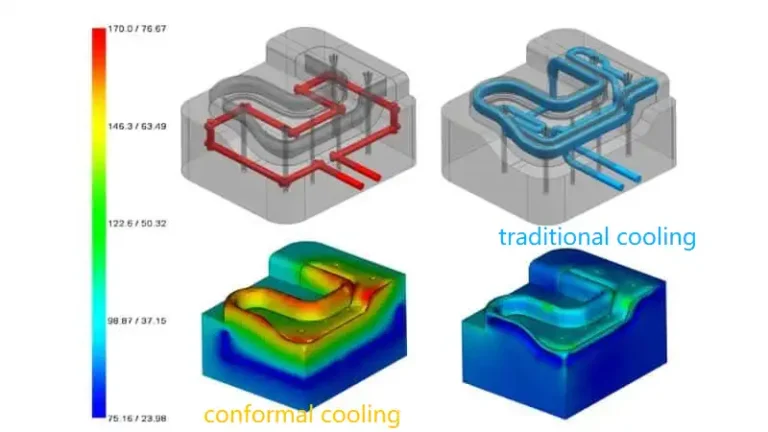
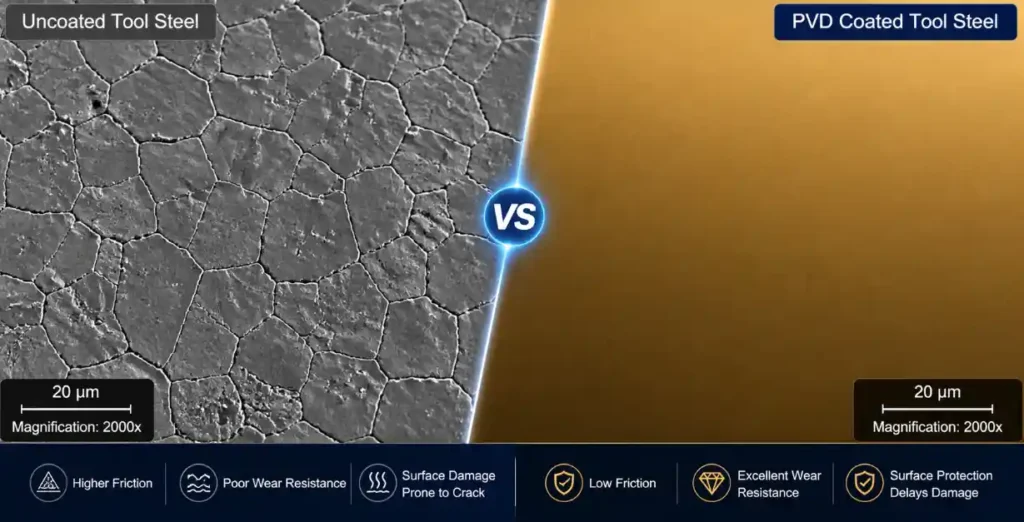
Understanding what drives tool wear and failure is key to improving performance and reducing long-term cost. Below are the most critical factors that influence the die casting tooling lifecycle:
📊 Key Factors and Their Impact on Tool Life
| Factor | Impact on Tooling Lifecycle |
|---|---|
| 🔧 1. Tool Material | Determines resistance to heat, wear, and cracking |
| ❄️ 2. Cooling System Design | Controls thermal balance and reduces fatigue |
| 🔥 3. Casting Alloy | Affects thermal load and chemical interaction |
| ⚡ 4. Injection Parameters | Influences mechanical stress and erosion |
| ⏱️ 5. Cycle Time | Impacts thermal shock and fatigue rate |
| 🧪 6. Surface Treatment | Improves wear resistance and reduces adhesion |
| 🛠️ 7. Maintenance | Extends life by preventing damage escalation |
📌 Key Insight
These factors do not act independently—they interact throughout the entire lifecycle.
For example, even a high-quality tool material cannot compensate for poor cooling design, and excellent design can still fail without proper maintenance.
👉 This is why optimizing the die casting tooling lifecycle requires a system-level approach, rather than focusing on a single variable.
Common Failure Modes in Die Casting Tools
Even with proper design and manufacturing, all dies will eventually experience degradation. Understanding the most common die casting tool failure modes helps identify risks early—and prevent costly production disruptions.
🔥 1. Thermal Fatigue Cracks (Heat Checking)
Repeated heating and cooling cycles create surface cracks over time, a phenomenon known as thermal fatigue in die casting tools.
These cracks typically appear in high-temperature zones and gradually expand, affecting surface finish and dimensional stability. If left untreated, they can lead to deeper structural failure.
🧱 2. Erosion and Washout
High-speed molten metal flow can erode critical areas of the die, especially near gates and runners.
This type of wear reduces dimensional accuracy and can alter metal flow behavior, leading to defects such as porosity or incomplete filling.
🧲 3. Soldering (Metal Sticking)
Soldering occurs when molten alloy adheres to the die surface, particularly in aluminum die casting.
This not only damages the tool surface but also increases cycle time and causes surface defects on the casting.
💥 4. Thermal Cracking & Structural Failure
Severe temperature gradients or improper material selection can cause deep cracks or even catastrophic failure of the die.
These failures often require complete tool replacement, resulting in significant downtime and cost.
⚙️ 5. Mechanical Wear & Deformation
Over time, repeated mechanical stress leads to gradual wear of edges, cores, and ejector systems.
This reduces part precision and may cause issues such as flashing, misalignment, or dimensional drift.
📌 Key Insight
Most failures are not caused by a single issue—but by the combined effect of thermal stress, mechanical load, and insufficient maintenance.
👉 In other words, tool failure is rarely accidental—it is usually predictable and preventable.
How to Extend Die Casting Tool Life
While tool wear is inevitable, its speed and impact can be significantly controlled.
A well-optimized strategy can dramatically extend die casting tool life, reduce downtime, and improve cost efficiency.
❄️ 1. Optimize Cooling System Design
Uniform cooling is one of the most effective ways to reduce thermal stress.
A well-designed cooling system minimizes temperature gradients, preventing thermal fatigue and cracking from developing prematurely.
🔧 2. Select High-Quality Tool Materials
Using premium tool steel with proper hardness and toughness improves resistance to heat, wear, and deformation.
Material selection should match the casting alloy and production conditions to maximize durability.
⚙️ 3. Improve Surface Treatment & Coating
Advanced treatments such as nitriding or PVD coatings reduce friction and increase surface hardness.
This helps prevent soldering, erosion, and early-stage wear—especially in high-stress zones.
⏱️ 4. Control Process Parameters
Optimizing injection pressure, speed, and cycle time reduces unnecessary stress on the tool.
Balancing productivity with tool protection is essential for achieving a longer tooling lifecycle.
🛠️ 5. Implement Preventive Maintenance
Routine inspection and timely repair are critical.
Addressing small issues—such as micro-cracks or localized wear—before they escalate can significantly extend tool life and maintain consistent quality.
🤝 6. Work with an Experienced Tooling Supplier
Tool performance is not only about design—it’s about execution and lifecycle support.
An experienced die casting tooling supplier can optimize design, ensure manufacturing quality, and provide maintenance guidance that directly impacts long-term performance.
📈 Lifecycle Impact
Improving die casting tooling lifecycle is not just a technical upgrade—it is a financial advantage.
- ✔ Longer tool life → lower cost per shot
- ✔ Fewer failures → reduced downtime
- ✔ Stable quality → less scrap and rework
👉 In many cases, investing in better tooling design and lifecycle management results in significantly lower total cost, even if the initial tooling price is higher.
Die Casting Tooling Lifecycle Cost: What Most Buyers Overlook
When evaluating die casting tooling, many buyers focus primarily on the initial tooling price. However, this approach often leads to higher total cost over time.
In reality, the true cost of a die is determined by its performance across the entire die casting tooling lifecycle.
📊 Initial Cost vs Lifecycle Cost
A lower upfront tooling price may seem attractive, but it often comes with trade-offs:
- ❌ Shorter die casting tooling lifecycle
- ❌ Higher maintenance frequency
- ❌ Increased risk of defects and downtime
- ❌ Earlier tool replacement
In contrast, a well-engineered tool may require a higher initial investment, but delivers:
- ✔ Longer lifespan (more shots)
- ✔ Lower maintenance cost
- ✔ Stable production quality
- ✔ Reduced scrap and rework
👉 The result is a significantly lower cost per shot and better long-term ROI.
📈 Cost Per Shot: The Real Metric That Matters
Instead of asking “How much does the tooling cost?”, a better question is:
“What is the cost per shot over the tool’s lifecycle?”
This metric reflects the true economic performance of a die.
For example:
- Tool A: lower price but fails early → higher cost per part
- Tool B: higher price but longer life → lower cost per part
👉 In most production scenarios, die casting tooling lifecycle optimization is one of the most effective ways to reduce total manufacturing cost.
Hidden Lifecycle Costs in Poor Tooling Decisions
Ignoring die casting tooling lifecycle factors can introduce hidden costs that are often underestimated:
- Production interruptions due to unexpected tool failure
- Urgent repair or replacement expenses
- Quality issues leading to customer complaints
- Delays in delivery schedules
These issues are not simply the result of poor purchasing decisions—they are symptoms of weak lifecycle planning and tooling strategy.
👉 When tooling is not optimized for die casting tooling lifecycle performance, costs accumulate gradually and often remain invisible until they become critical.
Choosing a Supplier for Maximum Lifecycle Performance
Since tooling performance is determined long before production begins, selecting the right partner is critical.
A reliable die casting tooling supplier should not only manufacture tools, but also optimize their performance across the entire lifecycle.
🔍 1. Engineering & Lifecycle-Oriented Design Capability
Look for suppliers with strong in-house engineering expertise. They should be able to optimize cooling systems, gating design, and structural layout specifically for long-term lifecycle performance—not just initial manufacturability.
🧪 2. Material Selection & Heat Treatment Control
High-quality tool steel and proper heat treatment are essential for durability. Suppliers should have strict control over material selection to ensure resistance to thermal fatigue, wear, and cracking throughout the lifecycle.
⚙️ 3. Precision Manufacturing & Surface Engineering
Advanced machining and surface treatment capabilities ensure the tool performs consistently over time. This includes dimensional stability, coating technology, and resistance to long-term wear.
🛠️ 4. Maintenance Strategy & Lifecycle Support
A strong supplier does not stop at delivery. They should provide guidance on tool maintenance, repair cycles, and lifecycle management to extend tool life and reduce downtime.
📊 5. Proven Lifecycle Performance in Real Projects
Suppliers with real-world case studies can demonstrate how their tooling performs over extended production runs. This is often a more reliable indicator than initial pricing or theoretical capability.
📌 Key Insight
Choosing a supplier based only on price often leads to higher long-term costs.
👉 The right partner focuses on die casting tooling lifecycle performance, not just tooling delivery.
FAQ About Die Casting Tooling Lifecycle
1. How long does a die casting tool last?
Die casting tool life typically ranges from 50,000 to over 1,000,000 shots, depending on the alloy, tool material, and operating conditions. Aluminum dies generally have shorter lifespans due to higher thermal stress, while zinc dies last longer. Proper design, cooling, and maintenance can significantly extend tool life.
2. What factors affect die casting tooling lifecycle?
Key factors include tool material, cooling system design, casting alloy, injection pressure, cycle time, surface treatment, and maintenance practices. These variables influence thermal fatigue, wear, and structural integrity. Optimizing them together—not individually—is essential for achieving a longer and more stable die casting tooling lifecycle.
3. How can we extend die casting tooling lifecycle?
To extend tooling lifespan, focus on optimized cooling design, high-quality tool steel, proper surface treatment, controlled process parameters, and preventive maintenance. Early detection of wear and timely repair can prevent major failures. Working with an experienced tooling supplier also helps improve long-term durability and performance.
4. What is the real cost of die casting tooling?
The real cost is not just the initial tooling price, but the total lifecycle cost, including maintenance, downtime, defects, and replacement. A longer-lasting tool usually results in a lower cost per shot, making it more cost-effective despite a higher upfront investment.
5. When should a die casting tool be replaced?
A die should be replaced when it shows severe cracking, dimensional instability, excessive wear, or declining product quality. If repair costs become too frequent or performance becomes inconsistent, continuing to use the tool may increase defects and production risks, making replacement the more economical choice.
Die Casting Tooling Lifecycle Determines Your True Cost
If you are planning a die casting project, evaluating tooling based on lifecycle performance—not just initial price—can significantly reduce long-term cost and improve production stability.
Working with an experienced engineering team ensures your tooling is designed for durability, optimized for performance, and supported throughout its entire lifecycle.
👉 Looking for a reliable die casting tooling solution?
Contact us to discuss your project and explore how optimized tooling design can improve your cost efficiency and product quality.