
Why Die Casting Cost Is Not Just About Price?
When discussing die casting cost, many projects still focus heavily on the quoted unit price.
But in high-volume production, the real die casting cost per unit is rarely defined by price alone. It is shaped by what happens across the entire process—tooling design, material usage, machining requirements, scrap rate, and overall production efficiency.
From daily production experience at IEC MOULD, many cost issues do not originate from the quotation itself, but from decisions made much earlier in the project.
In some cases, a part may appear to have a competitive die casting price during RFQ, but later requires additional machining, process adjustments, or even tooling modifications. These hidden factors quickly increase the total die casting cost during mass production.
👉 This is why understanding the real cost drivers in die casting is critical before trying to reduce cost.
Reducing die casting manufacturing cost is not about pushing suppliers for a lower quote—it is about identifying where cost is being created and optimizing those areas early.
| Cost Factor | Impact on Total Cost | Common Cost Risk |
|---|---|---|
| Tooling Cost | High (initial) | Over-complex mold design |
| Material Cost | Medium | Over-spec alloy selection |
| Machining Cost | High | Excessive secondary operations |
| Scrap Rate | Very High | Process instability / defects |
| Cycle Time | High | Low production efficiency |
💡 Insight: In high-volume die casting production, even small inefficiencies—such as slightly longer cycle time or higher scrap rate—can significantly increase total cost over time.
Optimize Part Design to Reduce Die Casting Cost (DFM First)
In most projects, the biggest opportunity for die casting cost reduction appears long before production starts—at the design stage.
Across many projects handled by IEC MOULD, it is quite common to receive designs that are functionally correct, but not optimized for manufacturing. These parts can be produced, but not always at the lowest possible die casting cost.
1. Why Design Has the Biggest Impact on Die Casting Cost?
A design that looks acceptable on paper can still create significant cost pressure during production:
- Undercuts that require complex tooling mechanisms
- Thin walls that increase the risk of defects
- Sharp transitions that affect metal flow
- Tight tolerances that increase machining cost
In practice, these factors often lead to higher die casting tooling cost, longer cycle time, and increased die casting defects, all of which directly increase total cost.
👉 Many of these issues are closely related to common die casting defects caused by design limitations.
2. How DFM Helps Reduce Die Casting Cost?
Design for Manufacturability (DFM) focuses on optimizing the design to reduce die casting cost without affecting functionality.
At IEC MOULD, DFM review is typically carried out before tooling begins, as this is the most effective stage to control cost. A proper DFM review can help:
- Simplify part geometry to reduce tooling complexity
- Improve metal flow and reduce defect risk
- Minimize unnecessary secondary machining
- Optimize wall thickness and draft angles
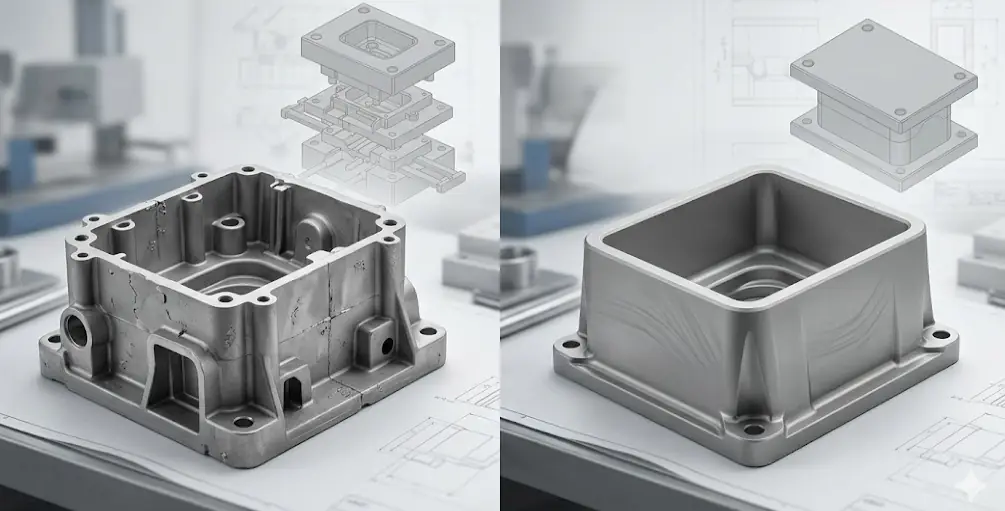
These improvements directly contribute to die casting cost optimization, especially in high-volume production where small savings are multiplied across large quantities.
👉 A clear understanding of the die casting process is essential when making these early design decisions.
3. What This Looks Like in Real Projects?
In one typical project, a part design included multiple undercuts and tight internal features, leading to high die casting tooling cost and additional machining requirements.
After a DFM review by the engineering team at IEC MOULD, several adjustments were made without affecting the function of the part. The result was:
- Reduced tooling complexity
- Lower machining cost
- Improved production efficiency
- Reduced overall die casting cost per unit
These types of improvements are often simple—but they play a critical role in reducing total cost in high-volume die casting orders.
Key Takeaway: The most effective way to reduce die casting cost is to optimize the design before tooling and production begin.
💡 Practical Insight: In high-volume production, reducing even a small percentage of die casting cost per unit can result in significant overall savings.
Choose the Right Alloy to Balance Die Casting Cost and Performance
Material selection is one of the most underestimated factors affecting die casting cost, especially in high-volume production.
In many RFQ stages, parts are designed with higher-grade alloys than necessary. While this may improve certain mechanical properties, it often increases material cost, machining difficulty, and overall die casting manufacturing cost without delivering real value.
From project experience at IEC MOULD, material over-specification is a common reason why initial die casting price appears higher than expected.
1. How Material Selection Impacts Die Casting Cost
Different aluminum alloys behave differently in casting and machining. The choice of material directly affects:
- Raw material cost
- Fluidity during casting (affects defect rate)
- Machinability (affects CNC cost)
- Tool wear (affects tooling life)
For example, selecting an alloy with poor castability may increase die casting defects, leading to higher scrap rate and increased cost per unit.
👉 These issues are often linked to common die casting defects caused by improper material-process matching.
2. Common Die Casting Alloys and Cost Considerations
While aluminum alloys are the most widely used in die casting, other materials such as zinc and magnesium are also selected depending on application requirements.
Each material has a different impact on die casting cost, production efficiency, and overall performance—especially in high-volume production.
📊 Material Comparison for Die Casting Cost Optimization
| Material | Typical Cost Level | Cost Keyword Focus | Key Advantage | Typical Use Case |
|---|---|---|---|---|
| Aluminum | Medium | aluminum die casting cost | Good balance of cost & strength | Automotive, housings |
| Zinc | Low–Medium | zinc die casting cost | Excellent precision, low scrap | Small precision parts |
| Magnesium | High | magnesium die casting cost | Lightweight, high strength | Aerospace, lightweight parts |
💡 Insight: When comparing aluminum die casting cost, zinc die casting cost, and magnesium die casting cost, aluminum is often the most cost-effective solution for high-volume production due to its balance of material cost, castability, and machining performance.
3. Why Aluminum Is Preferred for Cost-Sensitive Projects
In most high-volume applications, aluminum die casting cost provides the best balance between performance and total production cost.
Compared to zinc, aluminum is more suitable for larger structural parts. Compared to magnesium, it offers significantly lower material cost while still meeting most mechanical requirements.
From production experience at IEC MOULD, the majority of cost-driven projects are based on aluminum alloys such as ADC12 or A380, as they allow for more stable production and better die casting cost reduction over time.
Design Tooling for Long-Term Die Casting Cost Efficiency
Tooling is often viewed as a one-time investment, but in high-volume production, it plays a critical role in determining long-term die casting cost per unit. A common mistake is to prioritize lower initial tooling cost, without considering how the mold will perform over time.
From experience at IEC MOULD, tooling decisions made at the beginning of a project often have the greatest impact on long-term cost stability.
1. Why Cheap Casting Tooling Can Increase Total Cost
A lower upfront tooling cost may seem attractive, but it often leads to:
- Shorter mold life
- Higher maintenance frequency
- Inconsistent part quality
- Increased scrap rate
Over time, these issues can significantly increase total die casting manufacturing cost, especially in high-volume production.
👉 This is one of the key cost drivers in die casting that is often underestimated.
2. Key Factors That Affect Die Casting Tooling Cost Efficiency
A well-designed die casting mold focuses not only on production, but also on long-term stability:
- Optimized cooling system for consistent cycle time
- Proper gating and runner design for stable filling
- Durable steel selection for extended mold life
- Easy maintenance and replaceable components
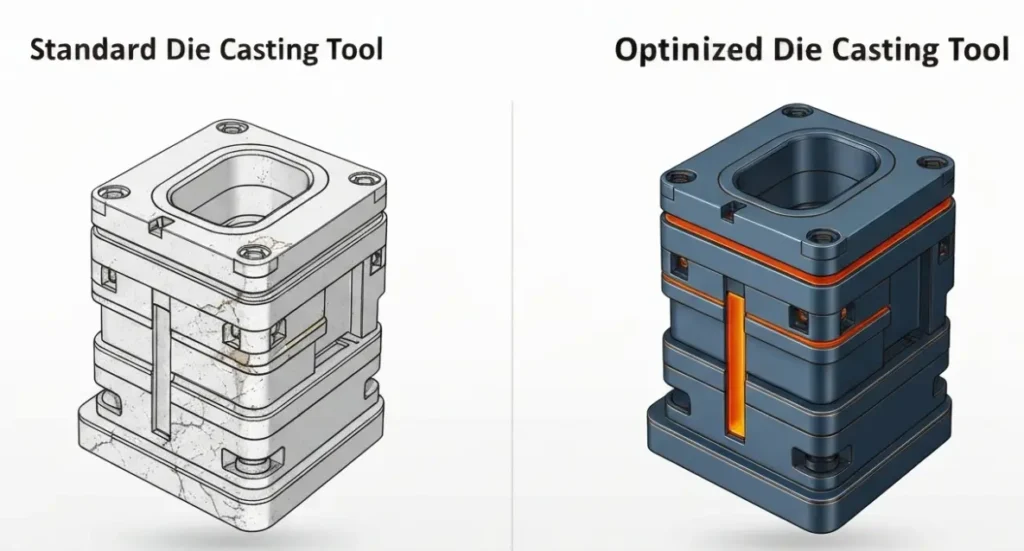
These factors help reduce die casting defects, improve yield, and maintain stable production over time.
3. Long-Term Cost vs Initial Investment
In high-volume die casting, tooling cost is typically amortized over thousands or even millions of parts.
This means:
- Slightly higher tooling investment
- Lower cost per unit over time
- More stable production
👉 Ultimately, this approach helps reduce total die casting cost, not increase it.
Key Takeaway:Tooling should be evaluated based on long-term cost efficiency—not just initial price.
💡 Practical Insight: In high-volume projects, a durable and well-designed mold often pays for itself within the first production runs.
Reduce Secondary Machining to Lower Total Die Casting Cost
In high-volume production, secondary machining is often one of the biggest contributors to total die casting cost.
While die casting is designed to produce near-net-shape parts, many components still require additional CNC machining, drilling, tapping, or surface finishing before they are ready for assembly.
From production experience at IEC MOULD, it is quite common to see projects where machining cost is underestimated during the quotation stage—but becomes a major cost driver once production begins.
1. Why Machining Significantly Increases Die Casting Cost
Secondary operations add cost in multiple ways:
- Additional CNC processing time
- Extra fixtures and setup
- Increased labor and handling
- Longer production lead time
In many cases, machining can account for a significant portion of the total die casting manufacturing cost, sometimes even exceeding the casting cost itself—especially for complex parts.
👉 This is why machining is often identified as a key factor in cost drivers in die casting.
2. How Design Decisions Drive Machining Cost
Many machining requirements are not unavoidable—they are the result of early design decisions.
Common examples include:
- Tight tolerances applied to non-critical areas
- Features that cannot be formed during casting
- Poor draft design leading to post-machining needs
- Overly complex internal structures
These design choices increase both machining time and cost, directly raising the overall die casting cost per unit.
👉 A deeper understanding of the die casting process can help reduce reliance on machining.
📊 Casting vs Machining Cost Impact (Typical Scenario)
| Process Step | Cost Impact | Optimization Opportunity |
|---|---|---|
| Die Casting | Base Cost | Optimize mold & process |
| CNC Machining | High | Reduce features / tolerance |
| Drilling & Tapping | Medium | Integrate into casting if possible |
| Surface Finishing | Medium | Standardize requirements |
💡 Insight:
Reducing even a small amount of machining time per part can significantly lower total die casting cost in high-volume production.
3. Practical Ways to Reduce Machining Cost
To lower machining-related cost, several practical approaches can be applied:
- Design features that can be formed directly in casting
- Apply tight tolerances only where functionally required
- Use standard hole sizes and thread specifications
- Simplify geometry to reduce CNC complexity
At IEC MOULD, DFM reviews often focus on identifying which features can be optimized or eliminated to reduce machining time without affecting product performance.
👉 Many of these improvements are part of broader die casting cost reduction strategies used in high-volume manufacturing.
Key Takeaway: The less machining required after casting, the lower the total die casting cost—especially at scale.
💡 Practical Insight: In high-volume projects, reducing machining time by just a few seconds per part can translate into substantial cost savings over thousands or millions of units.
Reduce Scrap Rate to Control Die Casting Cost at Scale
In high-volume production, scrap rate is one of the most critical—and often underestimated—factors affecting total die casting cost.
Even a small increase in scrap can significantly raise the die casting cost per unit, especially when production volumes reach tens or hundreds of thousands of parts.
From production experience at IEC MOULD, projects with unstable processes often appear cost-effective during quotation, but quickly become expensive once mass production begins due to higher rejection rates and rework.
1. Why Scrap Rate Has a Direct Impact on Die Casting Cost
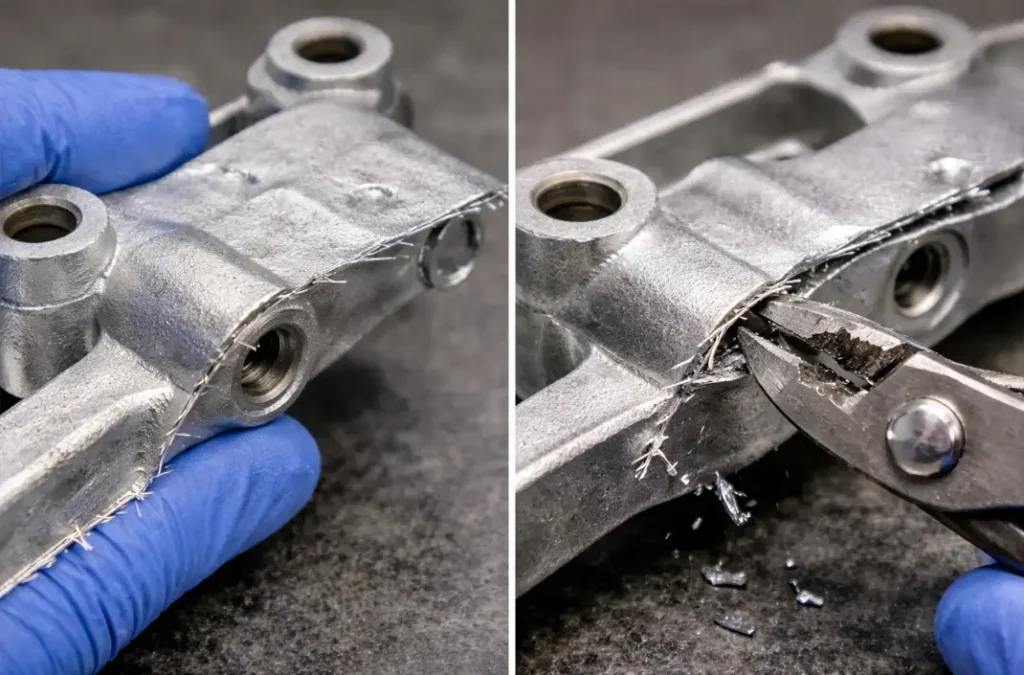
Every defective part represents wasted:
- Material
- Machine time
- Energy
- Labor
In high-volume die casting production, these losses accumulate quickly.
For example:
- A 2% scrap rate vs 5% scrap rate
- Can result in a significant increase in total die casting manufacturing cost
👉 This is why scrap rate is considered one of the most important cost drivers in die casting.
2. Common Causes of High Scrap in Die Casting
Scrap is rarely caused by a single issue—it is usually the result of multiple factors combined:
- Poor mold design or gating system
- Inconsistent process parameters (temperature, pressure)
- Material flow issues leading to porosity
- Inadequate cooling causing deformation
- Lack of process control during mass production
These problems often lead to common die casting defects such as porosity, cold shuts, or warpage.
👉 Understanding and controlling these die casting defects is key to reducing scrap.
📊 Scrap Rate vs Cost Impact (High-Volume Scenario)
| Scrap Rate | Effective Output | Cost Impact |
|---|---|---|
| 2% | High | Optimized cost |
| 5% | Medium | Noticeable cost increase |
| 8%+ | Low | Significant cost loss |
💡 Insight:
In high-volume production, improving scrap rate by just a few percentage points can lead to substantial savings in total die casting cost.
3. How to Reduce Scrap Rate in Practice
Reducing scrap is not about reacting to defects—it requires a stable and controlled process from the beginning. Effective approaches include:
- Optimizing mold design and gating system
- Maintaining consistent process parameters
- Implementing real-time production monitoring
- Regular mold maintenance to prevent wear-related defects
- Conducting early-stage process validation
At IEC MOULD, maintaining production stability is a key focus, especially for high-volume projects where small variations can quickly impact total cost.
👉 A stable process is also essential for effective die casting quality control.
Key Takeaway: Reducing scrap rate is one of the fastest and most effective ways to lower total die casting cost in high-volume production.
💡 Practical Insight: In large production runs, a small improvement in scrap rate can save more cost than negotiating a lower unit price.
Optimize Cycle Time to Reduce Die Casting Cost per Unit
In high-volume production, cycle time is one of the most direct factors affecting die casting cost per unit. Even a difference of a few seconds per cycle may not seem significant in a single part, but when multiplied across thousands or millions of units, it can dramatically change the total die casting production cost.
At IEC MOULD, cycle time optimization is often one of the key focus points in mass production projects, especially when customers are targeting long-term cost reduction strategies rather than short-term price adjustments.
1. How Cycle Time Impacts Die Casting Cost
Cycle time affects cost in several ways:
- Machine utilization rate
- Output per hour
- Energy consumption per part
- Labor efficiency
Longer cycle time directly increases die casting manufacturing cost, even if all other conditions remain stable.
📊 Cycle Time vs Cost Impact (High-Volume Example)
| Cycle Time | Output Efficiency | Impact on Die Casting Cost |
|---|---|---|
| Optimized | High | Lower cost per unit |
| Standard | Medium | Balanced cost |
| Inefficient | Low | Higher total cost |
💡 Insight:
Reducing cycle time by even 5–10% can significantly improve die casting cost efficiency, especially in long production runs.
2. Practical Ways to Optimize Die Casting Cycle Time
Die Casting Cycle time optimization is not just about running machines faster. It requires balancing speed and stability:
- Optimizing cooling system design
- Improving mold thermal balance
- Adjusting injection parameters
- Reducing unnecessary holding time
These improvements must be carefully validated to avoid increasing die casting defects or reducing product quality.
👉 A stable process is closely connected to effective die casting quality control.
3. Engineering Perspective from Production
From experience at IEC MOULD, cycle time optimization is often a trade-off between speed and stability.
In many cases, the initial focus is not on making production faster, but on making it stable enough to allow safe cycle time reduction later. This approach helps ensure that cost reduction does not negatively affect quality or increase scrap rate.
Key Takeaway:Cycle time optimization is one of the most scalable ways to reduce die casting cost in high-volume production.
💡 Practical Insight: A small improvement in cycle time becomes a major cost advantage when scaled to mass production.
Work with a Casting Supplier That Understands Total Die Casting Cost Optimization
In many die casting projects, cost is often discussed only at the quotation stage. However, real die casting cost optimization does not happen in pricing—it happens through continuous improvement across design, tooling, production, and quality control.
This is why the choice of supplier plays a critical role in determining the final die casting cost per unit, especially in high-volume production.
1. Why Supplier Capability Directly Impacts Die Casting Cost
A supplier that only focuses on production will typically follow the drawing and deliver parts as specified. But a supplier that understands cost reduction strategies will actively identify opportunities to:
- Simplify part design to reduce tooling and machining cost
- Optimize process parameters to improve production efficiency
- Reduce scrap rate through better process control
- Improve cycle time without compromising quality
These improvements are not always visible in the quotation—but they have a significant impact on the total die casting manufacturing cost over time.
2. What to Look for in a Cost-Focused Die Casting Supplier
When evaluating a supplier, it is important to look beyond price and consider:
- Whether they provide DFM feedback before tooling
- Whether they analyze die casting cost drivers during the project
- Whether they can support both casting and machining optimization
- Whether they focus on long-term production stability
These factors are often discussed when evaluating a reliable die casting supplier.
3. How This Impacts Real Projects
From experience at IEC MOULD, projects that involve early collaboration between engineering and production teams tend to achieve better cost optimization results. In many cases, cost reduction is not achieved through one major change, but through a series of small improvements across:
- Design optimization
- Tooling adjustments
- Process stabilization
- Production efficiency
Over time, these incremental improvements can significantly reduce total die casting cost, especially in high-volume production.
Key Takeaway: The right supplier does not just produce parts—they help reduce total die casting cost throughout the entire project lifecycle.
Plan Production Volume Early to Reduce Die Casting Cost per Unit
In die casting projects, production volume is one of the most important factors affecting die casting cost per unit. However, in many cases, volume planning is only considered after tooling is completed. By that stage, the opportunity to optimize cost has already been limited.
From experience at IEC MOULD, projects that define production volume early tend to achieve much better cost optimization results, especially in high-volume manufacturing.
1. Why Production Volume Impacts Die Casting Cost
Die casting involves a significant upfront investment in tooling. This cost is distributed across the total number of parts produced, which means:
- Higher volume → lower cost per unit
- Lower volume → higher cost per unit
📊 Volume vs Die Casting Cost per Unit
| Production Volume | Tooling Cost per Unit | Total Cost Efficiency |
|---|---|---|
| Low Volume | High | Low |
| Medium Volume | Moderate | Balanced |
| High Volume | Low | Optimized |
This concept is often referred to as tooling amortization, and it plays a key role in overall die casting production cost.
2. How Early Planning Helps Reduce Cost
When production volume is considered early in the project, several optimizations become possible:
- Tooling design can be optimized for long production runs
- Process parameters can be adjusted for efficiency
- Automation can be introduced to improve output
- Material and machining strategies can be aligned with volume
These decisions directly contribute to die casting cost reduction and long-term production efficiency.
👉 This is especially important in high volume die casting projects where cost differences scale quickly.
3. Practical Perspective from Production
At IEC MOULD, projects with clear volume planning typically achieve more stable production and better cost control.
Without a defined volume target, decisions tend to be conservative, which often leads to higher long-term die casting manufacturing cost.
Focus on Total Cost Optimization Strategy
When evaluating a die casting project, it is common to focus on unit price. However, in real production, the lowest unit price does not always mean the lowest die casting cost.
A more effective approach is to focus on total cost optimization, considering all factors that influence cost throughout the entire project lifecycle.
1. What Is Total Cost in Die Casting?
Total cost goes beyond the price per part. It includes:
- Tooling investment
- Material cost
- Machining and secondary operations
- Scrap rate and rework
- Cycle time and production efficiency
- Quality stability and consistency
Each of these factors has been discussed in the previous sections—and together, they define the real die casting production cost.
2. Why a Total Cost Strategy Matters
Focusing only on unit price often leads to short-term decisions that increase long-term cost.
For example:
- Lower tooling cost → shorter mold life → higher maintenance cost
- Loose process control → higher scrap rate → increased cost per unit
- Over-machining → unnecessary secondary cost
In contrast, a structured cost optimization strategy looks at the entire process and identifies where improvements can create long-term value.
3. Connecting All 9 Ways Together
The 9 ways discussed in this article are not isolated actions—they work best when applied together:
- Design optimization reduces unnecessary complexity
- Material selection balances performance and cost
- Tooling design supports long-term production
- Machining reduction lowers secondary cost
- Scrap control improves yield rate
- Cycle time optimization increases efficiency
- Supplier capability enables continuous improvement
- Volume planning reduces cost per unit
Together, these form a complete approach to die casting cost reduction.
Ready to Reduce Die Casting Cost in Your Project?
If you are currently working on a die casting project, the easiest way to identify cost-saving opportunities is to review the design and production approach early. At IEC MOULD, most cost optimization starts with a simple technical review.
📩 What You Can Share
To get a more practical evaluation, you can share:
- 2D drawings or 3D files
- Existing samples or photos
- Target annual volume
- Any known issues (cost, defects, machining, etc.)
🔍 What You Will Get
Based on your project, the team can help identify:
- Opportunities to reduce die casting cost
- Ways to optimize machining and tooling cost
- Improvements to reduce scrap rate and improve yield
- Practical suggestions for cost reduction and production efficiency
🤝 Next Step
In many projects, the biggest cost savings come from changes made before tooling begins.
If you would like a practical review of your project, sharing your drawings or samples is usually the fastest way to start.