
Introduction to Die Casting Products and Applications
🔍 What Is the Die Casting Process
The die casting process is a highly efficient manufacturing method used to produce complex metal components with excellent precision and consistency. It involves injecting molten metal—such as aluminum, zinc, or magnesium—into a hardened steel mold under high pressure. After cooling and solidification, the part is ejected as a near-net-shape product, requiring little to no additional machining. This combination of speed, accuracy, and repeatability makes die casting an ideal solution for high-volume production in industries where tight tolerances are critical.
✨ Advantages, Applications & Materials of Die Casting
Die casting offers several key advantages, including high dimensional accuracy and smooth surface finishes that reduce secondary operations, as well as fast cycle times that support cost-effective mass production. The process also ensures excellent material efficiency and consistent quality across large production runs. As a result, die casting is widely used in industries such as automotive (engine components and structural parts), electronics and telecommunications (heat sinks, enclosures, connectors), home appliances, and industrial equipment. Common materials used in die casting include aluminum, known for its lightweight and corrosion resistance; zinc, valued for its strength and high precision in small components; and magnesium, preferred for ultra-lightweight applications such as aerospace and portable devices.
| Material | Key Benefits | Typical Applications |
|---|---|---|
| 🥇 Aluminum | Lightweight, corrosion-resistant | Automotive, electronics |
| 🥈 Zinc | High precision, excellent strength | Small parts, connectors |
| 🥉 Magnesium | Ultra-lightweight | Aerospace, portable devices |
📌 Why Understanding the Full Die Casting Process Matters
Understanding the complete die casting process—from design to production—provides a strong competitive advantage.
✅ Key Benefits:
- 📉 Reduce production defects
- 💰 Lower overall manufacturing costs
- ⏱️ Shorten development cycles
- 📈 Improve product quality and performance
👉 By optimizing every stage of the die casting process, manufacturers can achieve better efficiency, consistency, and scalability in mass production.
Overview of the Complete Die Casting
Understanding the full die casting process is essential for ensuring product quality, cost control, and efficient production. Each step is closely connected, and even small improvements in one stage can significantly impact the final result.
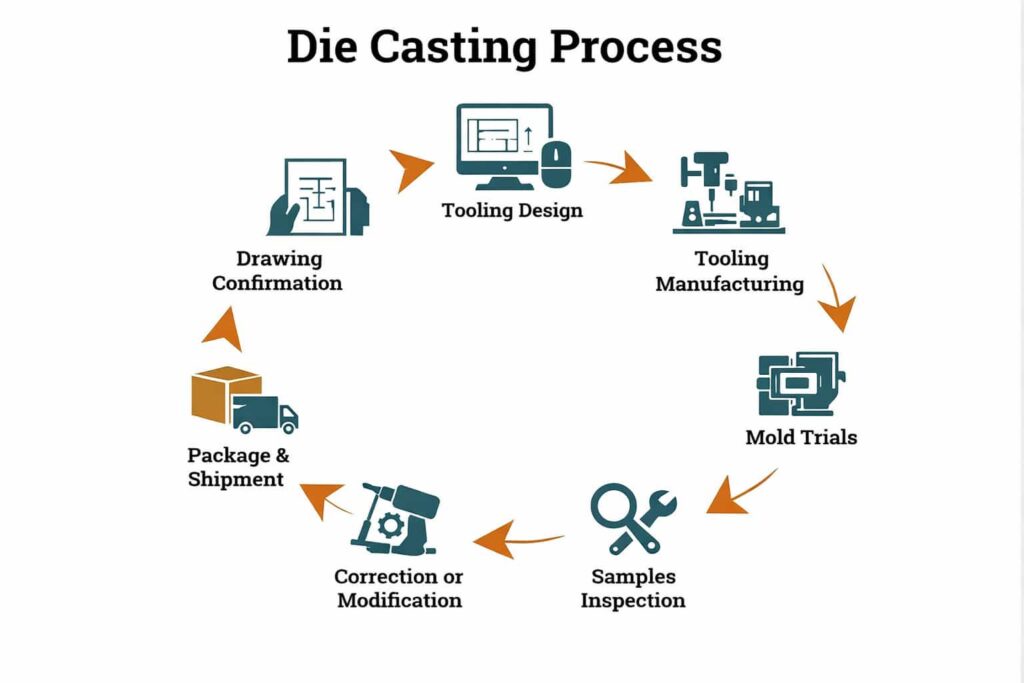
🔄 Step-by-Step Breakdown of the Die Casting Process
Below is a clear overview of the complete die casting process, from initial concept to final inspection:
- 🧠 Product Design
The process begins with designing the part based on functional and aesthetic requirements. Engineers apply DFM (Design for Manufacturability) principles to ensure the part is suitable for die casting.
- 🧩 Die Casting Mold Design
Once the product design is finalized, the die casting mold design phase starts. This step defines the mold structure, gating system, cooling channels, and ejection mechanisms—critical for part quality and production efficiency.
- 🔩 Mold Manufacturing
The mold is manufactured using high-precision machining processes such as CNC and EDM. After machining, heat treatment and assembly are completed to ensure durability and accuracy.
- 🔥 Material Melting
Selected metal materials (e.g., aluminum or zinc) are melted in a furnace at controlled temperatures to achieve optimal fluidity for injection.
- ⚡ Injection & Filling
Molten metal is injected into the mold cavity under high pressure and speed. This step ensures the material fills even the most complex geometries.
- ❄️ Cooling & Solidification
The molten metal rapidly cools and solidifies inside the mold. Efficient cooling design is essential to minimize defects and reduce cycle time.
- ⏏️ Ejection
Once solidified, the casting is ejected from the mold using an ejection system. Proper design prevents deformation or damage to the part.
- ✂️ Trimming & Finishing
Excess material such as runners, gates, and flash is removed. Additional processes like machining or surface treatment may be applied if required.
- 🔍 Quality Inspection
Final parts undergo strict quality checks, including dimensional inspection and defect detection, to ensure they meet specifications.
📌 Summary
The die casting process is a highly coordinated workflow where each step—from product design to quality inspection—plays a vital role. By optimizing every stage, manufacturers can achieve:
- ✅ Higher product quality
- ⚡ Faster production cycles
- 💰 Lower manufacturing costs
Product Design for Die Casting
A well-optimized design is the foundation of a successful die casting process. Thoughtful engineering at this stage can significantly reduce production costs, minimize defects, and improve overall product performance.
🧠 Importance of Design for Manufacturability (DFM)
Design for Manufacturability (DFM) ensures that a part is not only functional but also easy and cost-effective to produce using the die casting process.
By applying DFM principles early, manufacturers can:
✅ Reduce tooling complexity
💰 Lower production costs
⚡ Improve cycle time
📉 Minimize defects such as porosity or warping
👉 In short, good design = smoother production + better quality.
📐 Key Design Considerations
When designing parts for die casting, several critical factors must be taken into account:
| Design Factor | Best Practice | Why It Matters |
|---|---|---|
| Wall Thickness | Keep uniform and avoid sudden changes | Prevents shrinkage & internal stress |
| Draft Angles | Typically 1°–3° | Ensures easy part ejection |
| Fillets & Radii | Use rounded corners instead of sharp edges | Improves metal flow & reduces stress |
| Tolerances | Avoid overly tight tolerances unless necessary | Reduces machining and production cost |
⚠️ Common Design Mistakes to Avoid
Ignoring design best practices can lead to costly issues in the die casting process:
❌ Uneven wall thickness → causes shrinkage and porosity
❌ Sharp corners → leads to stress concentration and cracks
❌ Insufficient draft angles → difficult ejection, part damage
❌ Overly complex geometry → increases mold cost and cycle time
👉 Avoiding these mistakes early can save significant time and cost during production.
💻 CAD Modeling and Prototyping
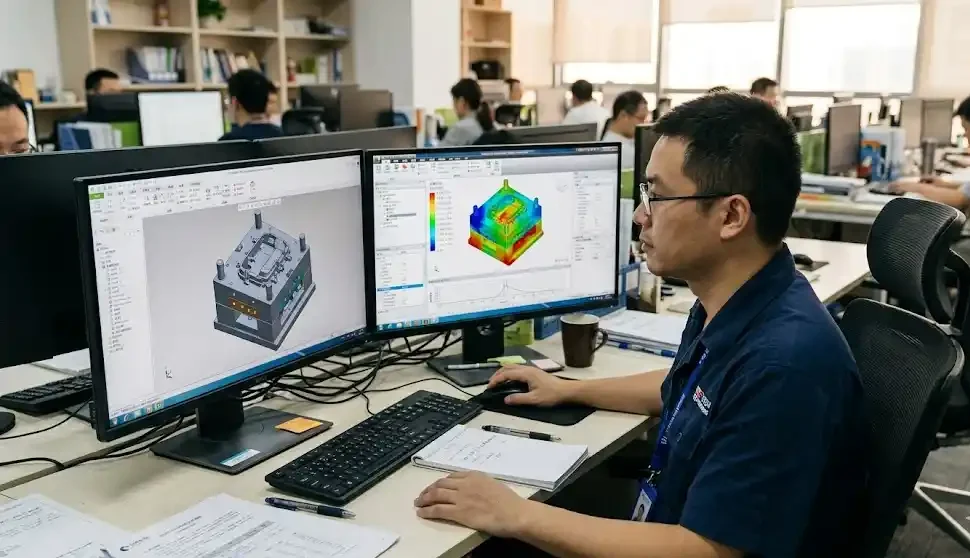
Modern product development depends on advanced CAD tools and simulation technologies to ensure design accuracy and manufacturability. 3D CAD modeling enables precise visualization of part geometry, while mold flow simulation helps identify potential defects before production begins. In addition, prototyping methods such as CNC machining or 3D printing allow designers to validate concepts prior to tooling. Together, these technologies streamline the transition from design to die casting, minimizing risks and improving efficiency.
📌 Key Takeaway
Optimizing product design is essential for successful die casting. By applying DFM (Design for Manufacturability) principles and following best practices, manufacturers can achieve higher product quality, lower production costs, and more efficient, reliable manufacturing processes.
Die Casting Mold Design (Core of the Process)
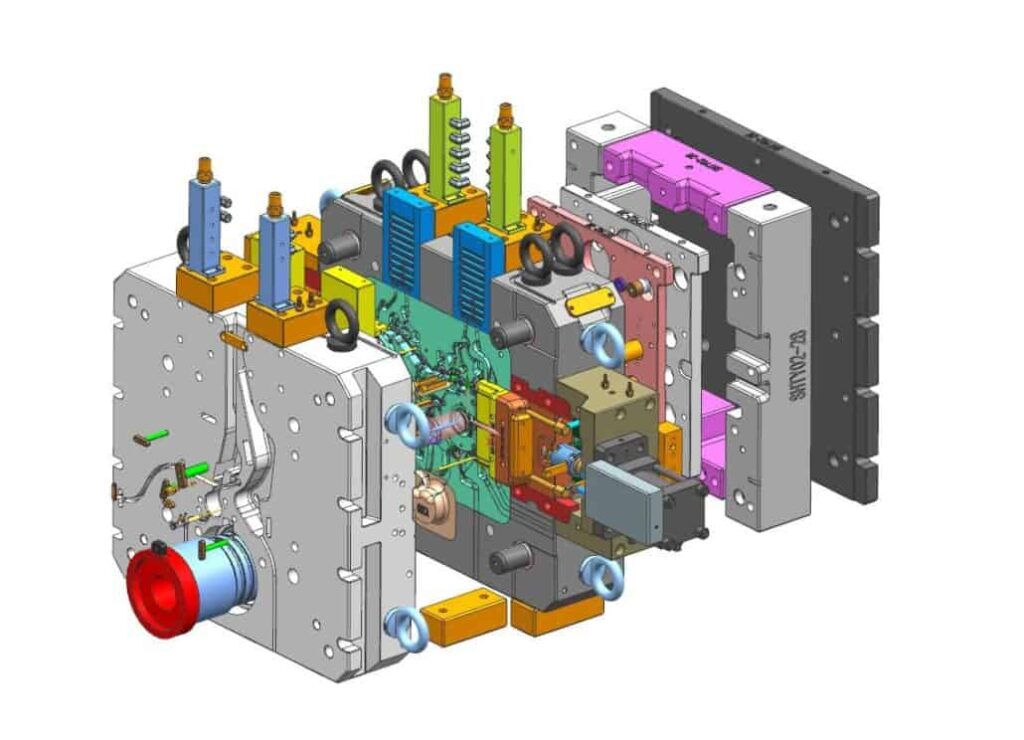
In the die casting process, mold design is the most critical factor influencing product quality, production efficiency, and overall cost. A well-engineered die casting mold design ensures proper metal flow, controlled solidification, and consistent part ejection, making it the foundation of stable mass production.
What Is Die Casting Mold Design
Die casting mold design is the process of developing a precision steel mold used to form molten metal into the desired shape under high pressure. It involves not only defining the geometry of the part but also designing internal systems that control filling, cooling, venting, and ejection.
An optimized mold design can:
- Improve dimensional accuracy and surface quality
- Reduce casting defects such as porosity and shrinkage
- Shorten cycle time and increase productivity
- Extend mold service life
Because of its impact on both quality and efficiency, mold design is often considered the core of the entire die casting process.
Key Components of a Die Casting Mold
A die casting mold consists of several integrated systems, each serving a specific function:
| Component | Function |
|---|---|
| Cavity & Core | Form the external and internal geometry of the casting |
| Runner & Gate System | Direct molten metal into the cavity with controlled flow |
| Cooling System | Regulate temperature and control solidification rate |
| Venting System | Allow air and gases to escape during filling |
| Ejection System | Remove the solidified part from the mold without damage |
The proper coordination of these components is essential for maintaining a stable and efficient die casting process.
Key Factors in Die Casting Mold Design
Several technical factors must be carefully evaluated during die casting mold design:
- Parting Line Design
Determines how the mold opens and affects both manufacturability and part appearance. Poor placement can increase flash or complicate tooling. - Draft Angle
Necessary for smooth part release. Insufficient draft can lead to sticking, surface damage, or excessive wear on the mold. - Wall Thickness Distribution
Uniform wall thickness promotes even metal flow and reduces the risk of shrinkage, porosity, and internal stress. - Cooling Efficiency
A well-designed cooling system ensures uniform solidification, reduces cycle time, and improves dimensional stability.
These factors must be balanced to achieve both quality and production efficiency.
Step-by-Step Die Casting Mold Design Process
The die casting mold design process typically follows a structured engineering workflow:
- Product Drawing Analysis
Evaluate part geometry, tolerances, and suitability for die casting. - Cavity Layout Design
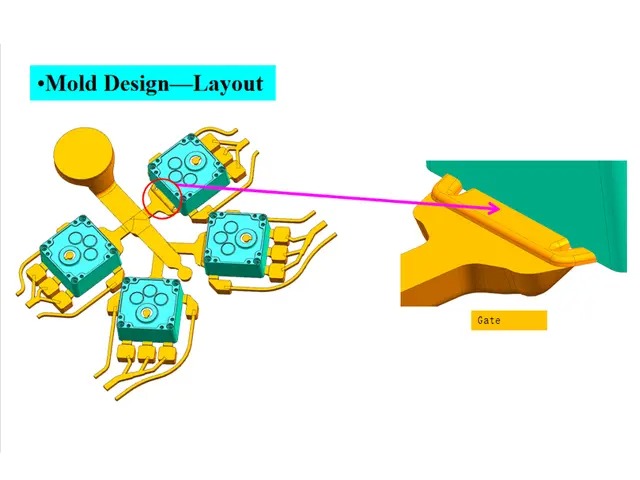
Determine the number of cavities and their arrangement based on production volume and machine capacity. - Gating System Design
Design runners and gates to ensure smooth, balanced filling and minimize turbulence or air entrapment. - Mold Base Design
Develop the overall mold structure, including support systems, alignment, and clamping considerations. - Simulation and Optimization
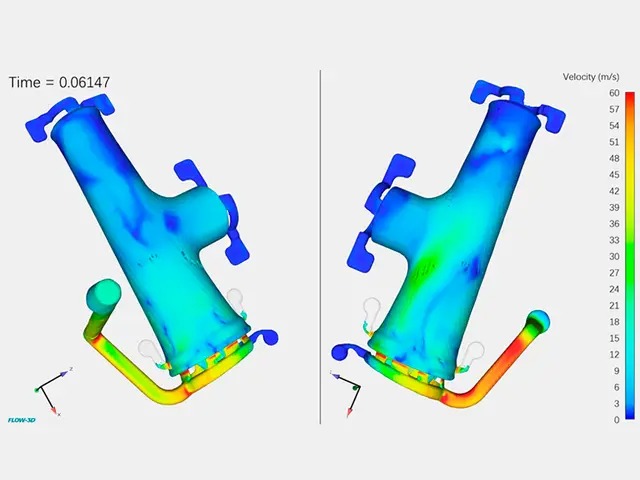
Use mold flow analysis to predict potential defects and optimize filling, cooling, and solidification behavior before manufacturing.
This systematic approach reduces risks and improves first-time success in production.
Common Mold Design Challenges and Solutions
Even with careful planning, challenges may arise during die casting mold design:
| Challenge | Cause | Typical Solution |
|---|---|---|
| Porosity | Air entrapment or gas buildup | Improve venting and optimize gating |
| Uneven Cooling | Poor cooling channel layout | Redesign cooling system for uniformity |
| Flash Formation | Inadequate sealing or alignment | Improve mold fit and adjust process setup |
| Incomplete Filling | Insufficient flow or pressure | Modify runner and gate design |
Addressing these issues during the design stage helps prevent costly modifications later.
Key Takeaway
A well-developed die casting mold design is essential for achieving a stable and efficient die casting process. By focusing on flow control, thermal balance, and structural integrity, manufacturers can ensure consistent product quality while optimizing production performance.
Die Casting Mold Manufacturing and Validation
After completing the die casting mold design, the next critical stage in the die casting process is mold manufacturing and validation. This phase transforms engineering drawings into a high-precision production tool that must withstand extreme temperature, pressure, and repeated cycling during mass production.
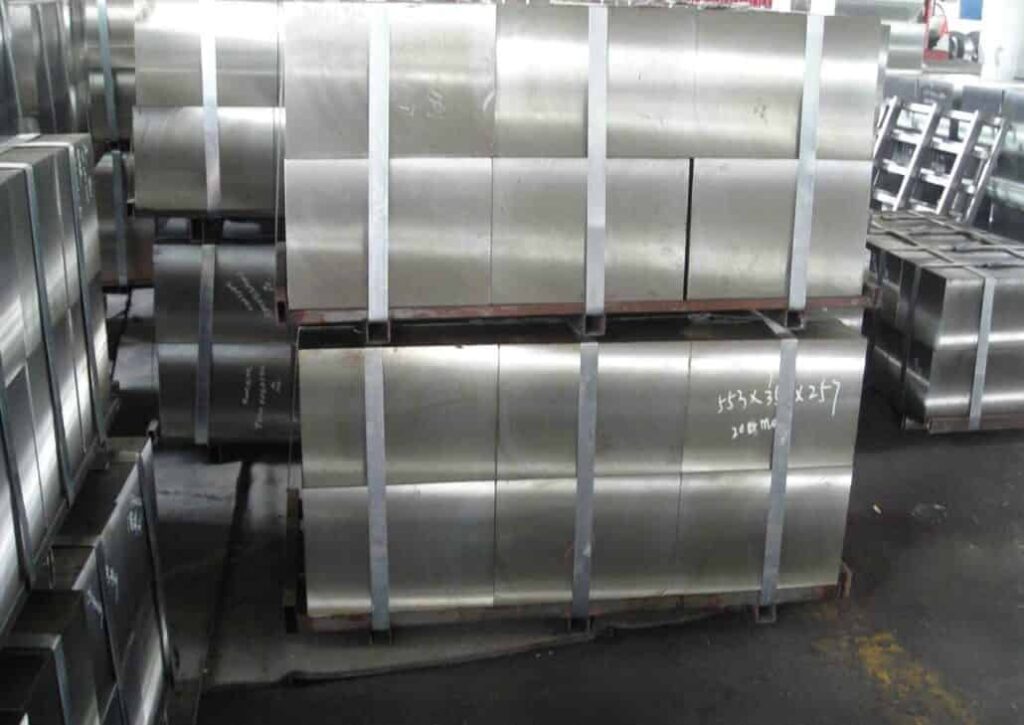
Mold Material Selection (e.g., H13 Steel for Durability)
Material selection is a key factor that determines mold performance and service life.
- H13 tool steel is the most commonly used material in die casting molds due to its excellent:
- Thermal fatigue resistance
- High hardness at elevated temperatures
- Good toughness and wear resistance
Depending on production requirements, other high-performance tool steels may also be used, but H13 remains the industry standard for most die casting process applications.
CNC Machining, EDM, and Precision Manufacturing Processes
High-precision manufacturing processes are essential to ensure the mold accurately matches the design.
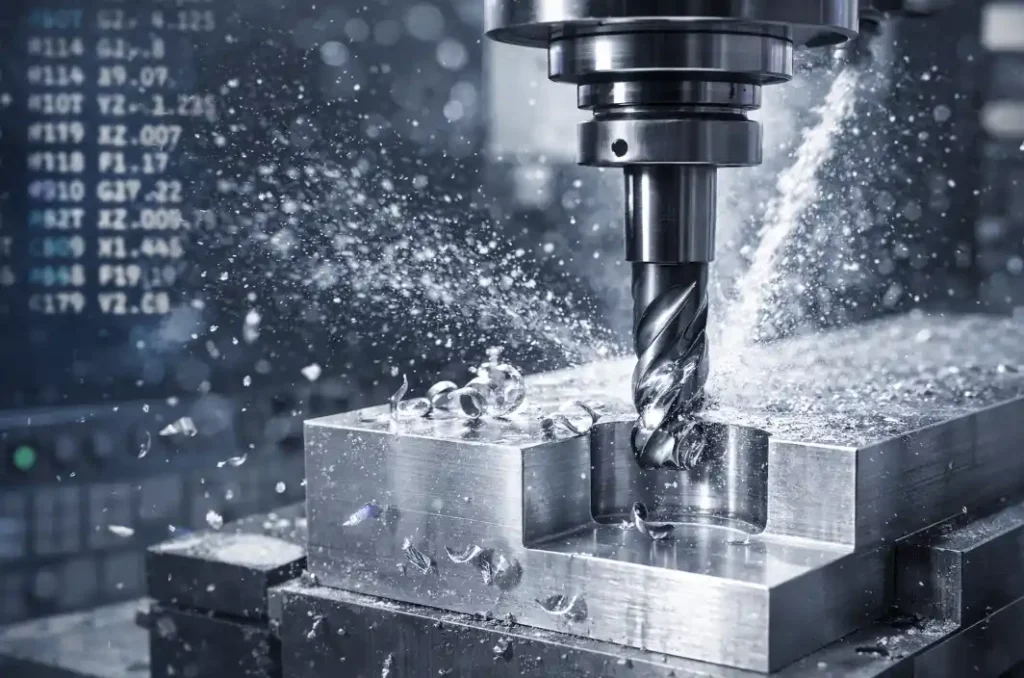
- CNC Machining
Used for shaping core components and achieving tight dimensional tolerances. - EDM (Electrical Discharge Machining)
Used for complex geometries, deep cavities, and sharp internal features that cannot be achieved by conventional machining. - Precision Grinding & Finishing
Ensures surface accuracy and proper fit between mold components.
These processes directly determine the accuracy and stability of the final die casting process.
Heat Treatment and Surface Finishing for Mold Longevity
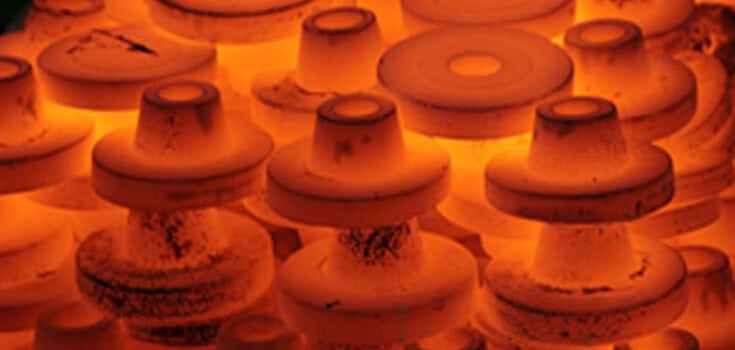
After machining, molds undergo heat treatment and surface finishing to improve durability and performance.
- Heat Treatment
Increases hardness and enhances resistance to thermal cracking and wear caused by repeated high-pressure cycles. - Surface Finishing
Includes polishing and surface enhancement to:- Improve release performance
- Reduce friction between mold and casting
- Extend mold service life
Proper treatment ensures long-term stability in the die casting process, especially for high-volume production.
Mold Assembly, Trial Runs (T1, T2), and Optimization
Once all components are manufactured, the mold is assembled and tested before正式 production.
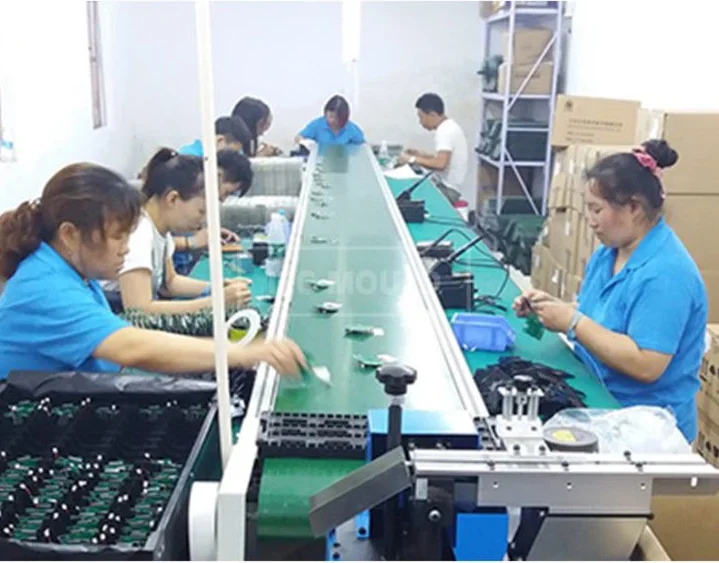
- Mold Assembly
Ensures all components (core, cavity, cooling, ejection systems) are correctly aligned and functional. - T1 Trial
First test run used to identify major issues such as filling problems, flash, or dimensional deviations. - T2 Trial
Optimized run after adjustments to improve stability, accuracy, and surface quality. - Optimization Phase
Fine-tuning process parameters such as temperature, pressure, and cycle time to achieve stable production conditions.
This validation stage is essential to ensure the mold is fully ready for reliable mass production in the die casting process.
Key Takeaway
Mold manufacturing and validation are critical steps that bridge design and production in the die casting process. High-quality materials, precision machining, proper heat treatment, and thorough trial testing ensure stable performance, long mold life, and consistent product quality.
Die Casting Production Process in Mass Manufacturing
In mass production, the die casting process becomes a highly controlled and repeatable manufacturing cycle. Once the mold has been validated, production focuses on efficiency, stability, and consistent quality across large volumes of parts.
Metal Melting and Alloy Preparation (Aluminum, Zinc, Magnesium)
The production cycle begins with the preparation of metal alloys.
- Aluminum alloys are widely used due to their lightweight properties, corrosion resistance, and good mechanical strength.
- Zinc alloys offer excellent fluidity and precision, making them suitable for small, detailed components.
- Magnesium alloys are chosen when ultra-lightweight performance is required.
During melting:
- Metals are heated in a controlled furnace to reach stable casting temperatures
- Alloy composition is carefully maintained to ensure consistent mechanical properties
- Impurities are removed to improve casting quality
Proper alloy preparation is essential for maintaining stability in the die casting process.
High-Pressure Injection and Filling Process
Once the molten metal is ready, it is injected into the mold cavity under high pressure.
- Injection systems deliver metal at high speed to ensure complete cavity filling
- High pressure helps form complex geometries with high dimensional accuracy
- Proper control of injection speed and pressure is critical to avoid defects such as air entrapment or incomplete filling
This stage is the core of the die casting process, as it directly determines part formation quality.
Cooling, Solidification, and Ejection Cycle Optimization
After injection, the molten metal begins to cool and solidify inside the mold.
- Cooling channels regulate temperature distribution across the mold
- Uniform solidification reduces internal defects such as shrinkage or porosity
- Once solidified, the part is ejected using a controlled ejection system
Cycle optimization is crucial in mass production:
- Faster cooling improves production efficiency
- Balanced mold temperature ensures consistent quality
- Stable ejection prevents deformation or surface damage
Optimizing these factors significantly improves overall performance in the die casting process.
Improving Efficiency in the Die Casting Process for Mass Production
Efficiency is a key goal in high-volume manufacturing.
Key strategies include:
- Reducing cycle time through optimized cooling design
- Maintaining stable process parameters (temperature, pressure, timing)
- Using automated systems for injection and part handling
- Implementing real-time monitoring for process control
By improving efficiency, manufacturers can achieve:
- Lower production costs
- Higher output rates
- Consistent product quality
A well-optimized die casting process ensures scalable and cost-effective mass production while maintaining strict quality standards.
Post-Processing, Quality Control, and Scaling to Mass Production
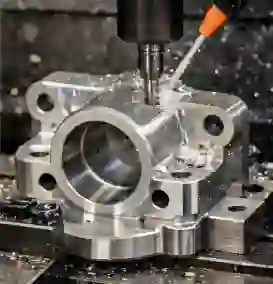
After the primary die casting process, parts must go through post-processing and strict quality control to ensure they meet functional, dimensional, and aesthetic requirements. This stage is essential for transforming raw castings into finished, market-ready products, especially in large-scale manufacturing.
Trimming, Deburring, and CNC Secondary Machining in Die Casting
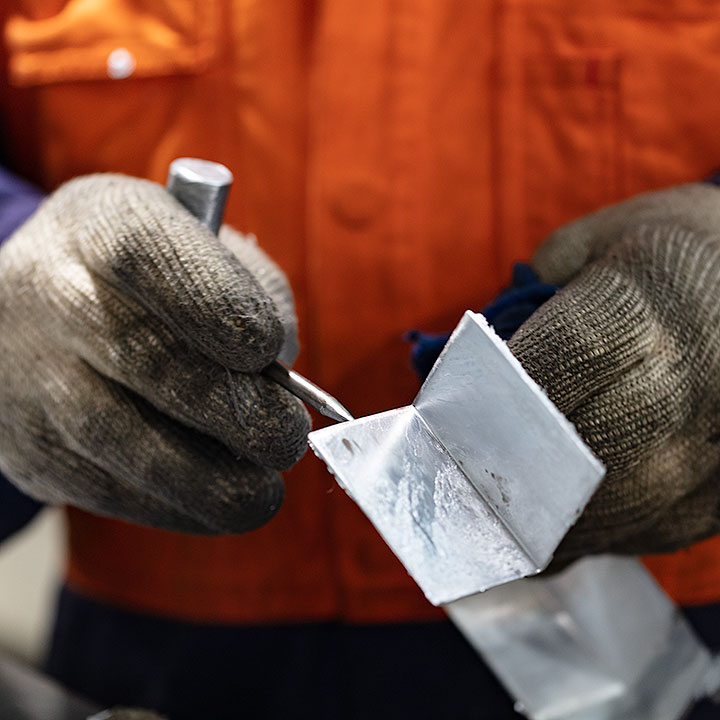
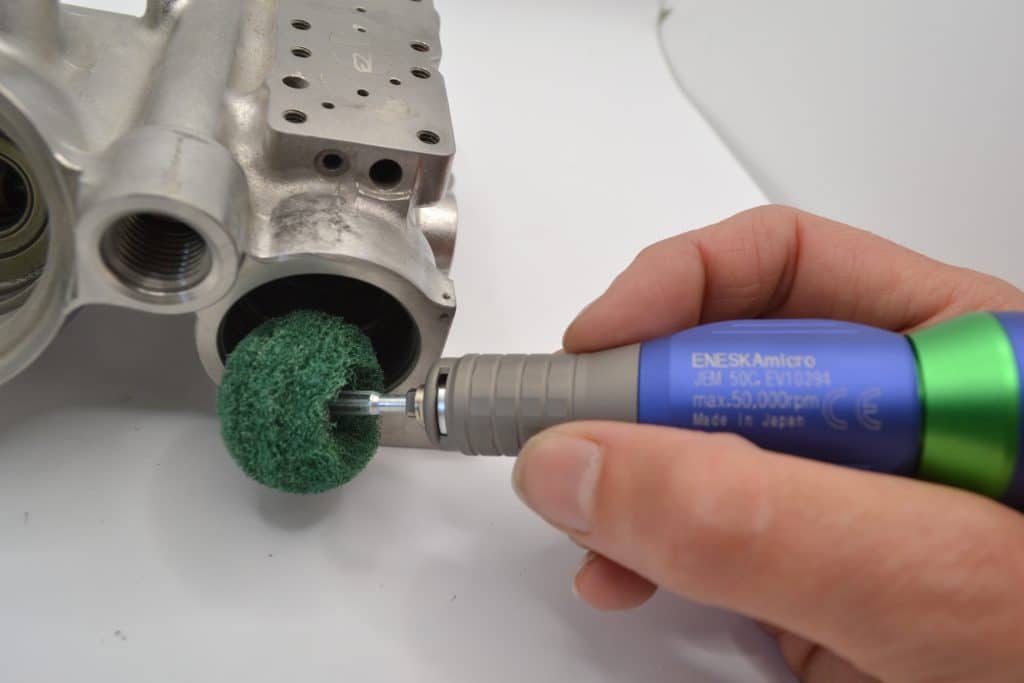
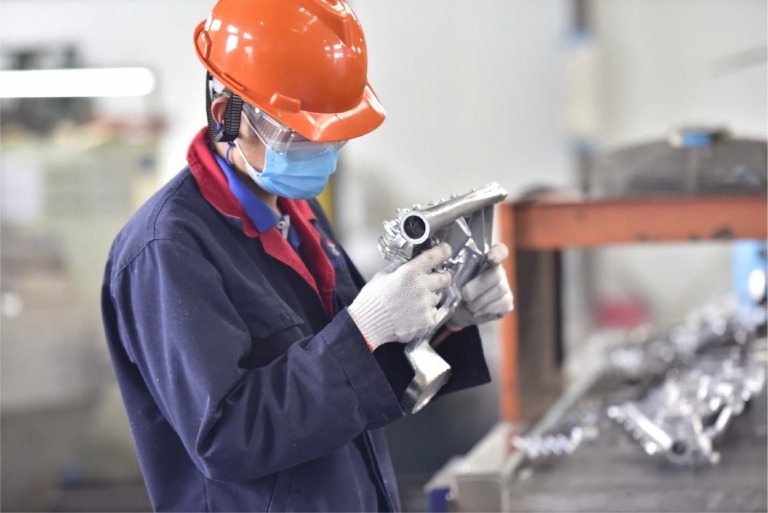
Once parts are ejected from the mold, they typically contain excess material such as runners, gates, and flash.
- Trimming removes unwanted material from the casting
- Deburring eliminates sharp edges for safety and improved appearance
- CNC secondary machining is used when tight tolerances or precision features are required
Although the die casting process produces near-net-shape parts, secondary machining ensures final dimensional accuracy for critical applications.
Surface Treatment Options: Powder Coating, Anodizing, and Painting
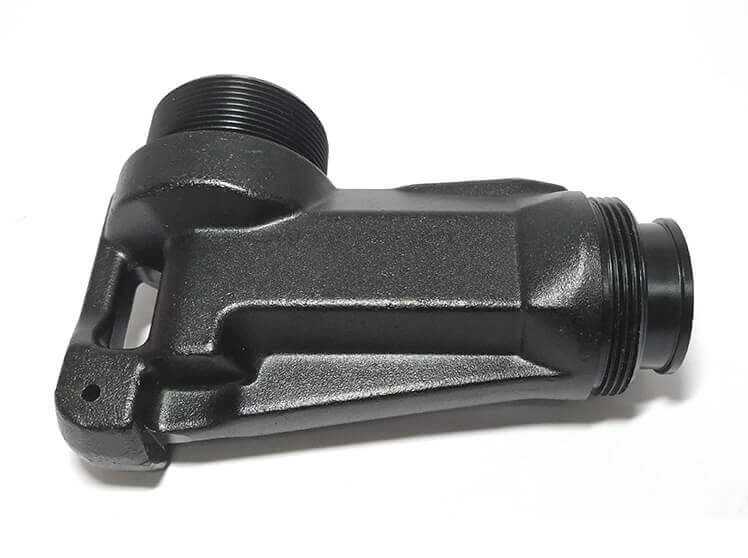
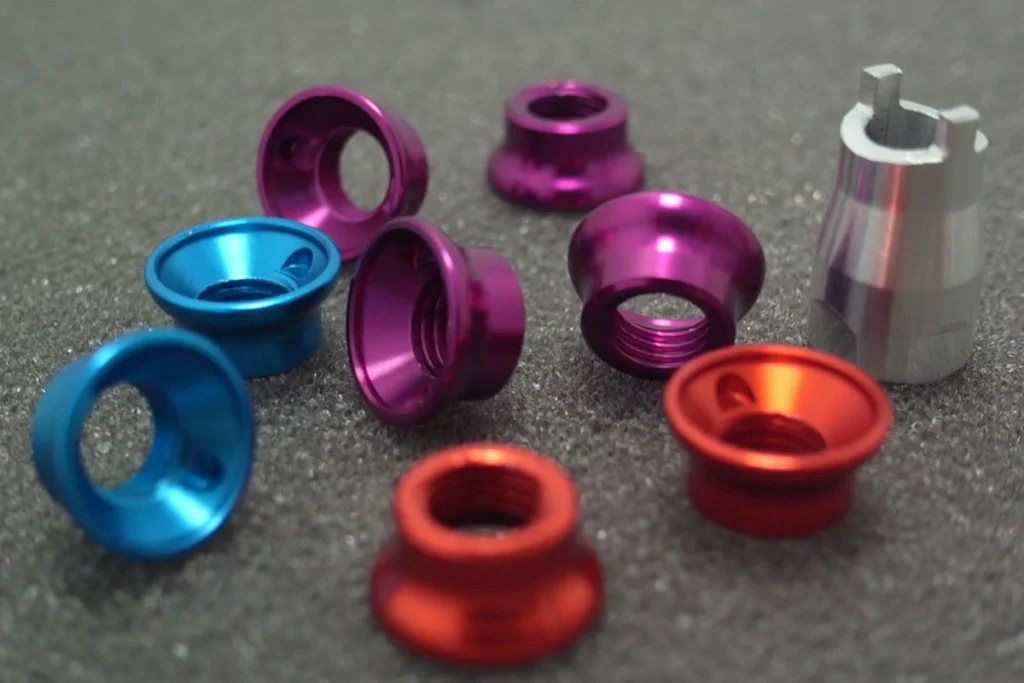
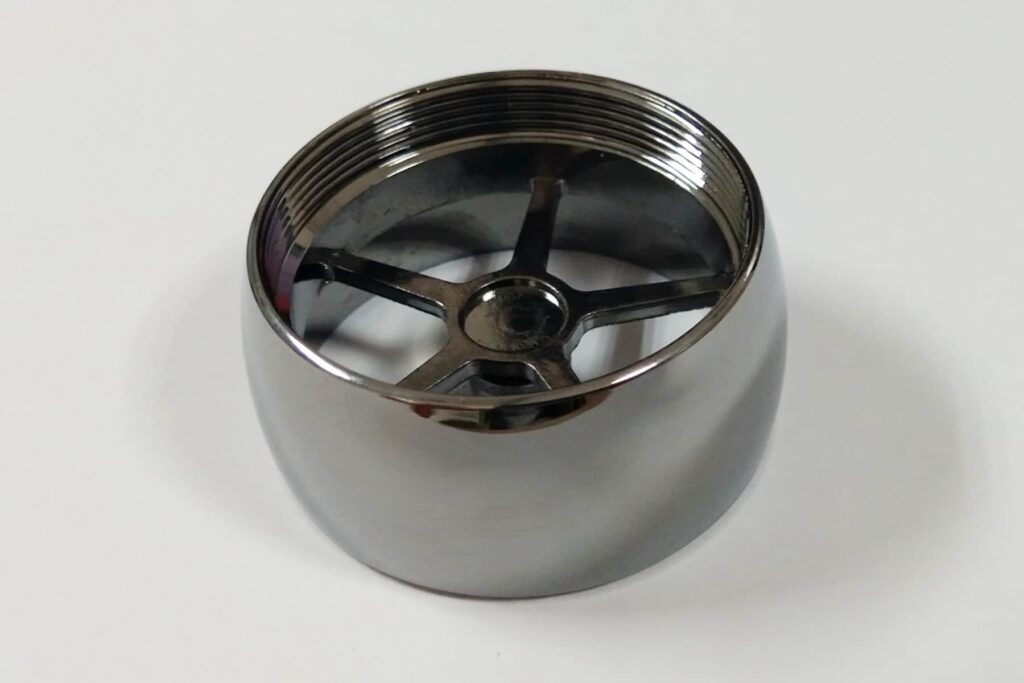
Surface treatment improves both performance and appearance of die cast components:
- Powder Coating
Provides strong corrosion resistance and a durable finish, widely used in industrial and automotive applications - Anodizing
Common for aluminum parts, enhancing corrosion resistance and surface hardness - Painting
Offers aesthetic flexibility and basic environmental protection
These finishing methods increase product durability and commercial value after the die casting process.
Common Die Casting Defects and Prevention Methods
Even in a stable production environment, defects may occur if process control is not optimized.
- Porosity → Improve venting and control gas entrapment
- Shrinkage → Optimize cooling rate and wall thickness design
- Surface defects → Adjust temperature, mold condition, and injection parameters
- Cold shuts → Improve metal flow and gating system design
Early detection and prevention are essential to maintaining high-quality output.
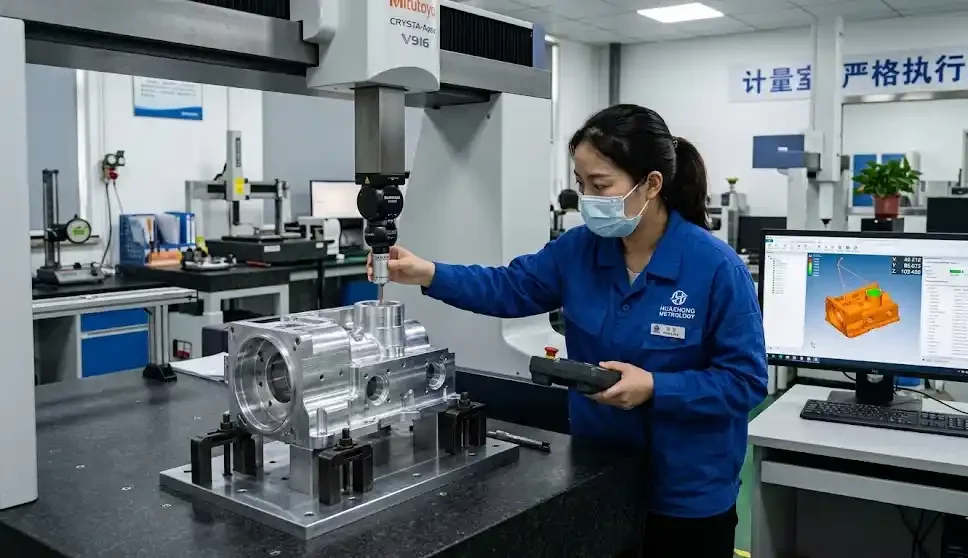
Inspection and Quality Control Methods in the Die Casting Process
Quality control ensures that every part meets specification requirements.
Common inspection methods include:
- Dimensional inspection using precision measuring tools
- X-ray inspection to detect internal defects such as porosity
- Pressure or leak testing for sealed or functional components
- Visual inspection for surface quality evaluation
These methods help maintain consistency throughout the die casting process.
Ensuring Consistency and Stability in Mass Production
Stable mass production depends on strict process control and continuous monitoring:
- Standardized production parameters (temperature, pressure, cycle time)
- Real-time process monitoring systems
- Regular maintenance of molds and machines
- Operator training and standardized workflows
Consistency ensures that every batch of parts meets the same quality level, which is critical in large-volume production.
Scaling from Prototype to High-Volume Die Casting Production
Transitioning from prototype to mass production requires careful planning and process validation:
- Prototype stage focuses on design verification and function testing
- Pilot production validates mold performance and process stability
- Mass production optimizes efficiency, cost, and output consistency
Key success factors include:
- Stable die casting mold design performance
- Reliable material supply chain
- Optimized cycle time and automation
- Robust quality control system
A well-managed scaling process ensures smooth transition into high-volume manufacturing while maintaining product quality and cost efficiency in the die casting process.
Choosing the Right Die Casting Partner & Conclusion
Selecting the right partner is one of the most important decisions in the die casting process, as it directly affects product quality, cost efficiency, and long-term production stability. A capable and experienced manufacturer can support the entire workflow—from design optimization to mass production—ensuring a smooth and reliable project execution.
Key Capabilities to Look for in a Die Casting Manufacturer
When evaluating a supplier, it is essential to consider their overall technical and manufacturing capabilities:
- Strong in-house tooling and production capacity
- Advanced equipment for high-pressure die casting
- Ability to handle complex geometries and tight tolerances
- Integrated quality control system across all production stages
A qualified partner ensures stability throughout the entire die casting process, reducing risks and improving efficiency.
Importance of Engineering Support and Die Casting Mold Design Expertise
Engineering capability is a key differentiator in successful die casting projects.
- Early-stage Design for Manufacturability (DFM) support
- Professional die casting mold design optimization
- Mold flow simulation and process analysis
- Continuous improvement during production
Strong engineering support helps reduce tooling iterations, shorten lead time, and improve final product quality.
Certifications and Quality Standards (ISO 9001, IATF 16949)
Certifications reflect a manufacturer’s commitment to quality and process control:
- ISO 9001 ensures a standardized and reliable quality management system
- IATF 16949 is essential for automotive-grade production requirements
Working with certified suppliers helps ensure consistent quality and traceability throughout the die casting process.
OEM/ODM and Global Supply Chain Capability
A reliable die casting partner should also offer flexible production and global service capabilities:
- OEM manufacturing based on customer drawings and specifications
- ODM services from concept development to final production
- Experience in global export and logistics management
- Stable supply chain to support long-term production needs
This flexibility ensures smooth cooperation across different industries and markets.
Summary of the Complete Die Casting Process from Design to Mass Production
The die casting process is a complete engineering workflow that includes product design, mold design, mold manufacturing, production, finishing, and quality control. Each stage plays a critical role in ensuring product performance, cost efficiency, and production stability.
By optimizing every step, manufacturers can achieve:
- Higher product quality
- Lower production costs
- Faster time to market
- Stable mass production performance
To achieve long-term success in die casting, companies must focus on early-stage design optimization, high-quality tooling, stable production control, and continuous improvement. Choosing the right partner ensures that every stage of the process is executed efficiently and professionally.
If you are looking for a reliable and experienced die casting manufacturer, IEC Mould is ready to support your projects from concept to mass production.
Company: IEC Mould Engineering Making Ltd
Email: [email protected]
Tel: +86-0769-85336570
Website: https://castingstool.com / www.iec-mould.com
Let IEC Mould be your trusted partner for all die casting needs.